Night time political summary
The day was dominated by world leaders arriving in Australia for the G20, which is being hosted by the Australian government in Brisbane. The whole show is costing $450m and it appears to have shut down Brisbane for the locals but the world leaders continue to stream in on their jets. The major news stories for the day:
- The US has pledged $2.5bn to the Green Climate Fund, to help poor countries fight climate change. Last year, Tony Abbott maintained Australia would never contribute to the fund which he called “socialism masquerading as environmentalism”.
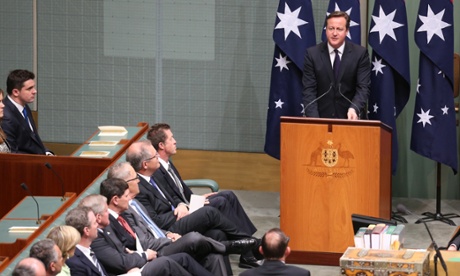
- British prime minister David Cameron addressed the Australian parliament, outlining his countries anti-terror laws, highlighting the importance of maintaining democratic values and fighting the extremist narrative.
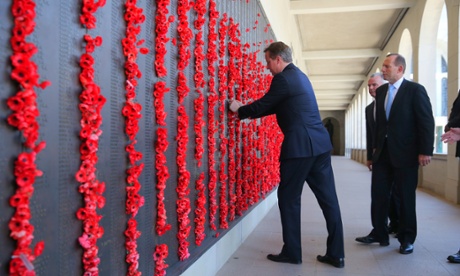
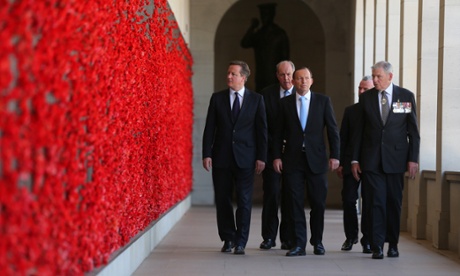
- Cameron said countries should resist protectionist urges and he called on leaders to push through an EU-US trade agreement, and also an Australia-EU agreement. Cameron laid a wreath at the Australian War Memorial.
- Bill Shorten has called on Tony Abbott to place climate change, global trade, youth unemployment and inclusive growth on the G20 agenda.
- Christine Milne said the failure of both Tony Abbott and David Cameron to mention climate change in their speeches to parliament was the “elephant in the room”. Bill Shorten did not mention it either.
- A spokesman for the Russian president Vladimir Putin, who is due to arrive in Australia at 9pm Friday, said the Russian ships were heading south for research purposes, as well as the “peace and stability of Russia and the world”.
Tony Abbott and David Cameron have arrived together in Brisbane, on what appears to be blustery hot conditions.
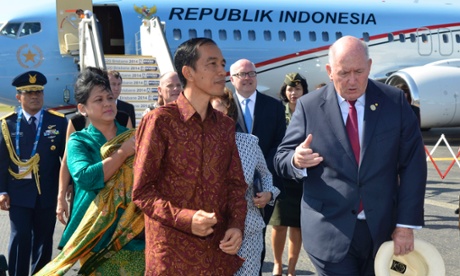
Indonesian president. Tick.
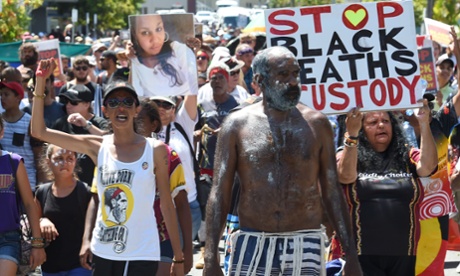
Protestors called for an end to black deaths in custody.
Tony Abbott has arrived in Brisbane for the G20.
A report from Joshua Robertson on the Aboriginal protests outside the G20:
World leaders at the G20 are meeting a stone’s throw from the most significant ancient meeting place of the Aboriginal nations of Brisbane, what is now Musgrave park.
The irony that most locals aren’t even aware of the park’s cultural significance is not lost on Brisbane Aboriginal sovereign embassy (Base) youth representative Boe Spearim.
“Through all forms of educational institution in this country, they do not teach about the traditions of this country, they do not teach local history,” he told Guardian Australia.
“This is Jagera land, across the river’s Turrbal, towards Beaudesert is Mundjaling. So within this small region of Brisbane, there are three large Aboriginal nations who have occupied these lands for so long. That’s not taught. The real stories of the stolen generation are not told. The way Australia acquired this country is never told.
Base led the day’s largest protest - a 300-person march to to acknowledge the 360 indigenous Australians “murdered in custody, whether it’s in a jail cell or in the back of a paddy wagon or on the streets”.
Spearim said racism started young, with those attitudes too entrenched by the time people had grown up and joined institutions like correctional services or the police.
“If we can teach these young non-Aboriginal children at a young age about the true history and give them a true understanding of who Aboriginal people are and why we are in the positions we are at the moment - why Aboriginal people drink and do drugs - that’s because of the trans-generational trauma that Aboriginal people have had to endure over the last 240 years without justice or compensation. That just shows you the resilience of Aboriginal people as a whole, that we can get up and march with a hop and a skip and a smile on our face after 200 years of bloodshed and dispossession.”
The protests are underway. Here are a couple of videos from the ever present video star Bill Code. Here is Oxfam highlighting inequality for the G20 leaders...
And this is People for Ethical Treatment of Animals, saying there is no such thing as a meat-eating environmentalist. Which may be news for some....
From Ben Doherty, our man on the spot.
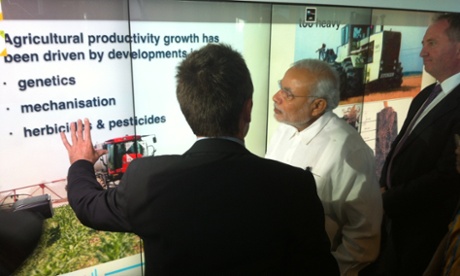
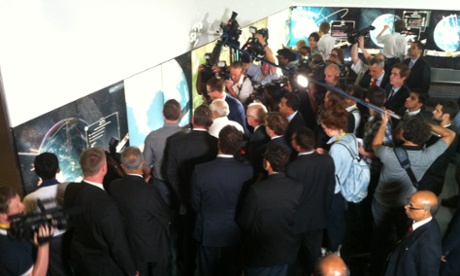
Modi is in there somewhere...
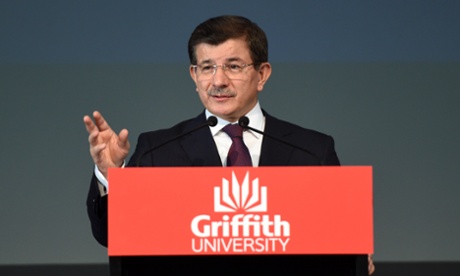
Turkish prime minister. Tick.
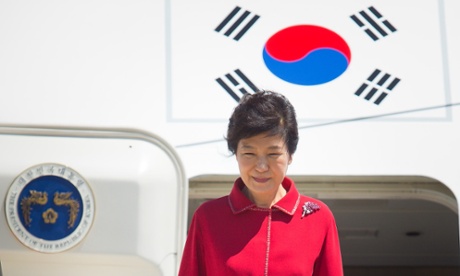
South Korean president. Tick.
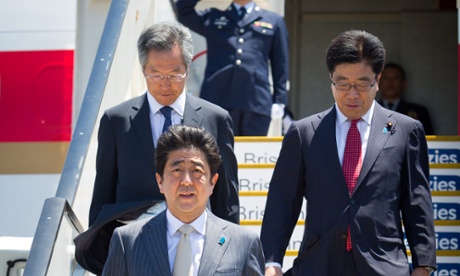
Japanese president. Tick.
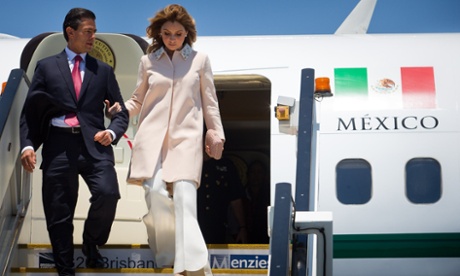
Mexican president. Tick.
Updated
Faced with the news earlier that the Russian ships were here to research climate change, Shalailah Medhora did her best to track down a Russian spokesman to check if AAP could possibly be correct.
A spokesman for Russian President Vladimir Putin clarified reports that Russian naval ships are in international waters near Australia to undertake climate research. He says the boats have a number of goals, including maritime and Antarctic research.
They are here for the peace and stability of Russia and the world.
The G20 centre in Brisbane is in gridlock as leaders and associated staff converge. I can sense the sigh in the voice of my colleague Daniel Hurst.
Irony. #G20 press conference scheduled for now is delayed because one of the speakers is caught in traffic
— Daniel Hurst (@danielhurstbne) November 14, 2014
Senator Scott Ludlam appreciating First Dog.
what even is the #G20 - http://t.co/TebJMiBath @firstdogonmoon dogue is on point today
— Scott Ludlam (@SenatorLudlam) November 14, 2014
The Green Climate Fund was the thing that the Abbott government really did not want anything to do with. Also from Suzanne and Lenore Taylor’s report:
As revealed by Guardian Australia, Australia has been arguing against behind-the-scenes diplomatic efforts for G20 leaders to promise to make contributions to the fund.
The prime minister, Tony Abbott, had previously insisted Australia would not make any contributions to it, although it is understood the Department of Foreign Affairs and Trade, which leads Australia’s negotiating position in international climate talks, has been considering whether Canberra should make a pledge. Sources said no final decision had been made.
Asked about the fund before last year’s UN climate meeting in Warsaw, the prime minister said: “We’re not going to be making any contributions to that.” It was reported that at one of its first cabinet meetings the Abbott government decided it would make no contributions to the fund that was described as “socialism masquerading as environmentalism”.
Abbott disparaged the fund at the time, comparing it to a domestic fund championed by the former Greens leader Bob Brown, which he wants to abolish.
He told the Australian newspaper: “One thing the current government will never do is say one thing at home and a different thing abroad. We are committed to dismantling the Bob Brown bank [the Clean Energy Finance Corporation] at home so it would be impossible for us to support a Bob Brown bank on an international scale.”
US pledges $2.5bn to Green Climate Fund
Suzanne Goldenberg and Lenore Taylor reports:
Barack Obama will make a substantial pledge to a fund to help poor countries fight climate change, only days after his historic carbon pollution deal with China.
In a one-two punch, America plans to pledge at least $2.5bn and as much as $3bn over the next four years to help poor countries invest in clean energy and cope with rising seas and extreme weather, according to those briefed by administration officials.
The financial commitment will be unveiled as world leaders gather for the G20 summit in Brisbane, sending a powerful signal of Obama’s determination to act on climate change despite the Republican takeover of Congress in mid-term elections.
The pledge to the Green Climate Fund was seen as critical to UN negotiations for a global climate deal. Developing countries have said they cannot sign on to emissions cuts at climate talks in Lima later this month without the funds.
Updated
Greens senator Rachel Siewert has taken issue with Tony Abbott’s earlier comments (see the 9.27am post) about the state of Australia when the First Fleet arrived. Siewart says Abbott keeps sending mixed messages about European settlement.
The Prime Minister’s ‘nothing but bush’ comments once again ignore the fact that Aboriginal and Torres Strait Islander peoples have been in Australia for many tens of thousands of years, and that British settlement began a process of discrimination and dispossession.
This is another example of the Prime Minister ignoring the reality of colonisation and the peoples, flourishing culture, languages that were here at the time of European settlement.
Brisbane Lord Mayor Graham Quirk has held a press conference with a little practical advice for leaders and punters alike, given the weather - along with China and the United States - is conspiring to push climate change onto the G20 agenda.
Q: Lord Mayor, there’s forecasts of 39 degree heat on Sunday. Do you have any advice for international visitors about how to cope, how Brisbane people cope, with that sort of heat? Should they go to the beach early in the morning on the Sunday or something?
Lord Mayor Quirk: Well, we have a saying here, which is “slip, slop, slap” and it is about slipping on a hat. But for those of you who haven’t bought a hat, I notice that in the welcoming packs out there, that there is an umbrella. So whether it is rainy conditions or pretty hot conditions out there, then umbrellas are there for people’s use. And also a cap. So people ought to take up that opportunity.
Meanwhile, AAP reports Queensland water police are investigating the cause of peculiar bubbles in the Brisbane River within the declared G20 zone. Divers and police boats were at the scene near the Queensland Performing Arts Centre at South Bank on Friday afternoon.
Water police are checking to see what the source of the bubbles are, but it’s not believed to be suspicious at this stage, a police spokesman said.
SUSPICIOUS BUBBLING PEOPLE THERE IS SUSPICIOUS BUBBLING THERE ARE BUBBLES IN A RIVER MAKE THEM STOP. http://t.co/aAYQq3w91s
— Stilgherrian (@stilgherrian) November 14, 2014
Karen Middleton of SBS caught the C20.
Civil society NGO reps call for fairness in #G20 growth strategies & discussion on climate change, youth, women pic.twitter.com/likay6i15z
— Karen Middleton (@KarenMMiddleton) November 14, 2014
I think Vladamir Putin is trolling Tony Abbott.
The Russian embassy gives an explanation in an AAP story:
RUSSIA has for the first time explained the presence of a fleet of warships off north-eastern Australia, saying that the ships are testing their range capability, in case they have to do climate change research in the Antarctic.
The Russian embassy also said the fleet could, if necessary, provide security for Russian President Vladimir Putin, who arrives in Brisbane for the G20 tonight.
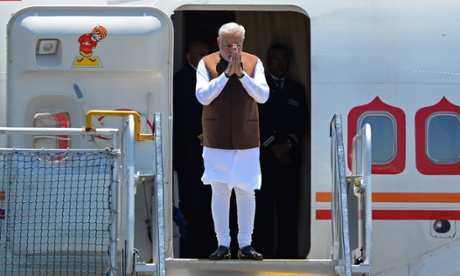
Namaste: Indian PM Narendra Modi.
The diplomatic rockstar of the G20, Indian prime minister Narendra Modi arrived in Brisbane on Friday for the G20 summit, the first Indian PM to visit Australia since Rajiv Gandhi in 1986. Modi, as a new PM, is the man everyone wants to see at this meeting.
Updated
Here is another bit of video for you showing the real Brisbane. Guardian’s correspondent Josh Robertson has been very busy.
There are two points to note with this video.
1. Which archbishop got a tattoo?
2. What a terrible organisation we are, here at the Guardian.
Costello blames rich countries for ebola outbreak
Guardian’s Ben Doherty has been at the C20 summit.
Tim Costello, chief executive of World Vision Australia, and chair of the C20, has blamed the world’s richest countries for the latest outbreak of Ebola being so deadly.
So far, the current outbreak has killed 5000 people.
Ebola: profound government and market failure. Why wasn’t there research into Ebola, it’s because we said ‘it only breaks out in Africa, and it’s patchy, and they don’t have a big market because they’re poor’. That’s why we don’t have a vaccine, that’s why we don’t have a treatment, it’s because it didn’t affect us. It’s a profound government/market failure, because suddenly Ebola’s reaching us and we’re scrambling. The G20 must have fairness for people who are the poorest.
The British PM and The Brick.
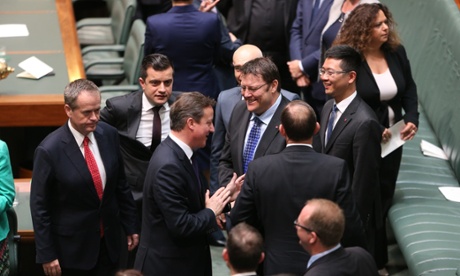
The C20 is the group representing domestic and international non government organisations and individuals who in social services, environment, women, Indigenous, multicultural and human rights organisations.
Kind of everyone else apart from governments and business.
They are having a press conference now about what they want from the G20.
The c20 has made 18 interrelated recommendations across the areas of inclusive growth and employment, infrastructure, climate change and resource sustainability and governance, including importantly, international taxation reform and transparency.
Chair of the C20, Tim Costello, says civil society has a right to be involved and is now finally embedded in the G20 process - given business has long been involved. He said the G20 cannot talk about growth without working out ways for the (income) growth to flow down to the bottom 20% households of the G20 countries.
It’s essentially about people and the high financial and economic architecture which is incomprehensible to most people in G20 nations dramatically affects their lives. Or the non-decisions, if we don’t get outcomes, affects their lives also.
The fact that business has always been a significant player at the G20 and we know with governments being broke they’re essentially saying to business “Tell us what red tape you want us to cut and deregulation you need so we can get you investing”.
Our Brisbane correspondent Josh Robertson reports from Brisbane:
The Australia Tibet Council chose to unfurl its protest against China’s human rights record outside Brisbane’s controlled security zone for G20 - but still managed to attract a flicker of interest from police.
The activists invited media to a cliff top, riverside park in New Farm this morning to make their point: G20 nations should unite to confront China, which seems to deflect concerns on Tibet whenever the matter is raised one on one.
“In all these bilateral engagements, China seems to have the upper hand, using empty threats of economic and diplomatic penalties, they’re able to easily shut down any criticism of Tibet and human rights,” the council’s Kyinzom Dhongdue said.
Dhongdue said Tibetan hopes that new Chinese president Xi Jinping would be a progressive influence had been dashed, with moves to “criminalise” those activists who burned themselves in protest, who number some 133 under Jinping’s watch.
Dhongdue said survivors had been charged as terrorists and their families threatened and spied on.
“It’s a vicious cycle of repression and resistence,” she said
“To address the human rights crisis in Tibet, governments must come together and stand up to China.”
A police car watched the demonstration from a distance but did not intervene.
I know you love a shirtfront joke so here it is. Entering the international diplomatic lexicon.
Lunchtime political wrap
- British prime minister David Cameron has addressed the Australian parliament, outlining his countries anti-terror laws, highlighting the importance of maintaining democratic values and fighting the extremist narrative. He said countries should resist protectionist urges and he called on leaders to push through an EU-US trade agreement, and also an Australia-EU agreement. Cameron laid a wreath at the Australian War Memorial.
- Bill Shorten has called on Tony Abbott to place climate change, global trade, youth unemployment and inclusive growth on the G20 agenda.
- Christine Milne said the failure of both Tony Abbott and David Cameron to mention climate change in their speeches to parliament was the “elephant in the room”. Bill Shorten did not mention it either.
-
Now the leaders will be preparing to head to Brisbane for the G20.
For a news story on the events of this morning, here is Lenore Taylor:
British prime minister David Cameron has linked controversial new foreign fighter and anti-terrorism laws in both Britain and Australia with the common values of freedom and democracy he cited as the “bedrock” of both societies.
In a speech to the Australian parliament, Cameron said the root cause of extremism was not poverty or social exclusion or foreign policy but rather the “extremist narrative” which had to be “rooted out”, including by government actions to remove extremist material from the internet.
Updated
Milne was asked about David Cameron’s comments about the US-China deal, in which he reacted cautiously about the emissions targets because the detail had not been released.
Milne said the US-China deal was the opening round ahead of the UN Paris climate summit and warned Australia would be left behind.
This is significant because it means that China has moved. The United States has moved. It leaves countries like Australia out in the cold. Wrong side of history. And what it signals is that the business of the planet is going to be on low carbon economies. New technology. Innovation. Encouraging entrepreneurial skills. Investment in research. This is where Australia is going to miss out really badly. You know the last thing I want to see isAustralia’s best and brightest leave Australia and go overseas because that’s where the action is on addressing global warming. Tony Abbott cannot absolutely condemn Australia to being the quarry.
Christine Milne laughs off the possibility of an European Union-Australian trade deal.
David Cameron first of all has to tell us whether he’s even committed to staying in the EU, all the talk from the Tories in the UK has been in response to the UK Independence Party trying to make the case for why the EU isn’t so great for Britain. And yet he comes out here to Australia and talks up the potential of an EU/Australia free trade agreement.
Here is what David Cameron said about trade deals, specifically regarding the EU-US and the EU-Australia.
Let’s start this weekend at the G20 and take these arguments head on. Let’s see through a EU-US deal that could be the biggest of its kind on the planet.
And while we are at it, let’s push for an EU-Australia deal too.
Because if we have the confidence to stay true to our values, we can defeat
the protectionist arguments and secure huge advances in prosperity.
For our nations and for our trading partners all around the world.
Greens leader Christine Milne is speaking about the huge elephant in the room.
Global warming.
The fact that you could have prime minister Cameron and prime minister Abbott both making their speeches today and no mention of global warming just shows you how out of touch Australia is. Prime Minister Abbott is not going to be able to get pay way with that at the G20. We are living in a global emergency. We have a situation where both China and the US and the EU have now all moved significantly on global warming, and here we have an Australian prime minister who loves coal, wants to stay in last century and be on thewrong side of history.
The latest boy band...
Good to host @TonyAbbottMHR & @David_Cameron in #Sydney today to discuss the value of investing in infrastructure pic.twitter.com/hlOfvaysfB
— Mike Baird (@mikebairdMP) November 14, 2014
I just want to see them clicking their fingers in unison.
David Cameron is laying a wreath in the hall of memory at the Australian War Memorial to honour the Unknown Soldier.
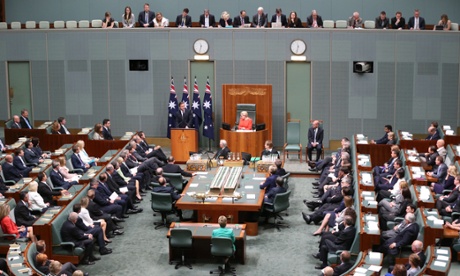
David Cameron addressing the chamber.
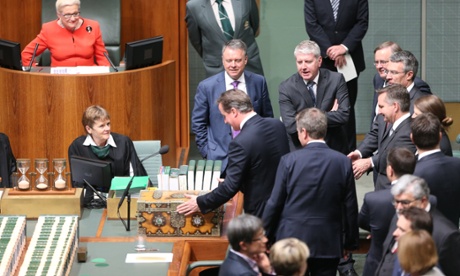
The last question is again to David Cameron on his anti-terror laws, particularly the power to take away British passports from people fighting overseas. The questions are around leaving British citizens effectively stateless. The British journalist also makes the point that even the Australian government has not done that. Our reputation precedes us, apparently. This from Cameron:
Successive governments have come to the view - and I agree with the view - that when you’re facing an existential challenge as great as the one we face with Islamist extremists, you need additional powers as well as simply the criminal law. That’s why we have these powers to take away someone’s passport before they travel, to ban someone from travelling and that’s why we’ve added this additional power to temporarily exclude someone from coming back into the UK, because we believe you need an additional set of powers in order to keep the country safe over and above what the criminal law allows.
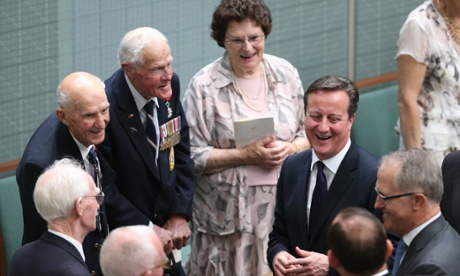
Happily, Murray and Eric Maxton obviously made it to David Cameron’s address. The brothers were invited from Western Australia for the event but there was no air ticket in the invitation.
Second question on whether Britain’s terror laws will maroon British citizens overseas.
Cameron says it is his duty to keep British people safe while Abbott echoes his comments.
Third question on Russia’s increasing military assertiveness.
Cameron:
Russian action in Ukraine is unacceptable. We have to be clear about what we’re dealing with here. It is a large state bullying a smaller state in Europe and we’ve seen the consequences of that in the past and we should learn the lessons of history and make sure we don’t let it happen again. I don’t believe there’s a military solution to this, but I think the sanctions are important.
Abbott:
The last thing I ever imagined 12 months or so back was I would be standing at this podium talking about Russian assertiveness and aggression.
Abbott says Russia’s involvement in the MH17 disaster through Russian-backed rebels and calls on Russia to:
come clean and atone.
Then we are back to the Tsar.
Interestingly, Russia’s economy is declining even as Russia’s assertiveness is increasing and one of the points I tried to make to Putin is that Russia would be so much more attractive if it was aspiring to be a superpower for peace and freedom and prosperity, if it was trying to be a superpower for ideas and for values instead of trying to recreate the lost glories of tsarism or the old Soviet Union.
First question is on climate change and the China-US agreement.
Cameron says he is waiting to see the details of the agreement but he believes all countries should be taking action on climate change.
Abbott says he welcomes the US China deal, given they are the biggest emitters.
China emits some 24% of global carbon dioxide. The United States emits some 15% of global carbon dioxide by contrast. Australia’s about 1%, so I think it’s important that they do get cracking when it comes to this. I’m very proud of the fact that at the same time as we got rid of the carbon tax which was damaging our economy without helping the environment, we’ve put in place our direct action policy and I am absolutely confident that our Direct Action policy will deliver our 5% cut on 2000 levels by 2020.
David Cameron says Britain is growing at 3% a year, and is happy that the G20 should boost growth.
I think you’re also right to highlight the importance of free trade and the dangers of protectionism. The other things I’ll be hoping to put on the G20 agenda are obviously the continuing issue of making sure we have better tax cooperation between countries so that big companies pay the tax bills they should.
Tony Abbott lauds Britain’s anti terror laws.
David Cameron said in his speech there will be new powers for police at ports to seize passports, to stop suspects travelling and to stop British nationals returning to the UK unless they do so on the government’s terms. Therre will also be new rules to prevent airlines that don’t comply with no-fly lists or security screening measures from landing in the UK.
David Cameron and Tony Abbott are in the prime minister’s courtyard for a joint press conference.
Abbott says he appreciated Cameron’s comments about economics, trade and security.
He looks forward to the G20 and says “you can’t have prosperity without security”.
Inspecting the troops.
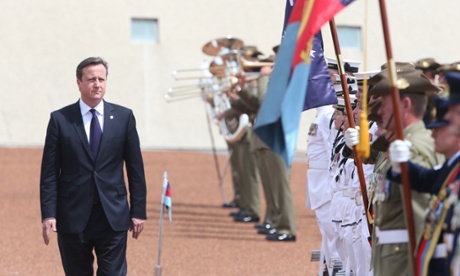
Age shall not weary them.
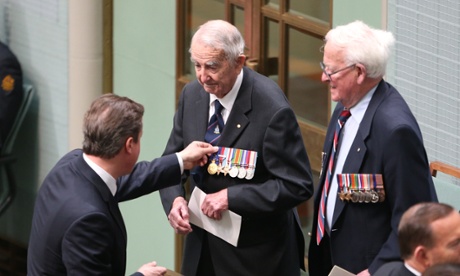
Shorten is asked about the Australia-Russian relationship.
All Australians know that Tony Abbott overreached when he had a brain snap and said he would shirt front Vladimir Putin. We heard the Prime Minister of England make a joke of the use of the word shirt front in his excellent address to theParliament. What really matters here is getting answers for the families of the victims of MH-17.
He says Russia should behave like a “good international citizen” and provide information to the Dutch investigation.
Bill Shorten:
If Australia wants to walk on the international stage, we can’t pick and choose when we want to be international and when we want to be isolationist. We can’t just talk about free trade without talking about tackling youth unemployment. We can’t talk about security alone in northern Iraq and then ignore the challenge of Ebola in West Africa. We most certainly need to address climate change as the presidents of China and the United States have done so in such a dramatic fashion this week. Make no mistake, when Tony Abbott says he only wants to concentrate on economic issues what we see is a stubborn isolationist who won’t admit climate change is an economic issue.
Bill Shorten is giving a press conference now. Shorten says Australia needs to be a nation of vision and confidence. He says the G20 is a test of leadership for Tony Abbott. He called on the prime minister to push:
- climate change
- inclusive growth
- pushing global trade
- and tackling youth unemployment.
Updated
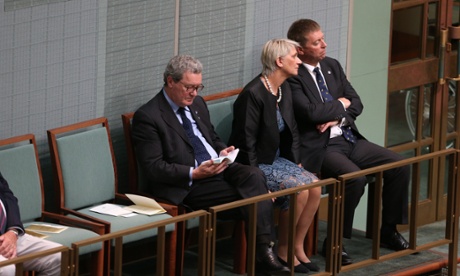
Downer in the House.
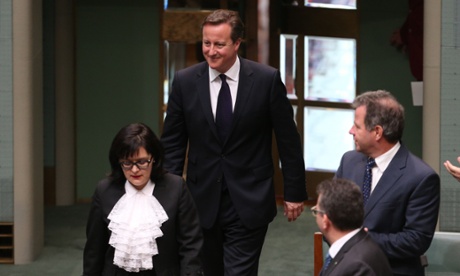
Cameron is ushered into parliament.
“Strewth”, said Cameron.
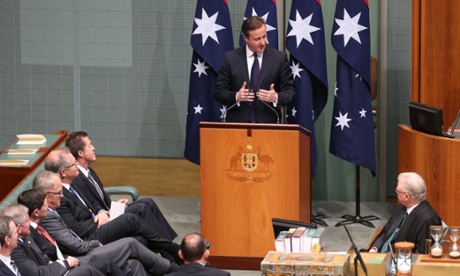
Trying a little Australian slang.
One more quote from Bill Shorten:
Today, the War Memorial salutes the memory of Australians who have served our nation in every conflict and peacekeeping operation. So often they have served, fought, fallen, side by side with British soldiers.
From the open veldt of South Africa, to the skies over Europe, most recently in the mountains of Afghanistan and the skies over Mesopotamia, our countries have forged an unbreakable bond of courage and sacrifice – of mutual respect and regard.
Their spirit, their bravery, their shared sense of duty and honour unites our countries in history forever.
Bill Shorten:
Britain has joined Europe and Australia has found our place in Asia. We sing our own anthems, we celebrate our own cultures.We enjoy a genuine exchange in education, art, music, cinema, literature and fashion.
And whether it is the Ashes, rugby, netball, the Olympics, the Paralympics or the Commonwealth games, we relish an international sporting rivalry as old as any on earth.
Our sledging can sometimes surprise the uninitiated – but it reflects the depth of our friendship – we can dish it out because we know we will get it back. We are both good losers – and fantastic winners.
Bill Shorten echoed a line of Tony Abbott’s with a twist:
The deep and abiding friendship between our nations has evolved and matured. Australia no longer looks to Britain out of need, or dependence – we no longer seek to imitate, or echo. Instead we greet each other as equals and peers - as partners in the world.
Let me back track to Bill Shorten now with some funny historical anecdotes.
Prime Minister, the first of your predecessors to visit our country did so before Federation - and before he was even a Member of Parliament.
Lord Salisbury, the Conservative icon and one of the great architects of the Empire, visited the colonies as a young man in the 1850s.
Two observations from his lordships journal stand out:
One, his lordship reported there was “less crime than expected”.
Two, his lordship reported that the “customary form of address was: mate’’.
Just over a hundred years later, Harold MacMillan became the first Prime Minister to experience Australian hospitality whilst in office.
As he recalled:
As I drove into Sydney on my first arrival there, I was amazed to see the great numbers of people in the streets and issuing from all houses.
A huge crowd had turned out to welcome me, far greater, I thought, than any similar crowd could ever be in the old country, and I was deeply touched.
Then someone told me the truth. It was six o’clock…[and the pubs were closing].
Prime Minister, you will be relieved to hear that the days of the six o’clock swill and early closing are long gone.
Updated
David Cameron finishes with the point that democracies always seem combative, in a nod - I thought - to the disillusionment with modern politics in the first world.
Here in this Chamber and in the House of Commons back in Britain, we let the brickbats fly. We sometimes say some pretty rude things to each other. We trade insults and put-downs. Not everyone quite gets it.
His point was that for all our flaws and the barbs traded in modern political arena, the values that underpin those societies are strong.
Never forget that we live in countries where the press is free, the law is fair, the right to redress universally available, property rights universally enforceable, the freedom of speech the foundation of our democracy. And let’s remember that these things – these incredible values we share – are not just what make our societies strong; they make our economies strong too.
After outlining the anti-terror laws, David Cameron lauds a free press:
Our free and fearless press shines a light wherever it is needed, without fear or favour. Of course that can make life difficult – but it helps drive out the corruption that destroys so many countries. Our governments lose cases in court, because we don’t control the courts. But that’s why people invest in our countries because they have property rights, and they know that they can get redress from the rule of law and that we have judges who are honest and not on the make.
David Cameron:
Finally, there’s a more insipient creeping threat to our values that I want to mention. And it comes from those who say that we will be outcompeted and outgunned by countries that believe there is a short cut to success, a new model of authoritarian capitalism that is unencumbered by the values and restrictions we impose on ourselves. In particular, an approach that is free from the accountability of real democracy and the rule of law. I say: we should have the confidence to reject this view and stay true to our values.
David Cameron warns against protectionism, saying it leads to more jobs and higher wages.
One of the greatest threats to our values and to our success is the spectre of protectionism. Too many people still seem to believe that trade is some sort of zero sum game.
David Cameron:
As we confront this extremism together, let us have faith in the appeal of what our modern societies can offer. Yes, the battles for equality of opportunity for every person of every race and creed are not yet fully won but today your country and my country are places where people can take part, can have their say, can achieve their dreams, places where people feel free to say, “Yes, I’m a Muslim. I’m a Hindu, I’m a Christian but I’m also proud to be a Briton or an Australian too.” And that sense of identity, that voice, that stake in society all come directly from standing up for values and our beliefs in open economies and open societies.
Cameron talks about the British economy turning the corner and pays tribute to John Howard and Gough Whitlam.
He says Australia and Britain have always stood firm together because they share the same values.
He briefly outlines Britain’s anti-terror laws, but then talks about how to address the root cause of terrorism, the extremist narrative.
As we do so, we must work with the overwhelming majority of Muslims who abhor the twisted narrative that has seduced some of our people. We must continue to celebrate Islam as a great world religion of peace.
He says the internet is presenting a challenge in the fight against the extremist narrative. He says government has a role to ensure it does not become an ungoverned space.
In the UK we are pushing (internet companies) to do more include strengthening filters, improving reporting mechanisms and being more proactive in taking down this harmful material.
David Cameron thanks Australia for its help on ebola: “Typical Australia, always there with action not words.”
But for a while our political relationship fell into a state of what William Hague called benign neglect. It’s extraordinary to think that no British Foreign Secretary had visited Australia in nearly 20 years. I was determined to change that. Now you’ve had three visits in as many years and a British Prime Minister twice as well. You might start to think we’re beginning to over-do it.
Updated
Cameron talked about Australia’s willingness to help on the world stage and cracks a shirtfront joke.
Only last month your Foreign Minister strode across the room towards me at a summit in Italy. I wondered for a moment whether I was heading for what I’m told we now need to call a shirtfronting.
David Cameron acknowledges the traditional owners of the country. (Abbott did not. Shorten did).
Every chapter of Australia’s story has been inspiring. I think of your Indigenous culture with roots stretching back millennia and I feel pride that Aboriginal Australians are now studying at Oxford and Cambridge and one of those scholars, Leila Smith, is here with us today.
Cameron plays tribute to Australian diggers and recalls going to Anzac Cove as a younger man.
We will never forget the thousands of Australian troops who stoodand fought and fell from Lone Pine to the Somme. I especially think of those who fell in Gallipoli which I visited as a young man, surrounded by Aussies and Kiwis the same age as me. We joked as we took the boat across the Straits. But aswe landed and saw that extraordinary memorial, we all fell silent, moved beyond words by what our forefathers had done together.
Cameron addresses Australian parliament.
David Cameron’s address.
Coming here is like visiting family, says Cameron.
He also goes to the rivalry mentioned by Shorten.
There’s our rivalries on and off the playing field, our fondness for teasing each other’s habits and phrases, of course we Poms are known for our bluntness and we never really get your tendancy to beat around the bush and not say what you really mean. We have enormous affection for each other. We may live on opposite sides of the planet but it is hard to think of another country to which theBritish people feel so instinctively close.
Updated
Bill Shorten is speaking now to echo the old friendship point and harks back to his ancestors. His is a more earthy speech, touching on the rivalry between the two countries but ultimately the unity between the two cultures.
I particularly want to pay a belated tribute to the British justice system because without your strong sentencing laws, some of my mother’s Irish ancestors would never have come to Australia.
Abbott finally quotes writer Clive James to note the integral part Britain has played in Australia’s development.
He presents Australia and Britain as very close and similar nations.
After two centuries in which both of us have constantly adapted to our own changing and different circumstances, it’s remarkable how similar we’ve become.
Updated
Tony Abbott makes a regular point about Australia’s place in Asia not diminishing the relationship with Britain.
Of course Australia is located in the Indo-Pacific but our place is wherever there is an interest to advance, a citizen to protect, a value to uphold or a friend to encourage. To a similar debate in Britain, Prime Minister Cameron has brought the same robust common sense. Britain is a European country with a global role. And like people, countries don’t make new friends by losing old ones and they don’t deepen some relationships by diminishing others.
Abbott makes the point Australia and Britain are still fighting together in the war against Islamic State:
History matters because it helps us to know who we are and where we’re going. It helps us to know what’s important and who can be relied upon. It shapes us but it should never control us.
Updated
Tony Abbott remembers the Australian and British soldiers who died during wartime, fighting with each other. A number of veterans are in the chamber.
Updated
Abbott:
And what would this world be if Britain had not settled the territory that Captain Cook earlier called NSW? Long ago, Madam Speaker, Australians ceased to regard Britain as the mother country but we are still family. The relationship between Britain and Australia has changed beyond recognition but it’s still important and we still matter to each other.
Abbott:
There is so much that Britain has given to us. There’s so much, indeed, that Britain has given to everyone. Parliamentary democracy, the common law, constitutional monarchy, and English, the world’s first or second language.
Abbot mentions Shakespeare, The Beatles, the advances of the first industrial revolution, and the determination of Churchill?
Tony Abbott:
The first Christian sermon preached in this country took as its text “what shall I render unto the Lord for all his blessings towards me?” This indeed has always characterised us. Gratitude for what we have and a fierce determination to build on it. Modern Australia has an Aboriginal heritage, a British foundation and a multicultural character.
Tony Abbott is welcoming David Cameron and giving a history lesson to build on the British-Australian relationship.
Of those on the First Fleet, the very best that could be said of them was that they had been chosen by the finest judges in England.
Updated
So it’s pretty squashy in parliament and the public galleries are full.
David Cameron is announced. The central chamber doors open and Cameron is introduced to the house and to applause and a standing ovation.
The Speaker Bronwyn Bishop is on her feet, opening parliament.
Here is a bit of smoke from the forecourt, via Karen Barlow of SBS.
Captured the moment one of those enormous guns fired out the front parliament! pic.twitter.com/g5xURYQWsT
— Karen Barlow (@KJBar) November 14, 2014
From the Aboriginal deaths in custody protest in Brisbane:
Crowd swelled to about 300 at the Aboriginal deaths in custody protest at #G20Brisbane pic.twitter.com/L9WiB4qykE
— Mark Di Stefano (@MarkDiStef) November 13, 2014
David Cameron’s address is coming up as the independent legal observers arrive in Brisbane.
There are six "independent legal observers" in white singlets hovering on the outside of the #G20Brisbane protest pic.twitter.com/Hp7OnOHAUN
— Mark Di Stefano (@MarkDiStef) November 13, 2014
Mark Di Stefano for Buzzfeed is tweeting from the G20 protests regarding Aboriginal deaths in custody.
At "Aboriginal deaths in custody" protest there about as many journalists as protestors at the moment #G20Brisbane pic.twitter.com/CoZOkdOPzB
— Mark Di Stefano (@MarkDiStef) November 13, 2014
That’s it for the welcome ceremony. David Cameron is in the House to sign the visitors’ book. DC woz ‘ere. There’s a warm leaders’ handshake for the cameras and then more official party stuff.
Now the Australian anthem, Advance Australia Fair. You li’l beauty rich and rare.
David Cameron is meeting the official party, including Speaker Bronwyn Bishop, Labor deputy leader Tanya Plibersek, Alexander Downer and others.
Now stand up for God Save the Queen please.
David Cameron is now inspecting Australia’s federation guard to a jaunty little tune, the kind you would hear as the troops were making merry in Guns of Navarone.
David Cameron has arrived at parliament in a white car with a British flag on the front as the seagulls whirl through the forecourt over head. The guns are going, in their customary salute.
Who wants to do fill in commentary? On ABC24, former advisor to Tony Blair, Nick Rowley is asked to explain the similarities between Cameron and Abbott.
Well...they are both men...
He did go on to make some very salient points, to be fair.
Meanwhile, in Brisbane, the locals have vanished.
Friday morning, and parts of the #Brisbane CBD are a ghost town #G20 #G20Brisbane pic.twitter.com/UPClMSwHfU
— Adam Todd (@_AdamTodd) November 13, 2014
Tony Abbott has arrived in the parliamentary forecourt. He is now waiting for David Cameron, who is in a different car.
The drums have started out the front. Australian flags are being waved, the anthem is played. A soldier is yelling very loudly.
Updated
Tony Abbott from this morning on the British-Australian relationship.
It’s a relationship between, if not quite equals, certainly peers, and it is as warm as, as intimate, and as important as any relationship on this eTarth.
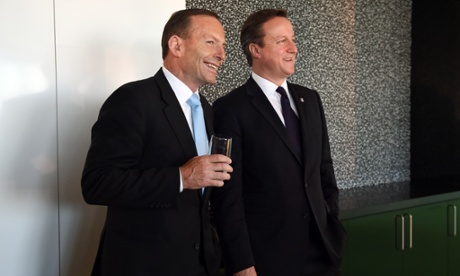
He was discussing economic size.
Former Australian Liberal prime minister Malcolm Fraser has some advice for his successor Tony Abbott.
Coal versus climate in Australia. Climate change must be discussed if meeting is to have relevance http://t.co/8YdQFA2zg3
— Malcolm Fraser (@MalcolmFraser12) November 12, 2014
Tony Abbott was not to be outdone. He was talking up the prospects of foreign investment, notably British foreign investment.
We will give this country the muscle and the sinew that it needs to advance into the future and we will do it in partnership with investors from Britain and elsewhere. There is a long history of British investment in Australia. After the US, Britain is by far the biggest investor in this country. It’s been a very steady consistent flow of British investment into this country ever since the very beginning of settlement here in 1788.
Arrrr me hearties. David Cameron has found his buccaneering spirit. It wasn’t only Tony Abbott spruiking his government’s achievements.
No doubt after some difficult years Britain is back. Our economy is now the fastest growing of any G7 countries, we’re going to do plus 3% this year. We’ve seen, since I’ve been PM, 2 million private sector jobs created, that is more jobs created than in the rest of the European Union put together. We’ve seen some real progress in our country. 400,000 more businesses operating in Britain and a sense that our economy is really on the move. Lots of challenges because we’re in a neighbourhood that doesn’t have a huge amount of growth and lots of things we need to crack but the British economy is back. We have refound that buccaneering trading spirit and we’re linking ourselves up with all of the fastest growing parts of the world.
While we are limbering up for David Cameron’s arrival, you may like to do a primer on what the G20 hopes to achieve. Lenore Taylor has written a piece to get you up to speed on the hopes and dreams of the G20 and whether they will get there:
In 2008 when the global economy was in crisis, the G20 stepped up. But in the six years since it has become better known for the protests it attracts than the progress it has made on its central goals of promoting growth and strengthening international economic institutions.
So when the leaders meet again this weekend in Brisbane, Australia, they will be under pressure to achieve something tangible for the gathering to prove its relevance. But it is not at all clear that the “announceables” – the outcomes pre-negotiated by officials after a full year of meetings – will be sufficient to achieve that goal.
Let’s put this story under the theme, my gun is bigger than yours.
Brisbane’s Courier Mail is reporting that another Australian ship has been sent to “intercept” the Russian fleet heading our way.
A third Australian warship has been dispatched to intercept a Russian flotilla steaming towards the G20 summit in Brisbane and a fourth navy vessel is ready to divert to the area. The replenishment ship HMAS Sirius is heading into the Coral Sea to support the frigates HMAS Parramatta and HMAS Stuart and the frigate HMAS Sydney is preparing to divert from an exercise in New Zealand to join the mission, according to a government source.
News’ national defence writer Ian McPhedran “understands that the government also asked the Navy about the possibility of a Collins Class submarine joining the mission but was told that the nearest boat was in Perth and would not be able to reach the area until well after the G20 summit was over”.
But there are anti-submarine warfare choppers on the Australian ships but don’t panic. Defence sources said a Russian submarine is not likely to be in the area.
Business is Gr8 Mate.
Talking to business leaders in Sydney about our long-term economic plan, which is helping the UK grow in tough times. pic.twitter.com/edbCJTqGKN
— David Cameron (@David_Cameron) November 13, 2014
Summary of morning events for David Cameron
Here is a rundown, just in case you need to adjust your day for the events of the parliament.
David Cameron and Tony Abbott is about to arrive in Canberra, due at 10am.
There will be a ceremonial welcome in the forecourt of parliament at 10.30am and then he will sign the visitors book shortly before 11am. He will address the house at 11.10am, with the senators squashing in to the green benches. Then the two leaders will give a joint press conference before speeding off to the Australian War Memorial to lay a wreath.
Head in the sand on climate change
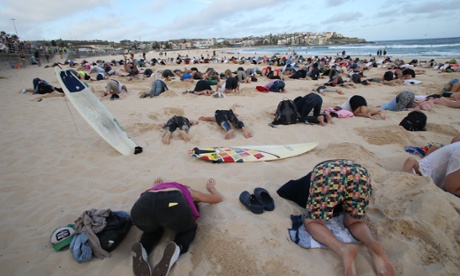
Bowers was scouting around Sydney yesterday in preparation for the G20 and caught these people, 400 of them, protesting about Australia’s stance on climate change. They buried their heads in the sand, bums in the air. With the surfboards, it seems a very Australian protest.
After the walk, Tony Abbott and David Cameron had a business breakfast. The theme was infrastructure, in keeping with Abbott’s election slogans, the infrastructure of the 21st century. Abbott showed his writerly tendencies in imagining what it was like for the First Fleet, fronting up in Sydney in 1788. The message was that Britain and Australia have had an “extraordinary partnership” since that first boat hit the harbour. (Lucky we didn’t stop that one.) Abbott went on to provide a word picture of what those first boat people saw. At this point, you might want to shut your eyes, indigenous Australia.
As we look around this glorious city, as we see the extraordinary development, it’s hard to think that back in 1788 it was nothing but bush, and that the marines and the convicts and the sailors that straggled off those 12 ships just a few hundred yards from where we are now must have thought they had come almost to the moon.
Everything would have been so strange. Everything would have seemed so extraordinarily basic and raw, and now a city which is one of the most spectacular cities on our globe, and in a country which is as free, as fair and as prosperous as any, a country which is in so many ways the envy of the Earth. So, it’s great to be here with you, David, and I hope, as you pay your first visit to Sydney, and you think of what your countrymen did 200-odd years back, you do feel a measure of pride and satisfaction at what has been achieved here in that time.
Look, it’s terrific to be talking about infrastructure.
Updated
Good morning politicos,
The guns are lined up on the parliamentary forecourt, Tony Abbott and David Cameron have taken a turn around the Sydney Opera House. There must be a big show on today. Yes, you guessed it, the G20 is in town.
The British prime minister, or rather one of his staffers, has kicked off the hoopla with this tweet from the PM2PM Power Walk. No doubting where he is.
With my friend @TonyAbbottMHR on a morning walk in Sydney. Later I'll address the Australian Parliament. pic.twitter.com/jc3iLhRi6u
— David Cameron (@David_Cameron) November 13, 2014
Stay with us for the day. Tony Abbott has already given a cracking speech reflecting on the Australia found by “the marines and sailors and convicts that straggled off those 12 ships”. More of that, I promise.
I am ably assisted by Mike Bowers and please join the conversation below or on Twitter. I am @gabriellechan and he is @mpbowers. If the G20 crosses your world, be sure to employ your smartphone on social media and tag me. We will share your experiences but keep it clean people.
Onwards and upwards.