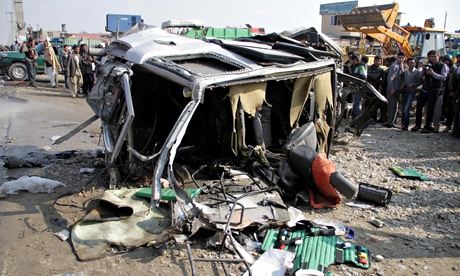
There are two ways of explaining Thursday’s attack on a British diplomatic convoy in Kabul. One is that it is an attempt to make a statement before the London conference on Afghanistan next week, a major event at which world powers will attempt to reassure Afghans, the region and one another that they will not leave the country in the lurch.
It comes at a key moment in the 13 years of the conflict. Within months, only a residual presence of about 10,000 international troops will remain in Afghanistan. The new president, Ashraf Ghani, faces huge challenges: a government has yet to be formed and the country cannot afford to maintain even a fraction of its military’s current strength without vast infusions of international cash.
Insurgent violence has been complex and unpredictable over the years, but many attacks have been designed to send a specific message to a specific audience. One audience is local, of course. The attack underlines that the Afghan government is unable to ensure security for its citizens. If a foreign diplomatic convoy can be attacked then no ordinary person is safe either.
“The flurry of bombing in Kabul looks like a propaganda effort,” says Graeme Smith, of the International Crisis Group in Kabul. “It’s the Taliban’s cruel farewell to the International Security Assistance Force mission. ISAF achieved all sorts of things but it did not bring security.”
Another audience being targeted is international. Western politicians respond to voters, and if those voters hear nothing but bad news from Afghanistan their leaders are less likely to make the sort of commitments that would sustain Ghani’s government.
Once, the best way for Afghan insurgents to affect public opinion in Europe or the US was to kill soldiers. A single ambush of French troops in eastern Afghanistan in 2008 shattered already shaky support for that country’s military intervention. Heavy casualties suffered by British troops in 2009 and 2010 reinforced the public sense that the pain of the conflict was too high. Spectacular attacks such as that on the hugely expensive Camp Bastion in 2012 reinforced the impression of costly failure.
But with troops gone, or behind multiple rows of blast walls and wire, attacks on embassy staff are a useful substitute and likely to get more publicity. The killing of two US servicemen in Kabul this week was barely reported.
A second possibility is that the attackers did not know exactly who they were attacking, other than they were foreigners. The busy Jalalabad Road, the site of the attack, is used by contractors, soldiers and many other international actors in Afghanistan.
“There are probably some Taliban who use Google but their strategic thinking is not like ours. They are working to a different timescale. I don’t think they had the conference dates in mind. It’s more likely that they just sent a suicide squad down there to hit some foreigners,” Smith said.
Multiple observers have predicted rising violence through 2014 and 2015. They have so far been proved right. Currently, colder weather is restricting the insurgents’ military operations. Once the winter has passed, the killing will resume at a new intensified level in Kabul, in other cities and in rural zones.