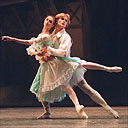
The Kirov Ballet's attempt to stage Kenneth MacMillan's Manon gives the lie to any notion that ballet is a universal artform. This is a work so steeped in the traditions of 20th-century British ballet - its theatrical realism and literary characterisation - that the Kirov can't help but dance it differently from the Royal Ballet, for whom it's a basic text. What we see from the Kirov is almost a 19th-century Russian ballet.
The production's style is set from the beginning by Peter Farmer's picture-book designs (a bland spin on the fabulous grubbiness and ostentation in the original Georgiadis conception). But the opening crowd scene rapidly signals that the performances will look just as generic and muted. These dancers are the most disciplined corps de ballet in the world, schooled in the language of classical mime, so it's hardly surprising they have neither the vocabulary nor the initiative to create the gallery of individuals we're used to seeing in a MacMillan ensemble. Only Maxim Khrebtov as Lescaut seems to have a coherent personality up and running. Whenever we look at him, we see a man engaged in an unfolding story.
The other principals tend to revert, dramatically, to other ballets they're used to. When Svetlana Zakharova's Manon first enters as an innocent girl, her naivety has the delicate unworldliness of Giselle. When her head is turned by the dazzle of money she morphs into Gamzatti (La Bayadère) and when she flaunts her sexuality she is Kitri in Don Q. She is, also, only one of these classical prototypes at a time. The idea of characterisation, where motives and desires exist in tension is not at work here.
The idea too that dance steps and natural body language can coexist in a single phrase is also foreign to Ilya Kuznetsov as her lover Des Grieux. Not only does his dancing go helplessly adrift when it ventures beyond the academic vocabulary, he has absolutely no idea of how emotional dynamics might phrase a sequence of steps, rather than basic counts. As hard as some of the dancers try, the drama of Manon, with all its moral ambiguity and sexual queasiness, is lost.
The dancing, however, is writ large and bright, especially in the radiantly delineated techniques of Zakharova and Natalia Sologub (Lescaut's mistress). Even if this isn't the MacMillan ballet we know and love, it is an interestingly alternative showcase for the Kirov's prowess - and a diverting lesson in the richness of ballet culture.
Ends tomorrow. Box office: 020-7304 4000.