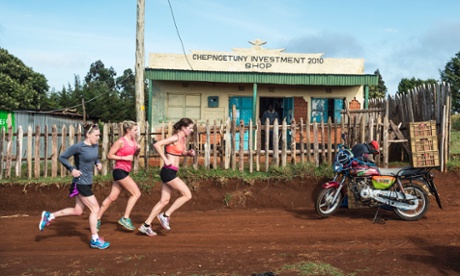
Shortly after a flaming dawn in Kenya’s Rift Valley, a bare-chested man is being stabbed in the ear in the name of scientific research. A family of curious, emaciated sheep plod by, straining to get a closer look. Charlie Grice doesn’t flinch as his blood is drained and stored. He knows the real pain lies ahead. For the next half-hour, Grice – one of Britain’s brightest 1500m hopes – and a dozen other elite athletes tackle a series of brutal hill repetitions: three minutes flat out, one minute easy; two minutes flat out, one minute easy; one minute flat out, one minute easy – all repeated three times.
It may not sound that hard but the rocky, crimson-coloured road from the valley floor to Iten is so unrelentingly steep that even a 4x4 drive splutters and coughs while keeping up with the athletes, whose lungs struggle to grasp oxygen at 8,000ft. Towards the end of the session, every rep ends with heads on knees. Grice is not so lucky. He has to stand while Gareth Turner, the camp‑based physiologist, rushes out of a car and jabs another spring-loaded lancet in his ear. Grice’s blood samples will be assessed for their lactate levels to see how hard he was working. But his hangdog appearance tells you all you need to know. He is spent.
As the group finishes, Turner turns to the cross-country runner Katie Brough and asks how she is feeling. In between hoarse gasps, she just about musters a response. “This is worse than childbirth – and you can quote me on that.”
These athletes are involved in the first wave of Project Pinnacle, a new research partnership between British Athletics and the English Institute of Sport, which seeks to advance the understanding of altitude training. The aim is simple: create more British medallists at major championships. As Barry Fudge, the head of endurance at British Athletics, points out, Mo Farah’s golden achievements over the past three years are an obvious lodestar.
“Mo’s success is down to a combination of a lot of factors, but altitude training is fundamental to what he does,” he says. “It was also a vehicle for him to understand what he had to do to be successful. Mo started comprehensive altitude training in 2010, and every year we have evolved it and changed it slightly to the point where we think we have cracked it.
“But with other athletes we don’t want to take four years. We want to go: ‘Right, that’s what we do.’ That’s what the science is missing, the ability to predict what’s going to happen.”
The benefits of altitude training have been known for decades: the lack of oxygen in the air forces the body to increase its red blood cell count, so when athletes return to sea level they usually find performance is improved for a short period. Typically, the more time you spend at altitude, the more you benefit.
But Fudge and his team want to know more. So they are focusing on three research projects: assessing the optimal time to compete after altitude exposure; identifying if training intensity when tapering for a major event has a priming effect on performance; and analysing if you can predict in advance how long an athlete will take to adapt to altitude.
Most athletes do not concern themselves with such cutting-edge science. For them, Kenya is about a simple and stark routine: eat, run, rest, repeat. No one questions whether it works. They see the evidence with their own eyes. David Rudisha, the world 800m record holder, trains in Iten. So do Dennis Kimetto, the world marathon record holder, and Wilson Kipsang, the winner of this years’s London and New York marathons.
Every time they visit, the British team base themselves at the High Altitude Training Centre. Outside there is a sign that says it is the “University of Champions”. It is no idle boast. But while its food is decent and the roads and trails around Iten are perfect for running, pretty much everything else is no-frills. Everyone does their own washing in sinks or buckets. The electricity in the camp is solar powered, so after two days of rain the hot water turns lukewarm. The bedrooms fit two single beds and not much else. There is no pharmacy in Iten so the British Athletics physio room doubles up as a one-stop chemist, with everything from Dioralyte sachets to Deep Heat.
There are frequent power cuts, too. Sometimes they occur when athletes are on the treadmills and they find themselves flying off at high speed – a sight that is vaguely comic, as long as it happens to someone else. As Andrew Osagie, the 800m world indoor bronze medallist, puts it: “Coming from the western world the facilities are really basic but when you look around Iten you appreciate we are lucky.”
Osagie, like everyone else, keeps coming back to Kenya because he knows that the simple programme – typically running twice a day as well as doing core, stretching, and strength and conditioning – works.
Fudge says: “Our altitude camps run from November through to summer, and what we tend to see is athletes that go in November and again in January are massively ahead of where they would have been if they didn’t go. If you are a young 1500m runner and you start in Kenya in November at 6.30min mile-pace and you find it really hard because of the altitude, by the time you go again in January that 6.30 is easy.”
The 800m runner Alison Leonard puts it more poetically. “It’s much harder to breathe out here,” she says. “But some of the hills have shrunk since I got here.”
Training in Kenya is not all about altitude: it’s also about mental fortitude. When your pulse flies into the stratosphere on what is supposed to be an easy run, you have to retrain the brain to what is possible, which can be particularly hard when you are going at least a minute a mile slower than back home. It is even harder in the rare cases when an athletes’ body does not adapt to training at altitude.
Hannah England, the 2011 world championship silver medallist in the 1500m, says: “The problem is that I’m one of those athletes you might call a non-responder. There is no escaping from simple genetics – out here it is whether you’re able to produce your own natural hormones and extra red blood cells. My body does not really respond to being at altitude. Most people’s bodies say: ‘Right, I’m here let’s throw red blood cells out like no tomorrow,’ but mine’s: ‘No.’ It just doesn’t do it.
“But I still keep coming back because I get very fit off it. I might get sick, my heart rate will go through the roof – hitting 190 beats per minute – and the breathing is very laboured. But there are aspects I enjoy – the group atmosphere and my time in the gym.”
England – along with Osagie – is among the senior members of the British camp. Farah would usually be here, but he has been given six weeks off by his coach, Alberto Salazar, after flogging his body over the past three years. Also there are promising youngsters, such as Grice, who are here to absorb the benefits of altitude training as early as possible and to learn from the established runners.
It is, says Fudge, a key part of British Athletics’ strategy. “Not only do they get the aerobic conditioning and the fancy bits we talk about, but also four weeks with experienced professional athletes. That’s great for helping them understanding what they have to do to reach the top of the sport. You could be there having breakfast with Mo Farah for the next four weeks, understanding how he lives his life, what he does and how he trains.”
Kyle Langford, the youngest athlete on the trip at 18, quickly vouches for Fudge. “It’s the perfect lifestyle for me,” he says. “I couldn’t really ask for anything more – training and making new bonds.”
Langford, whose trip is funded because he is on the British Athletics futures programme, ran his first track race at 15 and he has got his 800m time down from 2min 02sec to 1:47 despite very little training. When Rudisha ran the fourth-fastest 600m in history in Birmingham in August, Langford was seventh – just over two seconds back. He is very much on the fast track to the top.
Some less successful athletes have had to pay their own way. The 23‑year‑old Ben Coldray, a decent-but-no-more 1500m runner, financed the £1,500 trip through a mixture of babysitting, modelling, and being a Butler in the Buff, which involves dancing for hen parties for £40 an hour.
In Kenya, however, he spends most of his time fending off Grice’s surges rather than tipsy ladies. It is Grice who leads the British athletes up the steep mountain and under the “Welcome to Iten – home of champions” sign at the end of their morning run, having averaged 5min 30sec a mile pace on the hard intervals.
No sooner have the British athletes gathered their breath than it is lost again when they see Rudisha gliding down the mountain. Initially, he is not spotted. Then someone shouts “Rudisha” and there are loud cheers and pointed fingers. As he waves back, some boys start chasing after him. It vaguely resembles a scene from Rocky.
It is supremely graceful sight – a perfect example of amazing genetics, hard work and altitude training. Fudge says: “I spent three or four years in Kenya doing my PhD, looking at genetics and training, and my feeling is that the Kenyans – and I include Mo in this as well – are sprinters with engines. Their engines come from multiple years at altitude and training and getting that aerobic adaption.
“Mo is a 1500m runner who has got a fantastic engine, has multiple years of developing it. Rudisha is a 400m runner with an engine and lots of aerobic adaption and so on. That’s what altitude gives them.”
Having lived with the Kenyans, could more British athletes start beating them? Fudge certainly hopes so. “The ones who are close to medalling, when they spend more time at altitude the benefits they get are humongous,” he says. It is not a word you will find in scientific journals but that’s OK. The man behind British Athletics’ endurance programme is far more concerned with what happens on the track.
The British Athletics Endurance Programme is supported by London Marathon, English Institute of Sport, National Lottery, Nike and Polar
Runs, rehab and rice
Andrew Osagie, the world indoor 800m bronze medallist, explains a typical day in camp
8am Wake up. Some are up earlier but I’ve always been someone who goes to bed around midnight. I’ll grab a light breakfast straight away.
8.30am The athletes go to the team physiologist, Gareth Turner, for a flexibility test and also to fill in a questionnaire to assess how they are feeling. If someone is tired or irritable their training for the day will be eased back.
9am Most go for a run that can last anything from 45-90 minutes but I have been nursing an injury so I will do 50 minutes on the cross trainer and bike.
11.30am Rehab and drills. I will often have a circuit session that not only elevates my heart rate but works on strengthening my achilles tendon. Afterwards I will see the physio to make sure everything is in the right place.
12.30pm Lunch. The food here is organic, grown locally and pretty good. I grew up eating quite an African diet because my dad is from Nigeria, so I’m used to lots of rice and things like curried goat. For some of the other guys it was a bit of a shock.
1.30pm Chill time. Most people have a nap, either 30 minutes or 90 minutes but I don’t really sleep during the day. Instead I’ll speak to people at home, play some table tennis or the QuizUp app, or simply rest.
4pm Most will use the late afternoon to do a weights or core session. Some of the younger lads end the session with a bench-press challenge – it has nothing to do with helping them run faster, they’re just doing it for bragging rights.
5pm Some athletes will go for their second run of the day in the late afternoon. Usually it’s nothing too strenuous.
7pm Dinner.
8pm Play time. Sometimes we’ll watch television – you can watch more Premier League football in Kenya than in the UK – but just as often we’ll play on games consoles. My coach Craig Winrow brought his old Game Cube out so every one, boys and girls, have been playing Mario Kart.
Midnight Bed