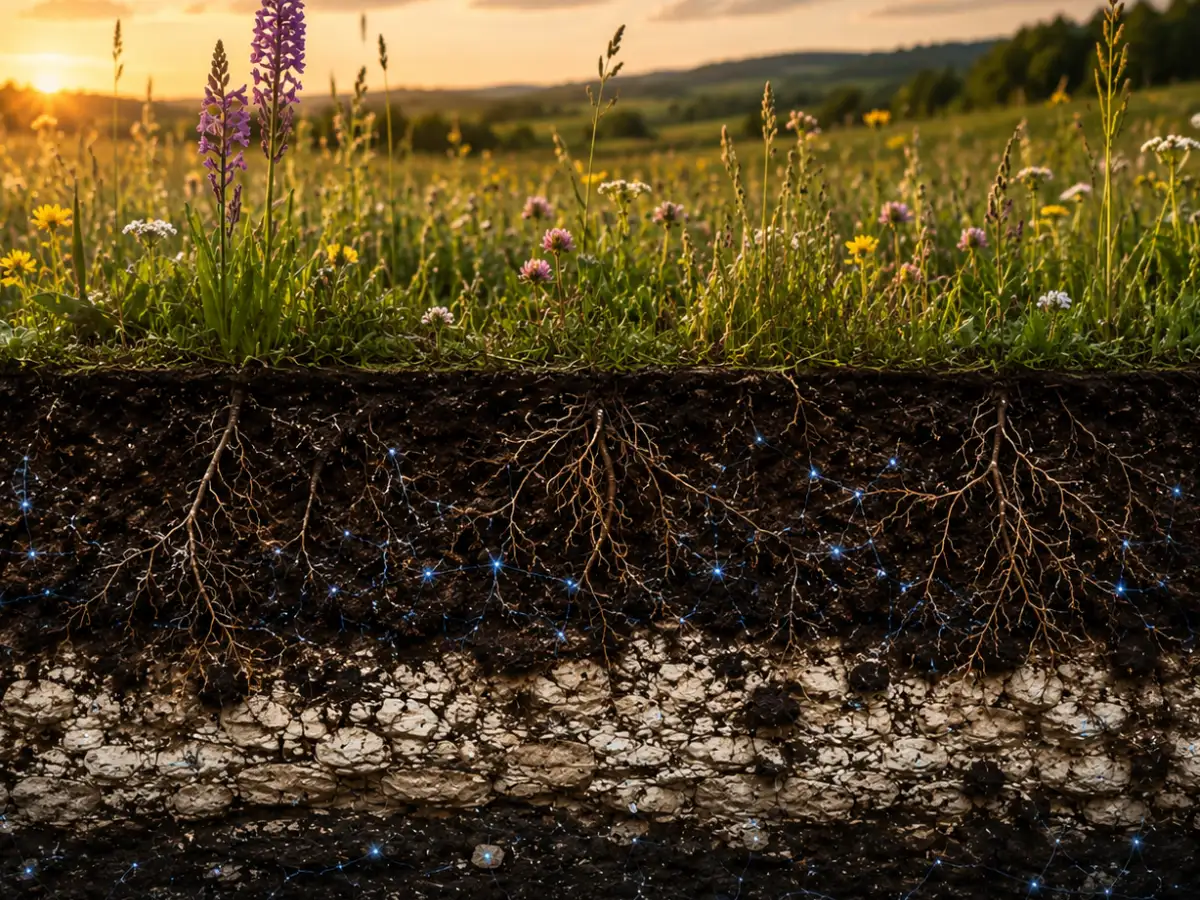
We usually think of land restoration as something we can see. Plant some wildflowers. Let the fields lie fallow. Watch for the green to return. Problem solved, right?
Not really. According to this landmark study published in The ISME Journal by researchers at the UK Center for Ecology & Hydrology, the real recovery, the invisible underground kind, can take well beyond a century. And we may be seriously underestimating how long it takes.
The experiment that spanned 143 years
The researchers chose Salisbury Plain in England as an ecological time capsule, a military training area so restricted that huge swathes of it never saw modern industrial farming.
In this study, soils from four different land histories were compared: active farmland (0 years of recovery), grasslands recovering for 23 years, grasslands recovering for 67 years, and ancient grasslands undisturbed for at least 143 years. They examined plant diversity, soil chemistry, and the communities of microbes that live in the soil. What they found conflicts with much of what we know about restoration.
Plants bounce back fast; soil doesn't
First, the good news. The study found that within the first 23 years after farming stopped, vegetation richness increased by about 300 percent, a huge win for anyone trying to restore native habitats in a human lifetime.
But the underground story is messier. The research showed persistent legacy effects in soil chemistry, organic matter and nitrogen continued accumulating slowly, and the soil ecosystem remained distinct from the ancient grassland stage even after 67 years of recovery. Phosphorus and potassium chemical residues from decades of synthetic fertilizer use were still elevated in soils that had been “resting” for more than six decades. Those nutrient legacies don’t just go away.