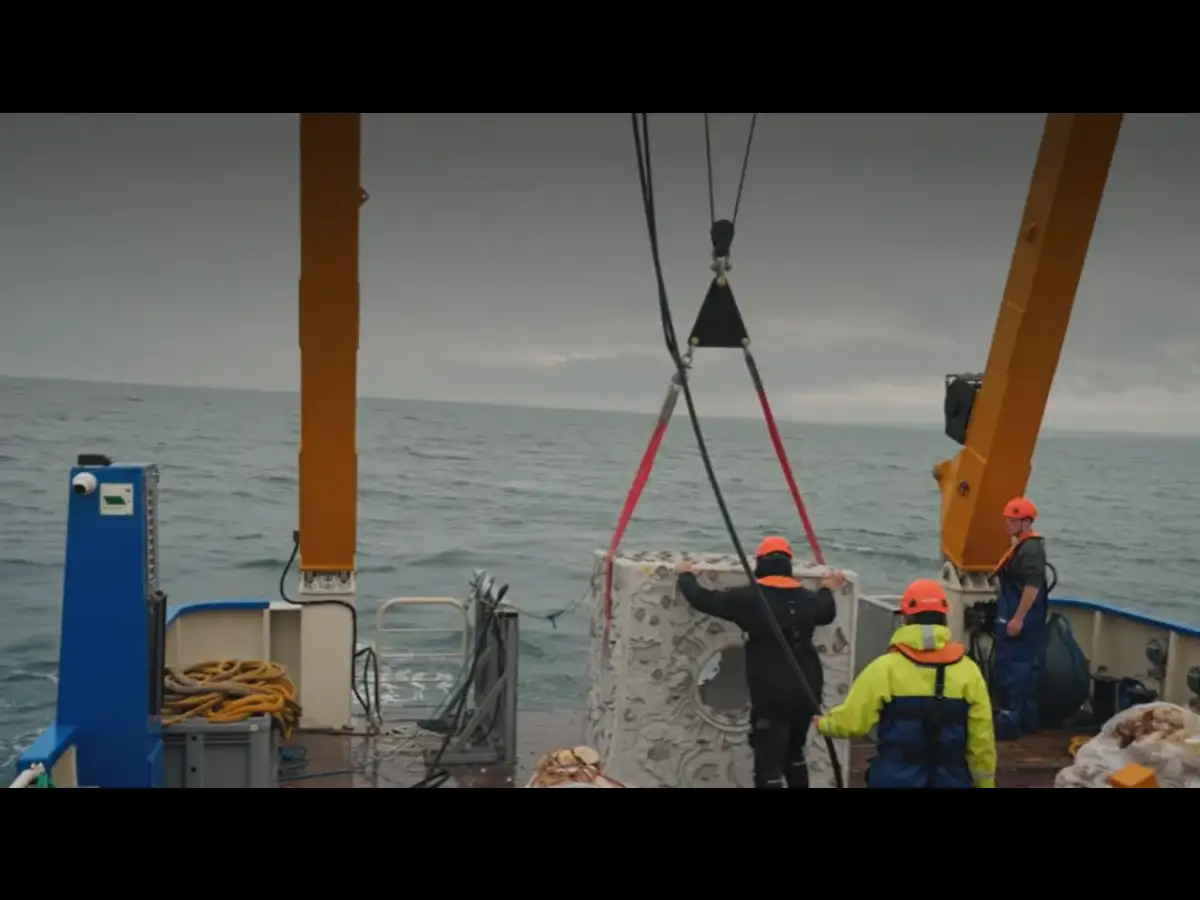
Britain is taking an innovative approach to restoring one of its most threatened marine habitats by combining engineering, recycled seafood waste, and conservation science. Along England's northeast coast, conservationists have lowered specially designed reef cubes, thousands of oysters, and repurposed scallop shells into the North Sea in an ambitious effort to revive native oyster reefs.
The restoration project follows decades of dramatic population decline that left the European native oyster on the brink across much of the United Kingdom. Now, researchers and volunteers hope these new underwater foundations will help rebuild an ecosystem that once supported countless marine species.
Britain used a brilliant approach to solve the collapse of native oyster ecosystems
Britain is attempting to reverse more than a century of decline in its native oyster population with an ambitious restoration project that combines innovative engineering, recycled materials and years of conservation work. According to information published by the Zoological Society of London (ZSL) , the latest phase of the project has introduced specially designed reef cubes, thousands of oysters and repurposed scallop shells into the North Sea to help rebuild one of Britain's most important lost marine ecosystems, as per a report by Eco News.
The restoration effort focuses on the European native oyster ( Ostrea edulis ), whose numbers have fallen by more than 95 percent across the United Kingdom since the 1800s. Rather than simply releasing oysters into open water, conservationists are creating the conditions needed for an entire reef ecosystem to return.
Why are reef cubes being placed underwater?
At the heart of the project are 20 large reef cubes positioned about 1.1 miles offshore along England's northeast coast. Each structure weighs around 6.6 U.S. tons, giving the installation a combined weight of roughly 132 tons.
The cubes are built using Marine Crete , a seawater-resistant material described by the project team as a carbon-neutral alternative to conventional concrete.
Instead of smooth surfaces, each cube has textured ridges, openings and uneven features designed to resemble the complexity of natural oyster reefs. These surfaces provide places where oysters can permanently attach while also creating shelter for fish, lobsters, sponges and many other marine species.
Volunteers carefully attached around 4,000 mature oysters directly onto the cubes using specialist reef adhesive. More than 35,000 juvenile oysters growing on shells were also introduced, alongside approximately 44 U.S. tons of recycled scallop shells known as "cultch."
Together, these materials form the foundation of what conservationists hope will become a self-sustaining underwater habitat, as per a report by Eco News.
Why do oysters need hard surfaces to survive?
The restoration relies on one simple biological requirement. Young oysters spend the first part of their lives drifting through seawater as larvae. When they are ready to settle, they need a firm surface where they can permanently attach and continue growing. In healthy reefs, older oyster shells naturally provide that foundation.
However, once an oyster reef disappears, suitable settlement surfaces become increasingly scarce. Flat or shifting seabeds make it much harder for new oysters to survive, preventing future generations from rebuilding naturally.
That is why the recycled scallop shells play such an important role. They provide the stable base needed for young oysters to settle, while successive generations gradually build upward, creating the three-dimensional reef structures that support much broader marine life.
As these reefs develop over time, they create shelter, feeding areas and breeding spaces for fish, crabs, shrimp and many smaller invertebrates. Restoring oysters therefore means restoring an entire underwater community rather than a single shellfish species.
Another important benefit comes from the oysters themselves. As filter feeders, native oysters naturally draw seawater through their bodies while removing suspended material. According to the Zoological Society of London , one adult oyster can filter around 53 gallons of water each day, although the overall effect depends on the size of the population and local environmental conditions.
That natural filtration can improve water clarity and contribute to nutrient cycling. As Celine Gamble, Wild Oysters Project manager, explained:
"They may be small, but oysters can play an important role in keeping our seas clean and healthy."
Can these new reefs restore an entire ecosystem?
The need for projects like this reflects just how dramatically native oyster populations have declined. Overharvesting removed oysters faster than they could recover, while pollution, disease and habitat destruction placed even greater pressure on the species. As a result, native oyster reefs disappeared from this part of northeast England more than a century ago, leaving the species locally extinct or functionally absent across much of its former range.A wider assessment carried out by the Zoological Society of London (ZSL) and the University of Edinburgh concluded that Europe's native oyster reef ecosystem now meets the criteria for being classified as "collapsed." Historical evidence showed these reefs once covered more than 4.2 million acres across Europe, forming rich underwater habitats that looked vastly different from today's largely flat seabeds.
The restoration team has already learned valuable lessons from previous attempts.
In 2023, conservationists deployed around 10,000 mature oysters on roughly 827 U.S. tons of shell and stone near Whitburn. Soon afterward, Storm Babet and other severe weather shifted some of the loose reef material across the seabed. Although monitoring later confirmed that oysters had survived and begun establishing themselves, the experience highlighted how challenging restoration can be in the exposed conditions of the North Sea.
The new reef cubes were introduced to overcome that problem. Acting as heavy anchors, they provide a stable base that is far less likely to move during storms. According to the project team, this is the first time this approach has been used at this scale in the United Kingdom. While success cannot be guaranteed, the stronger structures are expected to give young oyster reefs a much better chance of becoming established.
The project has also depended on an extraordinary community effort.
Before any oysters entered the sea, around 90 volunteers gathered at North Shields Fish Quay to carefully clean and scrub every oyster. This reduced the risk of unintentionally introducing unwanted organisms into the restoration site.
Another group of nearly 100 volunteers then helped secure mature oysters onto the reef cubes using specialist adhesive before a survey vessel transported the structures, juvenile oysters and scallop shells offshore for deployment.
Although the finished reef may appear to be the result of heavy marine engineering, countless hours of patient manual work helped make the project possible. Every oyster was carefully prepared to maximise its chances of survival once returned to the sea.
Researchers will now closely monitor whether the oysters survive, reproduce and produce new generations capable of settling naturally onto the growing reef. They will also observe whether fish, crustaceans and other marine life begin using the structures as habitat, while checking that the cubes remain stable during future winter storms.
The long-term goal extends far beyond simply increasing oyster numbers. Conservationists hope these engineered reefs will eventually develop into self-sustaining ecosystems that support a diverse range of marine species while restoring some of the ecological functions lost over the past two centuries.
As Geoffrey Rogers has previously noted in similar restoration work, rebuilding a species is only one part of the challenge. The wider objective is restoring the complex web of life that depends on healthy habitats.
The newly deployed reef cubes should therefore be viewed not as the finished result, but as the starting framework for a much larger ecological recovery. On their own, 20 concrete structures cannot reverse more than 200 years of decline. However, by combining engineered reef habitats, recycled scallop shells, thousands of native oysters, dedicated volunteer support and long-term scientific monitoring, Britain is testing a practical model that could help restore oyster reefs and revive marine biodiversity for generations to come, according to information published by the Zoological Society of London.
FAQs
Why are scallop shells being placed in the sea?They provide hard surfaces where young oysters can settle and grow.
Why are native oysters important?
They help support healthy marine habitats and naturally filter seawater.