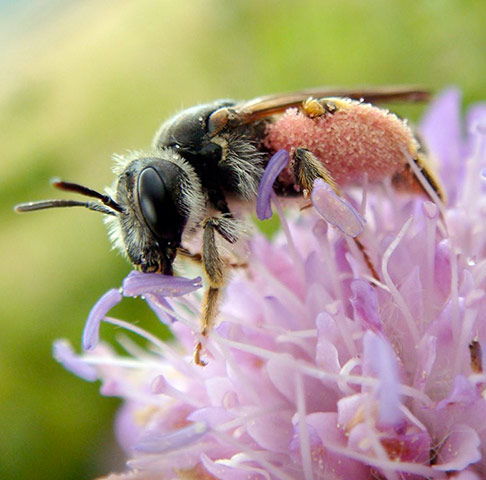
Britain's rarest bees in steep decline - in pictures
Half the global population of the northern colletes bee lives in the UK and Ireland, almost all in seaside locations in habitats such as sand dune, marram dune and machairPhotograph: Jeremy Early/BWARSThe buff-tailed bumblebee uses the empty burrows of mice and other small mammals to nest. While it remains numerous, it is changing its behaviour to produce two generations each year, perhaps due to climate changePhotograph: Nick Owens/BWARSThe tormentil mining bee is a solitary bee that digs burrows. It has declined rapidly and depends on heathland and moorland where its sole source of food - the tormentil plant - growsPhotograph: Sandy__R/Flickr
The bilberry bumblebee has been affected by overmanagement of land and climate change, both of which reduce the flowering plants it needs to complete its lifecycle: the bilberry and legumes such as clover and bird’s-foot trefoilPhotograph: David Whitaker/AlamyThe long-horned bee has extremely long antennae, reaching back along its whole length. It is suffering because of the continued conversion of flower-rich grassland to more intensive agricultural and grassland systemsPhotograph: Steven Falk/BWARSThe scabious bee is one of the largest solitary bees in the UK. It is declining because meadow cutting and grazing regimes do not give the field scabious, upon which it relies, a chance to flowerPhotograph: John Vallender/BWARSThe sea-aster mining bee is only found on the coasts of the eastern English Channel, the Atlantic coast of France and the southern North Sea, making it the UK's most globally significant bee. Coastal development, such as sea defences and urbanisation, erosion and sea-level rise have destroyed many of the saltmarshes it relies on • Man-made English saltmarshes 'failing to meet European plant standards'Photograph: Nick Owens/BWARSThe great yellow bumblebee once inhabited the entire UK but has lost 80% of its range in the last half century and is now restricted to the north and the west of Scotland. This is because of the loss of flower-rich habitats due to the intensification of farming and grazing practicesPhotograph: Nick Owens/BWARSThe female (left) potter flower bee is much darker than the male. This solitary bee is in decline across northern Europe. The reasons remain unclear but are probably linked to the rapid intensification of farming and urban and industrial development since 1945Photograph: Steven Falk and/BWARSThe large garden bumblebee is Britain’s largest bumblebee and has an extremely long tongue. It has been lost from about 80% of its former range over the last century, confining it to central and southern areasPhotograph: Steven Falk/BWARS
Sign up to read this article
Read news from 100’s of titles, curated specifically for you.