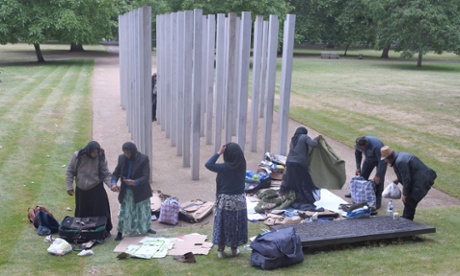
My God, now they are desecrating our memorials! Pictures of “East Europeans”, as the Daily Mail calls them, apparently camping out at the 7/7 memorial in London’s Hyde Park, are the stuff of national outrage as we approach the 10th anniversary of the bombings that killed 52 people and wounded more than 700 on 7 July, 2005.
The photographs undoubtedly show a bizarre moment in the life of contemporary London. Headscarved rough sleepers who look like they have come straight from the eastern European countryside to the British capital have piled their bags of belongings in front of the monument’s contemplative grid of minimalist columns. The cleanness of the memorial contrasts with the mess they have made. Then again, reality is a mess. How do you keep it away from memorials? Should they be sacred spaces protected from the city, which includes homelessness among its sorrows?
I would like to know more about the circumstances in which these people were photographed, for there is something almost stagey about the dramatic “exposure” of what looks like offensive, callous, inhumane behaviour. But leaving that aside, surely criticism should be directed at Hyde Park’s management. If it is imperative to keep this monument clear of inappropriate behaviour, surely there should be nighttime security to prevent anything like this happening?
You cannot assume perfect manners all the time from everyone in a city that never sleeps. Or rather, in this case, where some people have no fixed place to sleep. Why are we meant to be angry about these photographs of human suffering? The homeless campers do not show contempt for anything. They show desperation. They needed somewhere to rest and found it here. Perhaps, for all we know, they said a prayer for the victims of terrorism. Or, more likely, they simply did not know what the memorial was. It is a deliberately abstract monument, plainly designed so it could be a focus for memory without being an ostentatious call to arms: that very modesty helps to explain why someone might misunderstand its nature, especially if they don’t read English.
Even if these tired, cold people did know where they were camping, so what? They obviously only did it to get through another night, and not as some deliberate insult to the dead. Only someone desperate to hate immigrants would fail to see the sad human reality here.
There are many sides to memory. It is a betrayal of memory that makes Britain’s disdain for eastern European migrants possible. If we remembered our history, we would be far more welcoming. We would recall that no nation is an island. For why is being British something to be proud of? Which it is. What was our finest hour?
It was the decision to go to war in 1939 in defence of the peoples of eastern Europe who were being overrun by the Nazi blitzkrieg. It was the subsequent Battle of Britain in which we stood alone against Hitler – and yet not quite alone. Polish pilots played a leading role in the Battle of Britain and pioneered the most effective tactics against the Luftwaffe. Where is that heroism in the national memory? Britain is constantly unveiling new monuments to our stand in the second world war but the most timely memorial right now would be a big one for the Polish pilots who helped save us in the summer of 1940. That might make some people think before they get angry.
The failure of memory goes even deeper. We are forgetting our very identity. Britain proved itself much more than a selfish imperial power of inward-looking little England in 1939. It did not have to fight Hitler then. It may never have “needed” to fight him. Hitler’s central policy was the pursuit of Lebensraum in the east. He might have built his monstrous empire in eastern Europe and let us rule ours in Africa and India. In 1939, separated from Europe by sea, we could have stood aside – as the US did until it was attacked itself at Pearl Harbor. But we were so much better than that.
The sheer altruism and European solidarity of Britain’s bravery in the second world war has been tragically forgotten. So, apparently, has the almost unimaginable suffering of the people of eastern Europe not only in the war, but afterwards under Stalin’s iron heel. A wall of narrow ignorance has descended. It is plain that many Britons have no idea of the massacres and cruelties inflicted in the killing fields of Hitler’s and Stalin’s empires, the terrible scars on so much of our continent.
Wherever these “East Europeans” come from, you can bet it was somewhere that saw horrors Britons would find hard to imagine, even in the murderous 20th century. We cared about that in 1939. We should remember it now. But we choose our memories carefully. We edit out the altruism of our own past and the suffering of others. We are offended at this apparent slur on memory, but forget the history that should make us proud to be generous and welcoming.
• This article was amended on 2 July 2015, after readers pointed out that there is a Polish war memorial in the London borough of Hillingdon, and others in the UK. To clarify: the author of the article was referring to the lack of a large memorial in central London, but the words “a big” were lost in the editing process; they have now been restored to the article.