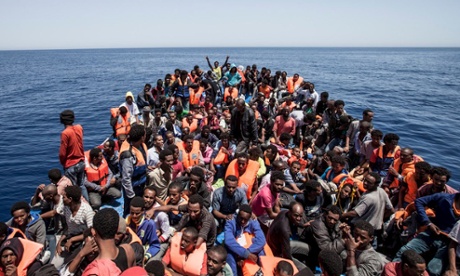
Britain is replacing the Royal Navy flagship that has saved the lives of more than 2,900 Mediterranean migrants with a survey vessel just half the size.
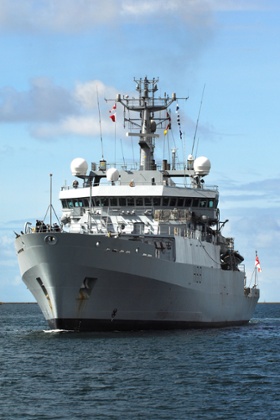
The HMS Enterprise, which is 3,700 tonnes and 90 metres long, will take over from HMS Bulwark – 19,000 tonnes and 176m – as part of what the government has called its “intelligence-led effort” in an attempt to tackle the migration crisis.
A team from GCHQ will also work on identifying the smugglers helping migrants enter Europe from Africa and the Middle East.
Downing Street said HMS Enterprise would help by gathering intelligence “while continuing to rescue people as necessary” but it would appear to be a deliberate scaling down of capability.
The announcement of the replacement is likely to disappoint campaigners who want the government to play a meaningful role European Union’s search and rescue operation in the Mediterranean. Italian coastguard officials said in May that the EU needed to make saving lives a priority, after the Mare Nostrum search and rescue programme ended in November 2014.
David Cameron sent HMS Bulwark to the Mediterranean on 23 April, after widespread concern about the rising death toll among migrants making the perilous sea crossing to southern Europe, and it has been used in dozens of rescues since.
But the Ministry of Defence said the flagship’s involvement was only planned to last for 60 days.
HMS Bulwark is an assault ship with 325 crew and has flight deck space for two large helicopters, as well as a landing dock for Royal Marines to launch operations in small boats.
Enterprise is a survey vessel with 48 crew and has space for a single motor boat and helicopter landing pad.
The survey ship has been used in the Gulf of Aden monitoring the Somali coastline, as well as scientific missions such as mapping the seabed of the Persian Gulf.
A Downing Street spokeswoman said the government was determined to “do more to better understand the smuggling network and business model”. She said the involvement of GCHQ will help identify organised crime groups, as well as their routes and methods.
“The information uncovered by analysts will be used to help disrupt those orchestrating the smuggling, and could pave the way for the second phase of the operation which would involve intercepting smugglers’ vessels on the high seas and – subject to agreement from others – in territorial waters, and impounding their vessels.”
Italian police have already amassed a large amount of intelligence about people smuggling operations. The British government has been under pressure from other European countries to help in the relocation of some of the 54,000 migrants who have landed in Italy so far this year.
Both David Cameron and Theresa May, the home secretary, have refused to have any involvement.
EU foreign ministers are due to meet on Monday to sign off on a new joint naval operation in the Mediterranean.