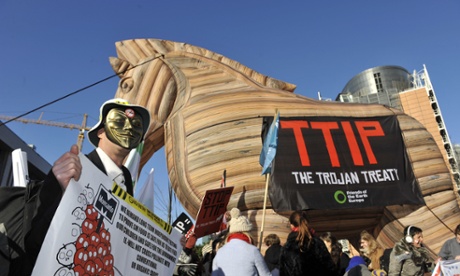
Not all the talk in Brussels this past week has been about Greece. The other hot issue is the Transatlantic Trade and Investment Partnership, or TTIP for short. Not since the Tory party split over the repeal of the Corn Laws in the 1840s has trade been such a sexy issue. There was an unprecedented response when the European commission held a public consultation, virtually all of it negative. Labour MEPs say it comes up often when they are canvassing – almost certainly a first for a trade deal.
The reason TTIP is contentious has nothing to do with what it would mean for tariffs, which are already low on goods traded by the EU and the US. Nor does it really have that much to do with the real meat of the negotiations, which is an attempt to harmonise regulations on both side of the Atlantic and therefore remove barriers to trade. There are some concerns that this might mean harmonising downwards rather than up, but this would not normally be enough to stir passions.
No, the real problem for TTIP is the investor state dispute settlement (ISDS) mechanism and, at this stage, it looks like a deal-breaker. The rationale is that investors needs protection from their property being seized by a foreign government, and that redress should come from an independent panel.
But, in truth, an ISDS is not necessary when both parties in a deal already have robust legal systems to deal with grievances. There is a strong suspicion that US companies, with their notoriously litigious approach, will use ISDS as a means of putting the frighteners on elected governments. The big concern in the UK is that ISDS would put the NHS at risk, with privatisation of services becoming much harder to reverse.
So while TTIP might boost growth and jobs, ISDS has made the deal politically toxic on this side of the Atlantic. If ISDS is taken off the table, the US will demand concessions in return, diluting the agreement. The alternative, though, is no deal at all.