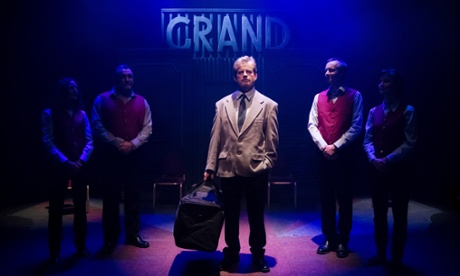
We’re the two Brighton-based co-writers of a play about the bombing of the Grand Hotel in Brighton during the Conservative party conference in 1984. The IRA bomb killed five people and injured many others, some severely. At the heart of the play’s story is the remarkable relationship between Patrick (Pat) Magee, who planted the bomb, and Jo Berry, whose father, MP Sir Anthony Berry, died in it.
This event still stirs up strong feelings for many people and the work Jo and Pat do towards conflict transformation is both lauded and criticised. Our two characters are controversial figures and we have faced dramatic and ethical challenges of writing about real people in a sensitive political context.
Since we started to develop the play three years ago, public interest in theatre that engages with the politics behind current affairs has greatly increased. There is a blossoming of new writing about real events, or fictionalised events based on reality.
What have we learned so far that might be of use to others facing similar challenges? Here are five observations.
Fact v fiction
There’s a continuum that reaches from plays in which actors with headsets speak real people’s recorded dialogue verbatim, to plays “inspired by” real events and characters. Verbatim theatre can reveal and illuminate truths of an event and personalities by close attention to the real speech of people we don’t usually hear on stage. Work inspired by real events and characters investigates human truths predominantly via the imagination.
In both forms there’s scope for blending fact and fiction – real and imagined characters and dialogue – to bring a story to life to find its truth. Our aim with this play was to represent the two main people, Jo and Pat, imaginatively but truthfully – and fictionalise other characters in the story.
In early drafts we found that fictional characters can become so interesting that they overshadow the real lives of the people central to the story. In our production draft we have deliberately lost some much-loved characters, in favour of foregrounding and shaping the parallel stories of our two main people.
Getting permission
It takes courage to approach people to tell you their stories, but it’s worth doing. People are often more prepared to talk about their lives and perspectives than you might think. You don’t require years of playwriting experience behind you, but you do need a good reason to interview subjects, so it’s worth understanding what drives you towards a particular story, personality or group before you approach those involved.
Get permission from the people you want to write about as early as possible and be transparent about how you intend to use what material they give you. When it comes to the interview, have a set of open-ended questions to ask and give people an idea of how long it might take (often longer than you think). Check with interviewees about using their real names if this is important to the play, for example, if they are a hard-to-disguise public figure.
Remember too that minor characters in the play – for example, friends and relatives of your key characters – might not give you permission. You may end up cutting scenes with them in.
Distractions
Interviewing strangers about incredible stories can be fascinating and addictive. You’ll unearth incredible true stories that you simply couldn’t dream up. In writing about the bombing of the Grand Hotel, aside from our main characters, we also interviewed a range of witnesses to the aftermath and investigation, who told us colourful and jaw-dropping stories that simply didn’t fit into the narrative we eventually shaped.
Interviewees will tell you things that lead you on to another person, then another, then another. Be careful not to spend too long chasing stories, which will leave you little time to shape the play itself.
Keeping in touch
Ask for contact details so you can keep people informed of the progress of the play. Invite them to readings and performances. If people are not happy about the way you are representing them, you have choices to make. Generally, if they’re an ordinary private person with no real public profile, it’s hard to make an ethical case for continuing to expose them against their wishes.
If the person disagrees or is put out by their stage representation, even if you feel it’s truthful, you could cut that character from the play, or think again about the way in which you show them. It can be a balancing act to make changes that satisfy all parties without compromising the truth of the piece. Either that or you could just carry on, hope that you’re not sued and make someone who has given you their time very unhappy.
The more public a figure is, the more likely you are interviewing them because of their position or role. In our case, the two people who are our main characters have read drafts of the play and expressed support for it. Neither has asked for a right of veto and they understand that we are aiming to represent them fairly, while also imagining scenes and characters and aspects of their own characterisation. We have often asked ourselves how we would feel if someone was writing a play about us, which brings us to a final and most important tip.
Be respectful
To you this is a play but to those featured in it, this is their lives.
Julie Everton and Josie Melia are co-writers of The Bombing of the Grand Hotel, which is at the Cockpit until 2 May
Join our community of arts, culture and creative professionals by signing up free to the Guardian Culture Pros Network.