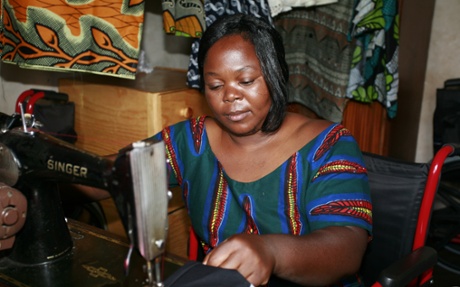
More than 800 million disabled people live in developing countries. That’s more than 12 times the population of the UK. And it is estimated that up to 80% of those who are of working age are unemployed, and many live below the global poverty line of $2 (£1.25) a day.
This is a problem. Not only for these individuals, their families and communities, but also for their countries, which miss out on an estimated 5% GDP each year, according to the UK House of Commons International Development Committee, due to disabled people not having equal access to employment.
At Leonard Cheshire Disability we have been working to change this. Our ‘Access to Livelihoods’ project model supports disabled people in developing countries to access the skills and resources they need to secure a job for the long-term.
With the support of Anglo American’s Group Foundation, we took this model into Zimbabwe in January 2013, and worked with local partners to establish a Livelihoods Resource Centre (LRC) in Harare – a kind of ‘one-stop-shop’ for disabled people looking for work, offering them the support they needed to find a job or to start their own business. Over the past year and a half, this project has trained more than 1400 people and is close to its target of supporting more than 1600 people to enter either paid employment or start their own business by the end of 2015.
Putting this project into action has not been without its difficulties. The economic downturn in Zimbabwe has caused large numbers of employers to close their operations, which in turn has created greater competition for jobs.
In order to respond to this challenge the Harare LRC has focused on supporting disabled people to set up their own businesses to help them gain more sustainable employment opportunities. The support on offer at the LRC includes “soft skills” training which such as how to compile a curriculum vitae, create business proposals; write applications and prepare for an interview. Entrepreneurship development training is also provided, which teaches basic business management, marketing, leadership and accounting.
Following research into local markets, the LRC also provides vocational courses in areas such as agriculture (including rearing indigenous chickens and potato growing), plumbing, artisan crafts (jewellery-making and basket beading), and soap and detergent-making.
One of the people we have helped is Zimbabwean father, Boniface Jinga, who faced a worrying future after he lost his job when he became physically disabled following a road accident and was unable to provide for his family.
Staff from our LRC in Harare met Jinga and supported him to develop his own grocery business through providing tailored entrepreneurial advice.
With business skills training focusing on financial management, the team supported him to manage his business more effectively. They carried out market research and analysis, created a three month cash flow plan, and then supported him to apply for a $300 (£188) loan to restock his business.
As a result his business has grown, and he is now able to support his family, pay for his children’s education, and feels confident about the future. Recently Jinga told us,“I am someone in society now. Anyone can see my life is going back to what it used to be before my accident.”
From textiles to plumbing, setting up stores to rearing chickens, this project has helped disabled people like Jinga to set up a whole range of businesses. As we enter the final year of the project, we look forward to supporting hundreds more disabled people to not only earn an income, but to gain self-confidence and respect within their communities.
Copy on this page is paid for and provided by Anglo American, sponsor of the social impact hub
Other articles of interest from Anglo American: