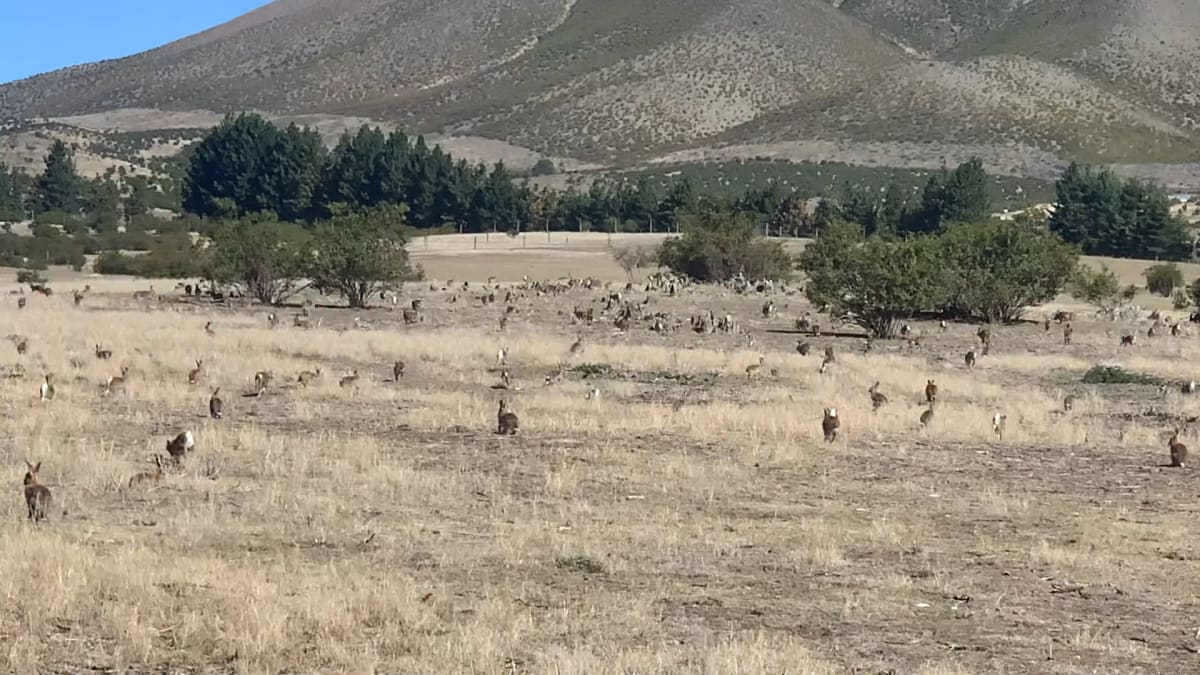
While much of Otago finds itself completely overrun, Maniototo locals have found a way to get the rabbit plague under control themselves - creating some jobs along the way
Finding a way to beat Otago’s worst pest without costing the taxpayer a bomb has eluded the government for decades and the wily rabbit is currently winning the war paws down.
But not so in the Maniototo. There a group of farmers have been quietly getting on with it themselves, transforming vast tracts of badly infested land into a place where few rabbits dare to tread. All this with no cost to taxpayers plus a bit of job creation.
Twenty-four years ago Ossie Brown of Naseby - then a disgruntled Otago Regional Council (ORC) Area Pest Overseer - left his job to help bring together the owners of 250,000ha of farmland to make their own plan.
At the time - the mid1990s - user-pays rabbit control was being introduced by the council. This was an instant recipe for a rabbit disaster, he said, and a better way existed to beat the notorious pest.
The council was gearing up to regulate pest levels, then come in and do control work where required. Brown says his council colleagues were less than impressed with the farmer’s idea, perhaps seeing the group as competition.

They pushed on regardless and quickly gathered dozens of landowners around the table to put together a self-funded, self-managing system that has successfully beaten back rabbit numbers and is still going strong.
“It was surprisingly easy, Brown says. “There were four prominent farmers who came up with the idea and they approached me to see if I would manage it for them. I suppose I had the respect of the farmers in the area and they just went for it. Within a week we had 80 percent to 85 percent on board and now 90 percent of farmers in our zone are in.”
The group created their own pest destruction board, launching Maniototo Pest Management (MPM) in 1997. Around 85 farmers became shareholders, paying a pest control fee based on the size of their property thus avoiding subsidising a larger neighbour. The group took on an area of badly infested hill country about the size of the whole of the Manawatu District. It stretches from Dansey’s Pass backing onto the Waitaki District, across the Maniototo Basin to near Middlemarch to the east, and Lake Onslow on the Roxburgh side.
The early years of fighting the pest on this prone country required expensive, time consuming work, involving some of the largest poison drops ever seen in New Zealand.
“At one stage during the early days we dropped 1200 tonnes off one airstrip, that was before the group started. To put that in perspective a big truck and trailer takes about 26 tonnes and there were trucks and trailers going in and out for two weeks. After the group started we were putting 1000 tonnes of carrots on every year.”
The calicivirus, illegally introduced in 1997, helped the cause and Brown said rabbit numbers dropped every year. The land began to recover – a slow process, he says, usually taking 10 to 15 years.

Once they had the bulk of the rabbits beat, poisoning was replaced by night shooting and helicopter patrols, with many places now only visited twice a year.
“We were at a very, very large property recently and they only got 14 rabbits in a four-hour period with the helicopter. We asked the farmer what he reckoned and he said too many, do it again.”
Brown believes shooting in heavily infested areas is a waste of time and money as rabbits can breed replacements faster than shooters can reduce numbers. Poisoning first with very low concentrations of 1080 then following up with shooting saved money and allowed the land to recover.
Rabbit-proof fencing, he says, should only be seen as a temporary barrier as the pests would eventually go under or jump clean over if there was something on the other side they wanted to get to.
“We’ve got the cheapest rabbits here now, that farmers are ever going to get because we only have to go once or twice a year. In some parts of Central they’re paying $150 or $200 a hectare to poison and that’s a colossal cost. It’s going to cost them millions and millions of dollars now and all the soil is blowing off into rivers and streams. It’ll take 10, 15 years for that land to recover. It’s buggered.”
The Limited Liability company has become an Incorporated Society for ease of management and an accounting firm takes care of the books. The group have just employed a new manager and Brown, who's 65 and now a pest advisor for the group, is looking forward to stepping back from the day-to-day work. He says vigilance is needed by all to prevent further land damage everywhere rabbits are present.

“The rabbit problem has been like a festering sore in Otago for years. Central Otago may not have seen the worst of it yet and if there’s a drought year they are going to do something really nasty. Rabbits don’t have a conscience and they’re very honest. If you dick around with them they make you look like an idiot.”
Rabbit numbers currently exploding outside the western and eastern boundaries of the MPM’s patch, is a growing worry for Kyeburn farmer Hamish Mackenzie. With numbers inside the zone down to manageable levels, neighbouring properties and private forestry blocks are still providing the pests with opportunity to breed up and spread.
In the past every small area had its own Rabbit Board - Naseby, Kyeburn, Patearoa and more. The whole place was covered but when these were disbanded by the ORC, work became disjointed, Mackenzie, who is a Director of MPM, said.
The success of MPM, he reckons, lies in having good management and in relentlessly keeping at it.
“It’s quite a clever set-up where you drip feed money into your own property account that the company holds in the bank and it’s only used on your place. It hasn’t all been easy, we’ve had a few issues but we have a pretty good group of people and they’re all people who have a passion for it.”
The Mackenzie’s 3500ha farm runs sheep and beef and like other MPM shareholders, the family have seen drastically reduced rabbit numbers.
“They are at low levels now purely because it is a continuous programme - little and often.”
Both Brown and Mackenzie felt the Otago Regional Council had been thoroughly unsupportive historically and ineffective in managing the pests over recent decades.
“They didn’t want to let something like this set up, they thought it would fail but these days we are building a better relationship with them and they want to use the model.”
ORC manager biosecurity and rural liaison Andrea Howard did not wish to comment on how the council responded to the initial set-up of MPM but confirmed the model could be successful in other areas in Otago.
“Staff are in regular contact with Maniototo Pest Management Limited and ORC occasionally uses Maniototo Pest Management Limited for some contract work. Along with the ORC general manager of operations, I met with Maniototo Pest Management Limited in 2020 and, amongst other things, discussed how their model may be applied to other rabbit prone areas.”
She said it appeared to be a viable solution to the current need to reduce rabbit numbers.
“We have commenced these discussions with the communities of Lake Hayes and Albert Town and will be working our way through other parts of Otago as quickly as we can. We will also be providing information for communities who wish to proactively establish such a model without facilitation help from the Otago Regional Council.”

In Southland a similar group of disgruntled farmers followed the same path back in the 1990s, facing the same resistance from their regional authority. They too have lasted the distance, destroying tens of thousands of rabbits and other pests.
The Southern Pest Eradication Society later began working with Environment Southland (ES) to make their landowner pest levy compulsory.
When membership was voluntary, 90 percent to 95 percent joined but the 5 percent not in the scheme had provided a place for rabbits to breed and spread. The compulsory levy is now collected on behalf the society by ES through its regional rates.
Life member Ken Buckingham, 78, of Waimahaka said rabbit boards had done an excellent job historically in keeping numbers down but when they were disbanded the rabbits starting “sneaking back in”.
“There were enough of us old fellas still around who could remember when rabbits were endemic. We weren’t prepared to watch as the rabbits came back under the regional council’s plan.”
He said under the plan, properties would get up to level 3 to 4 on the Modified McLean Scale before the council advised owners to act.
“All of a sudden you had a problem there.”
The 300,000ha zone covers all the land east of the Mataura River to near the Otago Southland provincial boundary and is covered by three full-time pest controllers.




.png?w=600)