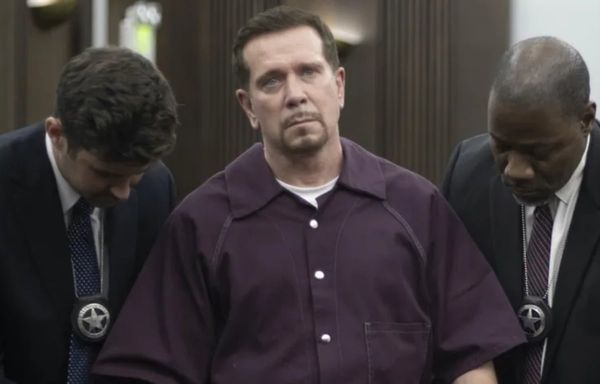
April 14--More than two decades after he was sentenced as a juvenile for a double murder, Adolfo Davis returned to a Cook County courtroom Monday to learn if he will spend the rest of his life in prison or possibly could be freed soon.
He is one of the first of some 80 Illinois inmates to be resentenced because of a ruling by the U.S. Supreme Court finding mandatory life sentences for juveniles to be unconstitutional. He showed little reaction as the high-stakes hearing got underway at the Leighton Criminal Court Building.
Testimony could take up much of the day, but it is unclear if Judge Angela Petrone will impose a new sentencing Monday or delay her decision.
Prosecutors want the judge to impose a life sentence again, while Davis' lawyers are seeking his immediate release.
Assistant State's Attorney James McKay argued to the judge that Davis, then 14, was fully involved in the murder, helped plan the robbery and even fired a gun.
"This defendant was not a naive, scared, merely present lookout," McKay said.
His attorneys disputed that Davis had fired a gun, describing him as a troubled youth who was lured into the violent gang activity a quarter of a century ago.
"He was a follower," said attorney Patricia Soung. "He had a desperate need for a sense of belonging."
In his more than two decades in prison, Davis has rehabilitated himself, Soung said. Previously, she has said he renounced his gang membership, got an education, wrote poetry and helped steer youngsters away from gang life.
"The question today is how much punishment is enough," she told the judge.
Among the first witnesses was a victim of the shooting who said he ducked for cover as shots rang out in October 1990. But he said he saw Davis open fire as well.
An eighth-grader from a troubled home, Davis had fallen in with a street gang on the South Side when he took part in a 1990 robbery in which two men were killed.
The U.S. Supreme Court decision in 2012 built on an increasing body of scientific and social research that found that the brains of teens were less developed than those of adults, giving them less impulse control, and that youths were susceptible to peer pressure and other forces that could lead them to commit such heinous crimes without considering their consequences.
Some of the state's most notorious murderers will be among the inmates given new sentencing hearings: David Biro, who was 16 in 1990 when he forced a pregnant woman and her husband into the basement of their Winnetka home and shot them as they pleaded for their lives, and Christopher Churchill, who was 16 in 1998 when he used a hammer to kill his half brother, the man's girlfriend and her three children in southern Illinois.
But the sentencing hearings no doubt will reopen emotional wounds for the families of victims.
The sentencings were mandatory for the juveniles because of their convictions on multiple murders or other factors. Most of the convictions came in the 1980s and '90s.
Some of the inmates will point to the fact that they played lesser roles in the murders and were convicted under laws that held them accountable. Others insist they have uncovered convincing evidence that proves they are innocent and have been trying all along to win freedom by unraveling their convictions.
Many are the products of poverty and abuse, the kind of information that could not be considered when they were originally sentenced but will be in the new hearings. Many others have turned their lives around while in prison, according to their lawyers, and hope to show a judge that they have been rehabilitated.
asweeney@tribpub.com