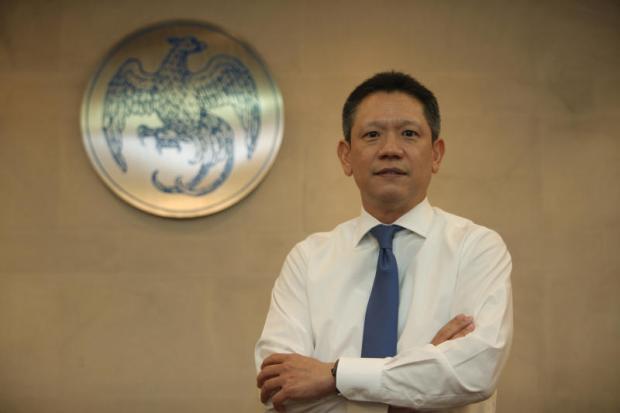
Job advertisements that showed senior and junior public servants working together at the Fiscal Policy Office (FPO), later circulated through social media to entice millennial talent to the Finance Ministry's think tank, provide a window into the modern-day management practices under Lavaron Sangsnit's leadership.
A reduction of the generation gap at the FPO is one of the attentions of Mr Lavaron, who has spent most of his 28-year career there and climbed to the top post last year.
"I'm Generation X, which followed the baby boomers but came before millennials," he says. "The baby boom generation has communication problems with Gen Y, while Gen X is in between. Gen X must know the art of talking with the next generation, so it's necessary to catch up with trends. We must know what the hot issues are in technology, IT, clothing. Personally, I follow these trends, so the gap with them is not so much."
Since the FPO cannot attract young job-seekers with big-ticket salaries and flashy benefits, Mr Lavaron tries to create a positive work environment with interesting and challenging tasks.
"For example, in the past people called this room [the director-general's working room] the slaughter room, but the room's environment has changed," he says. "Its atmosphere has becomes comfortable and it no longer has pressure. Any officer can walk to the room to eat snacks or chat with me.
"The FPO's task can't be done alone, so we must work as a team. However, one of the restrictions of talent is that some people don't work well with others, so breaking the barrier is a must to create a teamwork environment."
The FPO currently has 300 state officers and 150 employees.
Unlike most holders of an economics degree in his generation, Mr Lavaron started his career in the public sector, which offers far-lower salaries than the private sector.
After completing a master's degree in economic policy and planning at Northeastern University in Boston, he was drawn to the Finance Ministry by former finance minister and ex-Bank of Thailand chairman Virabongsa Ramangura, who had previously been his economics teacher at Chulalongkorn University.
"Mr Virabongsa, who was a deputy finance minister at that time, approached me to be his assistant," Mr Lavaron says. "After I worked there for a year, former finance minister Suthee Singhasaneh suggested I be a public servant if money wasn't an issue. He told me that working at the FPO would suit me well, so I took an exam when a job at the FPO opened up."
People working at finance and securities firms before the 1997 economic collapse took home big paychecks and bonuses, but Mr Lavaron decided to work in the public sector to change the country for the better.
"A civil servant's salary doesn't allow us to maintain talent as much, but the challenging work and chance to improve the country make people want to work at the FPO," he says.
The Asean Free Trade Area (Afta) was Mr Lavaron's biggest challenge, as he was among the first public officers involved in the issue, while the establishment of the Catastrophe Insurance Fund is his proudest achievement.
He recalls having to pick which tariffs on products would be eliminated or reduced.
"Free trade was a new issue for Thailand in 1992, and I drew up a product list by myself," he says. "I had to sit at the [Finance Ministry] IT centre for months, as the task needed a large computer system until a unit associated with Afta was set up."
The insurance system in Thailand nearly stalled after severe flooding in 2011 caused an estimated 1 trillion baht in damage, as most insurers did not provide sufficient natural disaster coverage. The FPO launched the Catastrophe Insurance Fund and Mr Lavaron helped put it into practice. (The fund is now defunct after the insurance system returned to normalcy.)
Apart from Afta and the Catastrophe Insurance Fund, Mr Lavaron took part in carrying out two policies that reshaped the country's tax system: value-added tax and land and buildings tax. Even so, the FPO remains unsatisfied with efforts to cope with growing expenses incurred by welfare and the ageing society. Tax revenue now accounts for 15% of Thai GDP, well below the target of 20%.
Maintaining balance is pivotal to a high-pressure job like Mr Lavaron's.
"My philosophy is balancing work and life," he says. "It shouldn't be too extreme in either working or living. I don't take work home. In the event of an urgent job, I must complete it at the office. I consider the home a place where I take a rest and spend time doing other things like talking with my parents, playing with the dogs, listening to music and watching movies."
Part of achieving that balance is working smart and delegating assignments.
"I allocate non-urgent tasks to others," he says. "All jobs should not be concentrated in the director-general. The FPO has three advisers and three deputy director-generals, and I decentralise them with signatory powers. It isn't essential for me to be aware of unimportant policies, money and issues that don't seek cabinet approval. We have a Line chat group of FPO executives where we can text one another without participating in meetings."
With the group chat, Mr Lavaron can lower the number of face-to-face meetings dramatically and cut down on time spent on introductions.
"Whatever jobs can be done in the chat room, I'll do it," he says. "It's my working style and it allows me more time to think. Unlike former director-generals of the FPO, my desk is not filled with 20 file folders a day; I manage to halve it."
The 52-year-old says he climbed to the top of the FPO ladder in a traditional manner, without skipping any ranks during his 25 years at the office.
"A public servant's duty is proposing what should be done to the government, which takes charge in making the decision," he says.