Airports and rail networks dominate most discussions about transport infrastructure. Flight paths are tracked in real time, rail corridors are documented down to individual stations, and road traffic data is widely accessible. Ferry routes, which carry millions of passengers and vehicles every year, remain far less visible on a global level.
This lack of visibility is not because ferries are marginal; rather, it is because they are often overlooked. Across Europe, Asia, North America, and island regions worldwide, ferries form a dense web of short crossings, overnight routes, and long-distance sea connections. In many regions, they are essential links rather than optional alternatives. The challenge lies in how this information is collected, structured, and presented.
Tools that attempt to map ferry routes
Several tools can be used to understand ferry connectivity, but each comes with limitations.
General-purpose platforms, such as Google Maps, often include ferry crossings, typically where they serve as part of a road network. These routes are often simplified, inconsistently labelled, or missing entirely, especially for international or seasonal services. Long-distance ferry routes and passenger-only connections are frequently absent or outdated.
Open data projects such as OpenStreetMap provide a more flexible foundation. Ferry routes can be mapped in detail, including terminals and connections, but coverage depends heavily on local contributors. As a result, some regions are well-documented, while others remain incomplete or inconsistent, particularly where routes change frequently or operators publish limited public data.
More specialised tools, including platforms like Ferryroutes.com, focus specifically on ferry networks. These tools aggregate route data across regions and operators to provide a higher-level overview of how ports, routes, and countries connect by sea. Rather than replacing local operator information, they aim to make the network's structure visible at scale.
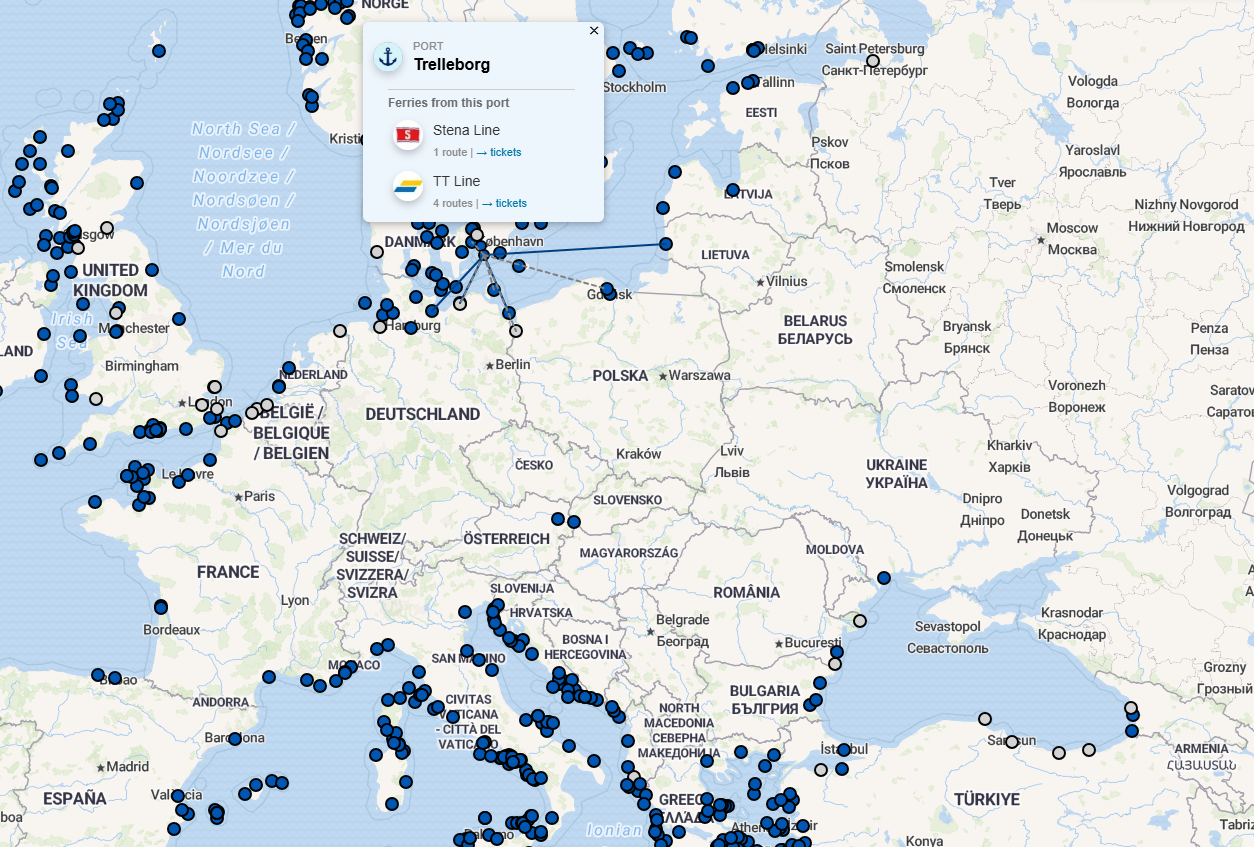
Why is ferry data difficult to keep up to date
Ferry networks differ significantly from aviation and rail. There is no single international registry of ferry routes. Services are operated by thousands of public and private companies, many of which run seasonal schedules or adjust routes based on demand, subsidies, or weather conditions. Ports themselves can host multiple terminals, each serving different operators and routes.
This fragmentation makes ferry data inherently fluid. A route that exists for one year may disappear the next, while new connections can appear with little notice. Static maps struggle to reflect this reality, which is why many general mapping platforms lag behind actual operations.
Who benefits from better ferry mapping tools
For travellers, tools that visualise ferry routes help answer practical questions that are often difficult to resolve through individual operator websites. These include the existence of international crossings, the location of major ferry hubs, and the alignment of sea routes with road and rail infrastructure.
For researchers and policymakers, ferry maps offer insight into regional dependency on maritime transport. They help identify critical links, underserved regions, and areas where ferries function as lifeline services. This becomes increasingly relevant in discussions around resilience, climate policy, and contingency planning when land-based infrastructure is disrupted.
An overlooked but essential network
Despite their scale, ferries rarely feature in global transport narratives. They lack the constant visibility of airports and the symbolic status of high-speed rail, yet they sustain daily movement across the seas worldwide. The network itself is not hidden, but the tools to understand it holistically have long been limited.
Mapping tools alone do not solve operational or policy challenges. They do, however, make the ferry network visible in a way that allows it to be analysed, compared, and discussed alongside other modes of transport. In doing so, they help position ferries where they belong - as a core, if often overlooked, part of global transport infrastructure.