The Bangkok Post Learning Community section is for stories written by our readers. If you have a story idea that you think would be interesting to our Learning community, send us a message on our Facebook page.
This story was written by Sophia Lohstapornpipit, a student at Concordian International School.
In Thailand, inclusive education for visually impaired students continues to face structural challenges, from limited access to learning resources to the societal barriers that restrict opportunities in higher education and employment. Many student-led initiatives designed to “help” blind schools often remain surface-level, providing donations or short-term volunteer work without long-term impact. Seeking a deeper and more sustainable solution, I founded Focus First—a peer mentorship program uniting sighted and visually impaired students in a shared journey of learning and exchange.
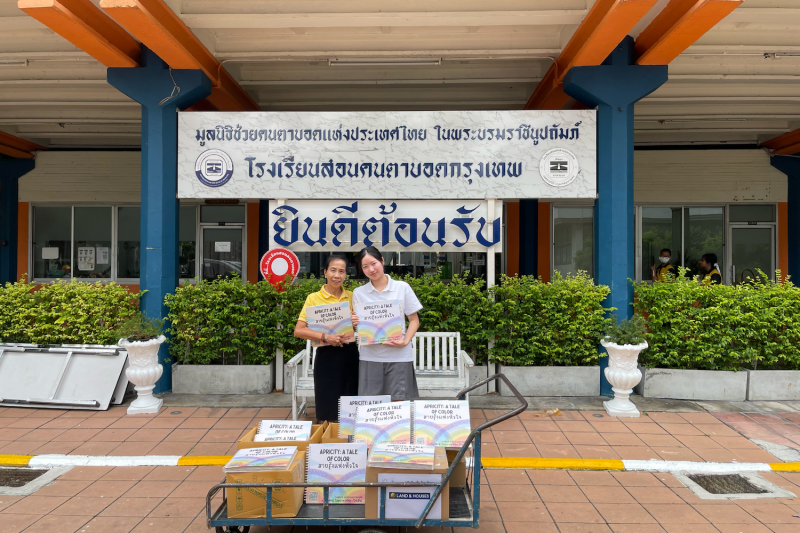
The idea for Focus First grew from my earlier project, Apricity: A Tale of Color, a bilingual English-Thai braille storybook I wrote, illustrated, narrated and published with the Educational Technology for the Blind Center in Thailand. With more than 200 copies now distributed to blind schools across Thailand, the book revealed how imagination sustains visually impaired children—helping them assemble a picture of the world through fragments of sound, touch, taste and smell. Encouraged by veteran educator Kru Won, who has spent more than 40 years teaching visually impaired students, I expanded my vision into a program designed to bridge the divide between sighted and blind communities.
The limitations of visual impairment education in Thailand are complex. Many underfunded schools struggle to access adapted textbooks or braille materials, while subjects that rely on visual aids, such as sciences, often cannot be fully translated into accessible forms. Integration into society is another hurdle, with many visually impaired graduates finding opportunities only in vocational training and service work, rarely in professional industries.
Focus First was built to address these challenges directly. Structured around the disciplines of science, art and music, the program follows a “teach–share–hands-on” model. Each session begins with sighted mentors teaching a subject through a tailored curriculum. This is followed by a discussion where ideas and life experiences are exchanged, allowing sighted students to share personal perspectives that visually impaired students might not otherwise encounter.
Finally, sessions conclude with hands-on activities, such as germinating seeds or sculpting clay, which provide practical, memorable engagement with the subject matter and bring theoretical concepts to life.
By situating itself within the frameworks of United Nations Sustainable Development Goals 4 (Quality Education) and 10 (Reduced Inequalities), Focus First highlights how peer-to-peer engagement can create both educational and social impact. Rather than treating visually impaired individuals as passive recipients of aid, the program positions them as active partners in reciprocal learning.
Where many service initiatives stop at temporary support, Focus First aims to build lasting change. In doing so, it provides a model for inclusive education that enriches both sides of the mentorship relationship and offers a pathway toward a more equitable, compassionate society.