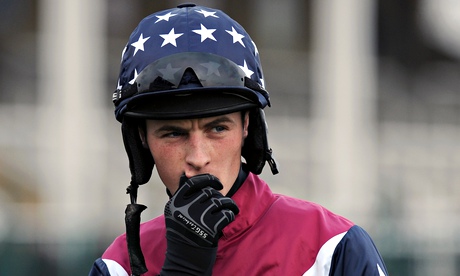
Brian Toomey has been passed fit to return to race-riding, two years after a fall that came close to killing him and which left him with a severe head injury. Toomey, now 26, has been told he was essentially dead for six seconds at one point after the incident at Perth on 4 July 2013, when he and Solway Dandy took a crashing tumble at the third-last in a hurdle race.
It has been known for more than a year that Toomey wished to return to his former occupation but there were considerable doubts about whether he could recover well enough to pass the necessary tests. Now that he has satisfied officialdom, it is just a matter of time before he is back in the weighing room, though Toomey said on Monday that the big day was unlikely to come in the next fortnight.
“I’ve been riding out for a long time,” Toomey explained, “but I’m still not what I would call 100% race-fit. I’m going to work extremely hard on that to make sure I get there before I ride in a race and make sure I’ve got all the right people behind me.”
Toomey says he has ben riding out every day for the North Yorkshire trainer Phil Kirby. “Phil’s an exceptional man, a friend of mine rather than a boss,” he added, and the likelihood is that Kirby will supply his first ride back, once Toomey has decided he is ready.
“Following the accident, the paramedics said that I was dead for six seconds, but they managed to resuscitate me. Then when I made it to the hospital they thought that I only had a 3% chance of survival.” Toomey was given surgery to reduce swelling on his brain that involved the removal of part of his skull.
“I know there will be people who will say I’m mad to want to come back but it’s been my dream since I was a boy to be a jockey and it’s a job and life I love, and I was absolutely determined that, if I couldn’t make it back, it wouldn’t be through a lack of effort on my part.”
Toomey made a point of thanking staff at Ninewells Hospital, Dundee, as well as his family and friends for supporting him in his recovery. “I hope what I’ve been through can serve as an inspiration for others who injure themselves and are told that they might never return to doing what they love. Work hard and never give up and you just never know what could happen.”
Dr Jerry Hill, the chief medical advisor to the British Horseracing Authority, said that Toomey had been tested for his physical and mental capacities as thoroughly as any applicant for a jump jockey’s licence, with no allowance being made for the fact that he had been injured. “The safety of our competitors is paramount in British horse racing and we have a duty, as far as is possible, to ensure any returning jockey is fit to safely control his horse and that he and his family understands the risks that he or she may be taking in race-riding,” Hill said. “Brian has shown through his medical assessments and physical tests that he is fit to ride again.
“The fact that Brian is still alive is a testament to the first-class medical care which exists on British racecourses. It is very likely that the team of doctors at Perth, with their rapid and decisive response, saved Brian’s life. To now be returning to ride again in Britain two years on, and having met all of the demanding criteria required of him to do so, is a quite remarkable story and an illustration of his determination and bravery.”
A list of big-name trainers appear to have assisted in Toomey’s imminent return to action, as the BHA said he had been riding work for Willie Mullins, Jonjo O’Neill, Enda Bolger and Nigel Twiston-Davies. He has also spent time at Oaksey House, the impressive rehabilitation facility built in Lambourn by the Injured Jockeys Fund.
Officials at Epsom expressed satisfaction with the two-day Classic meeting at the weekend and Rupert Trevelyan, the Jockey Club’s regional director, defended Channel 4, whose average Derby audience of 1.47m was a new low. “I watched the programme yesterday and I thought the quality of it was fantastic,” Trevelyan said. “Although the figures are roughly on a par [with 2014], the share was up, so, of the available TV audience, we got more.”
While all such matters will be reviewed, Trevelyan said there were no plans for a later start-time to the race, which could help improve the TV audience. And he spoke up for the on-course electric violin rendering of Led Zeppelin’s Kashmir which preceded the race and rather divided opinion, adding to the atmosphere for some while irritating purists.
“The majority of the feedback we’ve had has been very positive. Clearly, one or two people are concerned. The most important thing is that we have to maintain the Derby in its rightful place in the minds of the nation. We are up against other sports that do put on a very good show and we have to make sure we can compete with those sports. I’ve not formed a final view on it but the initial feedback has been more favourable than not.”