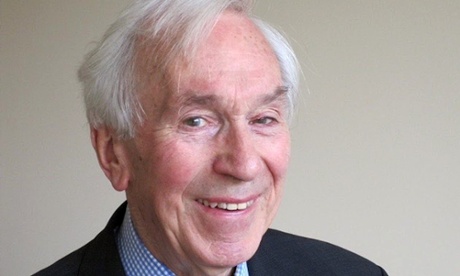
Brian Groombridge, who has died aged 89, championed the cause of lifelong learning as a researcher, writer, broadcaster, director and academic. His encouragement of ways through which adults of all ages might develop their talents and interests was a big influence on the development of adult education in the UK and internationally.
From 1960 he was a freelance writer and presenter of educational programmes for BBC radio and ABC television, and from 1964, as its deputy director, he increased the involvement of the National Institute of Adult Education (then NIAE, now Niace, the National Institute of Adult Continuing Education) in broadcasting. He was on the planning committee of the Open University, the world’s first successful degree-giving distance-learning body, which in its early years made great use of BBC radio and television at either end of the day. In common with the social activist Michael Young and the prime minister, Harold Wilson, Brian wanted to expand the opportunities of people who had not gone to traditional campus universities: realising their vision started in earnest in 1967 with the establishment of the planning committee, and four years later the first students were admitted.
In 1968, Brian became head of education programmes for schools and adults at the Independent Broadcasting Authority. His book Television and the People (1972) explored how the medium was being used, and could be used, to encourage educational and democratic engagement. For those of us on his small team at the IBA, his work opened up exciting educational possibilities, using mainstream peak-time programmes not classified as educational output. Thus, when supported by educational materials and activities, an insignificant costume drama served as a basis for further study. Social action programmes – a new departure – often relied on the cooperation of external agencies for print follow-up and support activities. Youth unemployment was one such topic and, encouraged by Brian, staff from ITV and Independent Local Radio worked with careers officers and others to better meet the needs of normally disengaged young people.
In 1969, the Department of Education and Science set up a committee on adult education chaired by Sir Lionel Russell, and Brian drafted the sections on broadcasting in its 1973 report, which drew attention to the needs of marginalised groups. His IBA work helped public service programming to flourish across the 15 independent companies of the ITV network, for adult audiences who might have found the prospect of going to classes forbidding. This approach helped later to shape the education policies of Channel 4, which opened in 1982, and of the European Broadcasting Union.
One of Brian’s early initiatives on being appointed professor of adult education at the University of London in 1976 was an education seminar with Finnish television; one of his last was to chair a team using European Space Agency satellite technology for international cross-border education. He was also director of extramural studies, which brought opportunities for collaboration with other bodies, notably the Open University. The extramural service was the UK’s largest, and in 1988 joined what is now Birkbeck University of London. Brian retired as professor emeritus in 1991.
Born in West Ham, east London, Brian was the son of Gerald, who was involved in the property business, and Jane (nee Watkins). The family lived in Leyton and then Ilford. When Brian was 14, his parents thought that he would become an officer worker: they were music lovers but – excluding a Chambers Dictionary and a gardening reference book – their home was bookless.
The blitz transformed Brian’s limited prospects when, instead of being evacuated to Somerset with his school, he was sent to stay with relatives in West Sussex, where he attended the remarkably progressive Midhurst grammar, a school where pupil voices were actively encouraged and where Brian and others discovered their potential. The result was a scholarship to Christ’s College, Cambridge, where he studied philosophy and psychology, and then history. His degree was interrupted when he volunteered for the RAF, and he graduated in 1948. The positive and democratic approach to education he experienced at Midhurst was to underpin all his professional life.
In his first two full-time jobs, from 1951, he ran centres in Letchworth, Hertfordshire, and Rugby, Warwickshire, for the democratic Educational Centres Association. University and local education authority courses rubbed shoulders with Workers’ Educational Association groups, arts and crafts and drama, according to student demand. It was an inclusive, non-elitist, informal environment.
In 1957, Edward Hutchinson, director of NIAE, invited Brian to research Education and Retirement (1960), the first British work to recognise the importance of education to the enjoyment of leisure. His subsequent freelance activities continued work with partners not associated with mainstream education – the Seafarers Education Service, the Cooperative Union and the Research Institute for Consumer Affairs, now Rica, founded in 1963 by Young.
Ideas that the two were pursuing in the 1960s tied in with developments in France during the 1970s, and following his return from a trip to Toulouse Brian introduced Young to the concept of the University of the Third Age. In 1981, with Peter Laslett in Cambridge and Eric Midwinter of the Centre for Policy on Ageing, they embarked on establishing the University of the Third Age (U3A) in Britain. All U3As are autonomous: the following year Brian co-founded and chaired a group in the capital, U3A in London.
A pro-European internationalist and Unesco adviser, Brian was involved with Czechoslovakia during the Prague Spring of 1968, and in later life continued to build cultural bridges with Finland, recognised through his being made a Knight of the White Rose of Finland (1999). At home he worked with Help the Aged, now Age UK, and Better Government for Older People. Interested in everybody and everything, he was great company and a wonderful friend.
Brian is survived by his wife, Joy (nee Samuel), whom he married in 1961; by their sons, Edward, Tim and Joe; and by Nicholas and Ellie, the children of his first marriage, to Yvonne Watkins, which ended in divorce in 1960.
• Brian Hughes Groombridge, adult educationist, academic and broadcaster, born 24 April 1926; died 6 July 2015