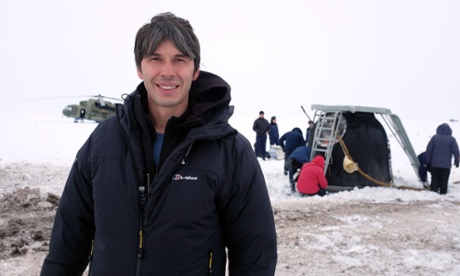
There’s something unnecessarily anthropocentric about the title of Brian Cox’s new show, Human Universe. Given there are more bacteria on Earth than people, the show could just as easily be called Salmonella Galaxy but I’m guessing that wasn’t thought to be as catchy.
Patting Homo sapiens over-enthusiastically on the back (of which more in a bit) is the only gripe I had with the show’s otherwise excellent first episode. Naturally it had all the Brian Cox tropes, which you’ll love or hate: the half-man half-silhouette wandering past gorgeous vistas, scattering mind-boggling facts in his wake like a tourism ad directed by Doctor Who.
The visuals alone are a great watch but there are revelations that make this fresh take on evolution even more compelling. Jumps in human brain size, Cox tells us, may have been responding to bursts of violent climate change, itself contingent on periods when the Earth’s orbit was at its most elliptical. That orbit owed itself to the makeup of our solar system, including the Earth’s relationship with the moon. And it’s the way these climate shifts were felt in the Great Rift valley that prompted our brain’s growth.
Before our evolution could even begin, an improbably long line of causal dominoes needed to fall. It’s humbling to think that if the moon were a bit larger – or a bit smaller – we might all be really stupid. What an inconspicuous connection! It’s like finding out we don’t die in our sleep every night thanks to the shape of Hawaii.
Putting human beings in their place using astronomical scale is one of Cox’s great gifts and a reason I’ll keep watching, but the praise he heaps on us for our abilities to travel into space seems a little over-egged.
There’s unnecessary boastfulness: “Why is it that we alone have ventured into space?” I don’t know, Brian. I’m sure prawns are trying their hardest; maybe they’re just crap pilots. He then goes on to declare humanity is a “space-faring civilisation” which makes me feel like a right idiot for going everywhere by bus.
Sure, for the sake of a Kubrick-esque narrative arc, it’s neat to go from spearhead to spaceship, an enormous leap in our technological abilities encapsulated perfectly by this opening episode’s closing moments. But space travel is still a somewhat forced purpose for humankind. There are lots of practical failings we haven’t remedied yet, such as how to embrace solar energy – something carrots figured out ages ago.
And if giraffes were singlehandedly obliterating the environment while drone-striking gazelles, I doubt we’d hold them in high regard as they fled their mess by blasting off into space: “They ruined everything but they do craft a fancy escape pod. Gotta give ’em that.”
We’ve come a long way and this show demonstrates that fact best when it focuses on where we started rather than fostering an infatuation with where we’ve ended up. Yes, 533 humans have orbited the Earth, but 4 million people pre-ordered the iPhone 6. It’s hard to praise humanity based on its ventures to stars that most people can’t be bothered lifting their heads to look at.
Then again, maybe that’s why we need more shows like this.
• The next episode of Human Universe airs on ABC1 on 14 January at 8.30pm. Catch up with the first episode on iView