Rugby league is no stranger to code swapping but in 2013, long before Jarryd Hayne was padding up and joining the NFL and Sam Burgess was crossing codes to play for England in the Rugby World Cup, the sport secured its own high-profile capture from another ball game.
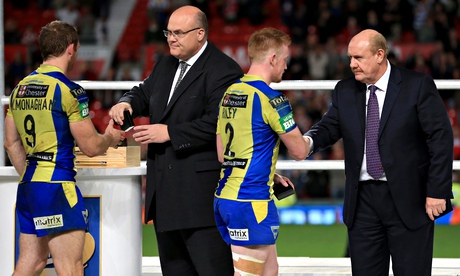
It is almost three years since the Rugby Football League announced the former Football Association chief executive Brian Barwick would be its new chairman and in that time a lot has changed. The 61-year-old arrived just in time to oversee the sport’s most successful World Cup in 2013 before becoming a driving force in pushing through a restructure of the game this season, which will climax on several fronts over the next fortnight.
Despite the structure receiving initial criticism for being too confusing and too elongated, Barwick has no doubts it has worked. “We’ve got a cracking league structure; there was scepticism over it but you can see it’s been strong,” he tells the Guardian. “The bookends of this year are great examples; the World Club Series was terrific and then there’s a Test series [for England, against New Zealand] to end the year, and with one of those games being in London, we can hopefully look back at our first year of the new structure with pride.
“Obviously, people didn’t want to be messed about too much and that’s why there was a healthy amount of scepticism – and we all had to be brave to push it through. But I’m thrilled personally; my take was we had to push it through but I would support it, push it in all the key places and chair the meetings when things are tough.
“We have to now accept that we can’t change it every two minutes from hereon out because what we’ve ended up with at every level of the game is renewed interest and an injection of real competitiveness – coupled with a really fascinating end to the season.”
Despite his obvious allegiances to football – Barwick spent four years at the FA and was heavily involved with the sport during his time at the BBC and ITV – he has his own history with rugby league, too, which was one of the reasons he opted to apply for the job when the previous incumbent, Richard Lewis, left for the All England Tennis Club.
“When Richard went, I immediately became interested in the post because throughout my personal life and professional career, I often bumped into rugby league,” he says. “When I started out at the BBC, rugby league was one of Grandstand’s major elements on Saturdays. I used to watch Liverpool City when I was a youngster and would alternate my weekends between watching Liverpool at Anfield and Liverpool City at Knotty Ash, which isn’t there any more. Then I started working at a local paper in Barrow and one of the main jobs was to be rugby league reporter, so I certainly know all about the sport.
“I remember working on Grandstand in 1980, they asked me to go to Hull ahead of the Challenge Cup final [between Hull and Hull KR]; it was Des Lynam’s first television film. I had to knock on his hotel door at 6am to get him to go to a fish factory in Hull – it’s probably the toughest thing I’ve done in my career.”
Barwick extends his remit to all levels of the professional game – “I was at Oldham to see them get promoted recently; there were around 1,400 people there and it was good, honest sport at its best” – and he believes the reintroduction of promotion and relegation is the biggest benefit of the new system. “There will still be some who say it’s too complicated but it’s really not been half as bad as people thought it would be,” he says. “It’s delivered some real vigour to the competition and the opportunity and possibility of promotion and relegation has really added some genuine excitement.
“You can only judge on what’s happened in year one but as it grows more, we’ll see more positive things happening in the sport. After three years or so I think we’ll be very pleased with what we’ve established.”
And his own challenge to drive a sport forward as opposed to overseeing one at the top of the food chain? “It’s obviously very different to football and it is a challenge,” Barwick adds. “But it’s an interesting one and it’s a great one to take on.
“We can’t avoid the fact that we’ve got strong broadcast contracts with numerous partners, which underlines the strength of our brand: national broadcasters recognise our sport makes for top-class television. But rugby league has got to learn how to progress it and to grow it. The challenge now is getting new people to engage in it; that’s a challenge that people have had before me and people will probably have after me – but I’m hungry to make it happen.”