For those wondering about the repercussions of Britain's vote to leave the European Union, here's a data point: By one measure, the largest US and European banks are about $165 billion (£125 billion) worse off.
A model set up by economists at New York University regularly performs a sort of simplified stress test on the world's largest financial institutions.
It does so by asking the stock market what it thinks about the value and riskiness of the banks' assets, then using that information to estimate what would happen to the banks in a severe crisis — and how much added equity capital they would need to avoid distress.
Even before Brexit, the model suggested that banks were much more fragile than official stress tests indicated: As of May 31, it estimated that the largest banks in the US, UK, Germany, France and Italy (those with more than $500 billion in assets) would have a combined capital shortfall of $998 billion (£758 billion).
After the Brexit vote, the shortfall rose significantly. As of June 28, it stood at $1.163 trillion (£887 billion) , an increase of $165 billion (£125 billion). Here's a breakdown by country, in billions of dollars:
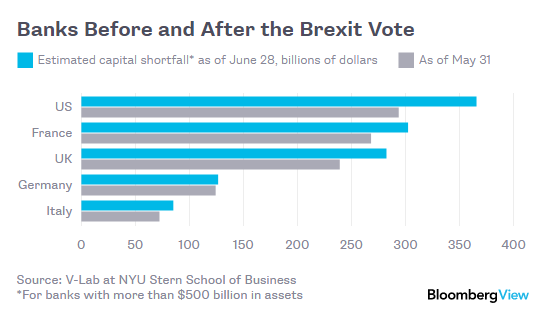
To give a sense of the potential burden on taxpayers in the event of government bailouts, here's a breakdown showing the estimated capital shortfalls as a percentage of each country's gross domestic product:
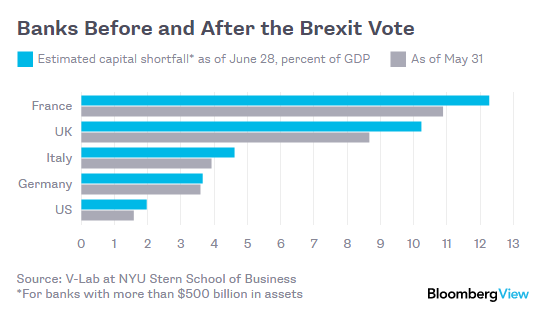
Why the pessimism? For UK banks, it's pretty straightforward: Forecasters expect increased uncertainty and other Brexit-related difficulties to undermine economic growth, which in turn will narrow profit opportunities and make it harder for people and companies to pay back loans.
For French and Italian banks, it may reflect concerns both about European growth and the possibility that voters will follow Britain's example.
For US banks it's harder to understand, though profits may suffer if worries about Brexit prompt the Federal Reserve to keeps interest rates lower than it otherwise would.
To be sure, markets have rebounded a lot since June 28 — and the share prices of US banks have done particularly well since they passed the Fed's latest round of stress tests last week.
So the next NYU exercise will probably show a smaller shortfall. That said, the market's initial verdict is clear: Brexit is pretty bad for banks.
© 2016 Bloomberg