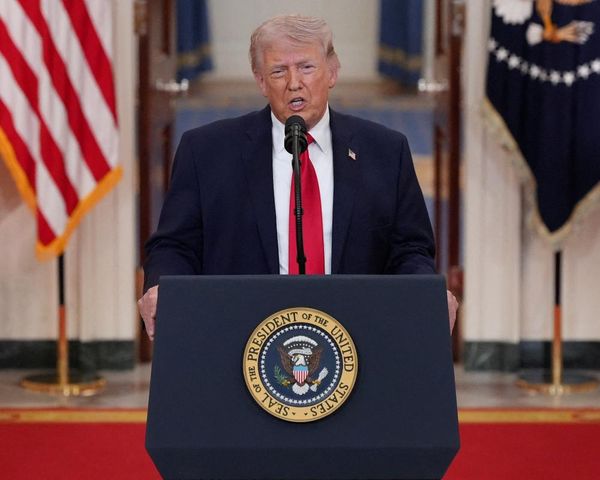
Donald Trump has said Theresa May's Brexit agreement "sounds like a great deal" for the EU, and may hinder trade between the UK and US.
The US president issued his warning hours after the prime minister faced an onslaught of criticism from hostile MPs in the Commons as she pitched her Brexit deal to them, saying that rejecting the agreement would cause division and uncertainty.
The date of the MPs’ vote on the agreement was revealed as 11 December, giving the prime minister a fortnight to avert what threatens to be a humiliating defeat at the hands of scores of Conservative rebels.
In a debate lasting nearly three hours, Ms May was forced time after time to defend her strategy as Tory grandees and opposition members alike lined up to attack aspects of the withdrawal agreement signed in Brussels at the weekend.
She was loudly barracked by MPs as she insisted that no better deal was available than the agreement and political declaration on future relations endorsed by EU leaders.
Former minister Mark Francois branded her deal a “surrender”, saying opposition from Eurosceptic Tories and the Democratic Unionist Party meant it was already “dead as a dodo”.
Former defence secretary Sir Michael Fallon described the deal as “a huge gamble” that involved the UK paying a £39 billion divorce bill and giving up its votes and veto without any firm commitment on future trade relations.
But Mrs May said: “The British people want us to get on with a deal that honours the referendum and allows us to come together again as a country, whichever way we voted.
“This is that deal. A deal that delivers for the British people.”
In a sign that she aims to go over fractious MPs’ heads and appeal directly to voters for their backing, Ms May said parliamentarians had a “duty” to listen to their constituents before taking their decision in the national interest.
But Labour leader Jeremy Corbyn said the Commons would have “very little choice” but to reject the “botched” deal, which he described as “bad for this country”.
With 90 or more Conservative MPs indicating they could rebel in the “meaningful vote”, Brexit Secretary Stephen Barclay admitted the prime minister faces a “challenging” division.
No one knows what would happen if this deal doesn’t pass
European Commission president Jean-Claude Juncker warned that there would be no more negotiation if MPs vote down the agreement, saying: “This is the best deal for Britain ... and this is the only deal possible, so if the House says no, we would have no deal.”
Ms May told MPs: “I can say to the House with absolute certainty that there is not a better deal available.”
She said MPs faced a choice: “We can back this deal, deliver on the vote of the referendum and move on to building a brighter future of opportunity and prosperity for all our people.
“Or this House can choose to reject this deal and go back to square one.
“Because no one knows what would happen if this deal doesn’t pass. It would open the door to more division and more uncertainty, with all the risks that will entail.”
Mr Corbyn said: “The prime minister says if we reject this deal, it will take us back to square one. The truth is, under this government we have never got off square one.
“This botched deal is still a bad deal for the country and all yesterday did was mark the end of this government’s failed and miserable negotiations.”
Ms May told MPs the government had ensured that Gibraltar was covered by the withdrawal agreement and would negotiate a future relationship “for the whole UK family, including Gibraltar”.
A two-hour Cabinet meeting earlier heard an update from Mr Barclay on preparations for a possible no-deal Brexit, which are continuing despite the deal being agreed.
After the Commons debate, Downing Street chief of staff Gavin Barwell and effective deputy prime minister David Lidington invited opposition MPs to a briefing on the agreement.
But Downing Street sources said they were not aware of the prime minister seeking to speak to Labour MPs thought to be considering backing her deal.
Analysis by the Bank of England and the Financial Conduct Authority of the impact of the deal on the UK economy is to be published on Thursday.
Ms May has started a campaign to sell her deal directly to the public, with visits to all parts of the UK planned.
Her spokesman declined to confirm or deny reports that No 10 is considering a possible television debate with Mr Corbyn, something the Labour leader has made clear he would relish.
For more on the debate, please see what was our live coverage below:

EU leaders approve Theresa May’s Brexit deal but warn it cannot be renegotiated
EU leaders have approved Theresa May’s Brexit deal at a special summit in Brussels on Sunday, warning that it is “the only deal possible” within the prime minister’s red lines.
The signoff by the bloc paves the way for MPs to vote on the deal, with officials in Brussels told to expect MPs to make their decision on 10 or 11 December.
The 27 heads of state and government are understood to have avoided discussing what would happen if the deal was rejected by parliament, as now looks increasingly likely.

Corbyn 'would relish' Brexit TV debate with Theresa May as PM tries to sell her exit deal
Jeremy Corbyn has said he “would relish” a head-to-head TV debate with Theresa May as the prime minister embarks on a campaign to sell her Brexit deal to the nation.
Ms May will attempt to drum up support for her withdrawal agreement – approved by EU leaders on Sunday – while hoping to overcome huge opposition to it in the Commons ahead of MPs’ “meaningful vote” in December.
She will warn MPs that rejecting her plan will “open the door to more division and uncertainty, with all the risks that will entail”. Reports suggested she would seek a TV debate with Mr Corbyn as part of that campaign.
Responding to those reports, a Labour spokesperson said on Sunday night: “Jeremy would relish a head to head debate with Theresa May about her botched Brexit deal and the future of our country.”

Theresa May's Brexit deal could leave UK £100bn poorer in first decade outside EU
Theresa May’s Brexit deal could leave the average person more than £1,000 worse off per year in the first decade outside of the EU, according to the first independent analysis of Britain exit terms.
As European leaders endorsed the prime minister’s plan, new research revealed the agreement could hit the UK’s economy by £100bn a year by 2030, equating to an average of £1,090 per person.
The report by the National Institute for Economic and Social Research (NIESR), commissioned by the People’s Vote campaign, also warned that the government’s preferred outcome could see a 46 per cent hit to trade with the EU and a 21 per cent fall in foreign direct investment.
But he told BBC Radio 4's Today the PM has got the best agreement possible for the UK after her negotiations with Brussels.
Asked about how the government will get the deal secured by Ms May at yesterday's summit approved by the House of Commons, Mr Barclay said: "Well it's going to be a challenging vote.
"But it's now the job of all of us in Cabinet to make the case to our colleagues, to make the case to the country.
"The Prime Minister, after two years working day and night in the national interest, has secured a deal that respects the referendum result. And does so in a way that also protects jobs, that also gives security to EU citizens."

Corbyn 'would relish' Brexit TV debate with Theresa May as PM tries to sell her exit deal
Jeremy Corbyn has said he “would relish” a head-to-head TV debate with Theresa May as the prime minister embarks on a campaign to sell her Brexit deal to the nation.
Ms May will attempt to drum up support for her withdrawal agreement – approved by EU leaders on Sunday – while hoping to overcome huge opposition to it in the Commons ahead of MPs’ “meaningful vote” in December.
She will warn MPs that rejecting her plan will “open the door to more division and uncertainty, with all the risks that will entail”. Reports suggested she would seek a TV debate with Mr Corbyn as part of that campaign.
Responding to those reports, a Labour spokesperson said on Sunday night: “Jeremy would relish a head to head debate with Theresa May about her botched Brexit deal and the future of our country.”

EU president Jean-Claude Juncker says he would vote in favour of Theresa May’s Brexit deal
The president of the European Commission has said he would vote in favour of Theresa May’s Brexit deal if he had a vote in the UK parliament.
Jean-Claude Juncker said the agreement was “the best deal possible” and that the EU would not change its “fundamental position”.
It comes as EU chief negotiator Michel Barnier insists he has always “negotiated with the UK, never against” it.

Final Say: Tony Blair claims Labour moving towards backing new Brexit referendum
Tony Blair has claimed that Labour is on course to throw its weight behind a second referendum, as there is “no other proposition that can get through parliament”.
The former Labour prime minister, who is backing a public vote on the Brexitdeal, admitted there was no Commons majority for a new vote but he said Labour was shifting towards backing the idea.
Labour’s official position is to keep all options on the table, including the prospect of a second referendum, but Jeremy Corbyn has repeatedly made clear that he would prefer a general election.

EU officials given date for crunch Brexit vote in Commons
EU officials have been told to expect the parliamentary vote on the Brexit deal on 10 or 11 December, according to senior sources in Brussels.
The date for the vote has not been officially confirmed by the British Government but it is now expected to be held before the next meeting of the European Council on 13 December.
Parliamentary arithmetic currently suggests that MPs are likely to overwhelmingly reject Theresa May's deal, with votes against from her own MPs – both eurosceptic and remain – as well as Labour, the, DUP, and the other opposition parties.

Theresa May's Brexit deal could leave UK £100bn poorer in first decade outside EU
Theresa May’s Brexit deal could leave the average person more than £1,000 worse off per year in the first decade outside of the EU, according to the first independent analysis of Britain exit terms.
As European leaders endorsed the prime minister’s plan, new research revealed the agreement could hit the UK’s economy by £100bn a year by 2030, equating to an average of £1,090 per person.
The report by the National Institute for Economic and Social Research (NIESR), commissioned by the People’s Vote campaign, also warned that the government’s preferred outcome could see a 46 per cent hit to trade with the EU and a 21 per cent fall in foreign direct investment.
Jacob Rees-Mogg, chairman of the European Research Group (ERG) of Tory Brexiteers, has criticised warnings of leaving the EU without a deal.
He told LBC radio: "These scare stories are absurd. We are not going to run out of clean drinking water. We managed to have clean drinking water long before a very large number of continental European countries, it is something we have been quite good at since the 19th century.
"We are going to get more of these scare stories but we need to make preparations, particularly to alleviate any problems around the Dover-Calais route."


Tory MP who blocked upskirting bill defends stopping bill to protect girls from FGM
The Conservative MP Sir Christopher Chope has defended his decision to block a parliamentary bill designed to protect children from female genital mutilation (FGM).
Mr Chope – who previously sparked outrage by blocking a bill to make upskirting a criminal offence – has been widely criticised for obstructing an FGM prevention bill in the House of Commons.
Labour peer Lord Berkeley, who sponsored the FGM bill, said he was “furious” at the move and said it is “amazing that Chope can halt an important improvement”.
But the controversial MP for Christchurch in Dorset justified his objection on procedural grounds on Monday, suggesting the proposal had not been subject to proper debate.

‘Theresa May’s open letter to the nation promises a campaign with ‘heart and soul’ – I’d rather she use her head’
If the prime minister lands a victory, she will have sold that soul to her survivalist instincts, and saddled the country with a deal almost nobody other than herself wants, writes Matthew Norman
Here’s how Theresa May can get her Brexit bill through parliament – while picking up some battle scars in the process
None of this will be easy, but the prospects may be brighter for May than seems possible now, writes Sean O'GradyColum Eastwood, leader of the Social Democratic and Labour Party (SDLP) in Northern Ireland, has appealed to Labour MPs to vote for the government’s Brexit withdrawal deal.
Senior figures from Sinn Fein, the SDLP, Alliance and Green Party all stated their support for Theresa May’s agreement after meeting business leaders at Stormont.
Mr Eastwood said: “We don’t think there is a good Brexit but if we are going to have one, let’s try and limit the damage to our communities and our businesses and our society here. That’s what the backstop does, we need to bank that backstop, it is our ultimate insurance policy.”
Business leaders in Scotland are calling on the Scottish Government to set up a £75m fund to help companies deal with Brexit.
The Federation of Small Businesses (FSB) in Scotland made the plea ahead of Finance Secretary Derek Mackay setting out his Budget to Holyrood next month.
With Brexit looming, FSB’s Scotland policy chair Andrew McRae said the “top priority” for business north of the border was “avoiding a chaotic no-deal, no-transition Brexit”.
The Independent has launched its #FinalSay campaign to demand that voters are given a voice on the final Brexit deal.
Sign our petition here