Investment intentions among firms have picked up slightly this year, according to the Bank of England's network of regional agents.
However, they are still well below the pre-referendum levels and respondents continued to cite a dampening impact from Brexit-related uncertainty about trade.
The latest agents' report from the Bank shows that the score for manufacturing investment intentions over the next 12 months in February ticked up to 0.7, from 0.2 in January.
It had fallen to zero in August, and the weakness was seen by the Bank as evidence justifying an interest rate cut to 0.25 per cent.
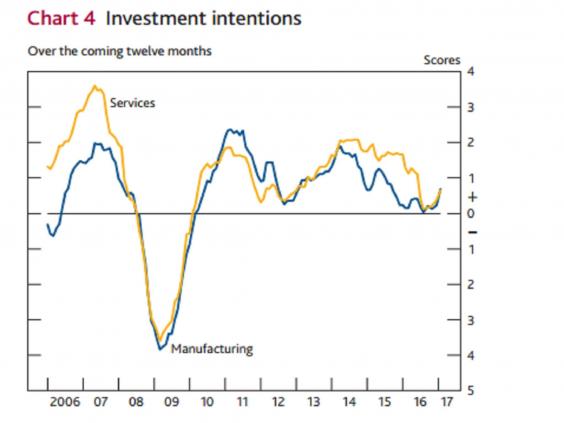
The services investment score also rose in February to 0.7, up from 0.4 in January.
But the report adds: "A lack of visibility of the United Kingdom’s future trading arrangements continued to weigh on longer-term plans for some contacts".
Theresa May in January confirmed that the UK will leave the EU single market and customs union and seek to establish a comprehensive free trade deal with the rest of the EU.
But many trade experts have doubts over whether it will be possible to do such a deal by 2019, when the UK is due to leave the bloc under the two year Article 50 deadline, and senior ministers have been countenancing the possibility that the UK could depart without a trade deal, which would mean tariffs on many UK exports to the Continent.
Official figures show that real-terms business investment fell in 2016, the first calendar year decline since 2009.
The Bank of England expects business investment to contract by a further 0.25 per cent this year, before growing by 1.25 per cent in 2018.
The average rate of growth of investment before 2007 was 2.5 per cent a year.
The Bank's Governor, Mark Carney, says it now expects business investment to be around a quarter lower in three years’ time than it projected before the referendum "with material consequences for productivity, wages and incomes".
The agents' report also pointed to an easing of retail sales volumes growth and expectations of a further slowdown in sales due to rising inflation, which hit 2.3 per cent in February.
Consumer spending has been almost solely responsible for the robust growth of the economy in the wake of last June's Brexit vote.
Businesses surveyed mostly expected to offer staff annual pay rises of 2 to 2.5 per cent, implying zero or negative pay growth after taking expected inflation into account.
The Bank's 12 regional agents hold discussions with around 700 firms across the UK to compile their scores.