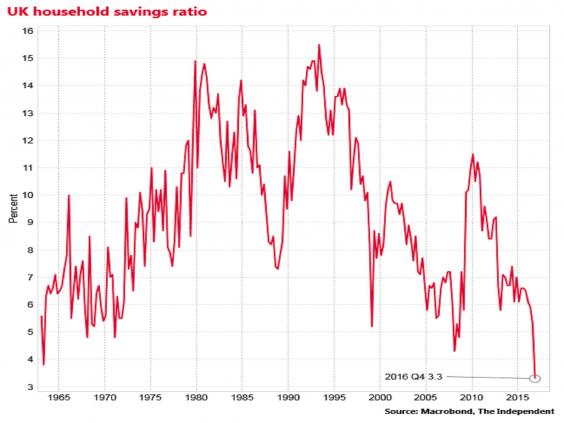
The UK's household savings ratio dived in the final quarter of last year, hitting its lowest level on record, according to the Office for National Statistics.
The ratio - which is the difference between aggregate spending and income in the household sector - slumped two percentage points to just 3.3 per cent, down from 5.3 per cent in the third quarter.
This was due to a strong increase in spending by households, even as their available income declined.
Saving ratio slumps
However, the ONS said the quarter's dramatic move was driven by technical factors.
"While at a historic low, the fall in the saving ratio is partly due to changes in imputed factors and the holdings of pension funds, rather than any significant changes in the real incomes of households," said Darren Morgan of the ONS.
Nevertheless, robust consumer spending has supported growth since last June's Brexit vote, enabling the economy to defy expectations of a recession. And the savings ratio has been on a declining trend since the beginning of 2016.
Economists are divided over whether consumers, as a collective, will continue to spend more than their income this year, thus prompting further falls in the ratio.
The Bank of England in its February Inflation Report projected a fall in the savings ratio, supporting consumption and overall GDP growth of 2 per cent.
But the Bank estimated a 2017 average for the savings ratio of 4.5 per cent, already above its Q4 2016 level.
Overall growth in the final quarter was confirmed by the ONS at 0.7 per cent.
More follows