The UK jobs market cooled at the end of last year and wage growth missed City expectations, according to the latest official report.
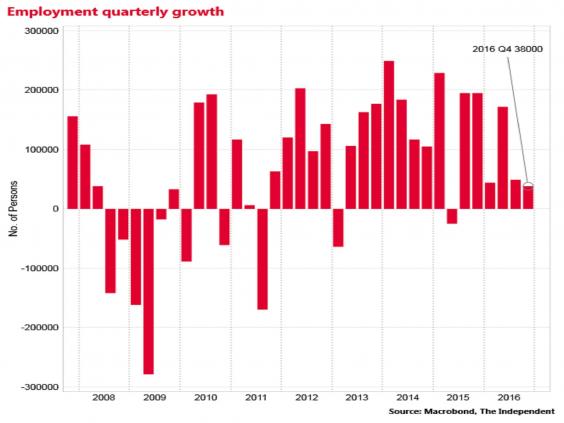
Job creation slowed to 37,000 in the final three months of 2016, according to the Office for National Statistics, the weakest performance since the second quarter of 2015.
"It is notable that the growth in unemployment has slowed appreciably since mid-2016," said Howard Archer, economist at IHS Global Insight.
The jobless rate remained steady at 4.8 per cent while the overall 16-64 employment rate hit a new record high of 74.6 per cent.
"Businesses have become a bit more cautious about hiring since the Brexit vote, although not enough yet to push up the unemployment rate," said John Hawksworth of PwC.
Slowing down
Average wage growth was 2.6 per cent, down from 2.8 per cent previously.
Economists in a Reuters poll had expected wage growth to continue at 2.8 per cent.
The Bank of England has said that it has a neutral stance on the next movement in interest rates and that it will be watching the wage data especially closely for confirmation that the equilibrium rate of unemployment - the rate at which inflation is stable - has fallen to around 4.5 per cent.
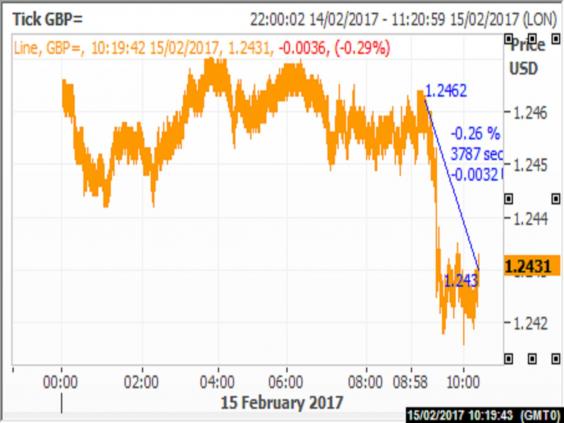
The report prompted a 0.3 per cent slide in the pound against the dollar to $1.243 as traders pushed back expectations of an imminent rate rise.
Pound versus dollar
"These figures tend to support the Bank of England’s view that there is still some slack remaining in the labour market, and therefore a hike in interest rates looks unlikely,” said Ian Kernohan, economist at Royal London Asset Management.
The more timely claimant count in January fell by 42,400 to 745,000, against City expectations that it would rise very slightly,
However, the ONS warned that this measure of unemployment was becoming more volatile because of the roll-out of the Universal Credit scheme.
There was a small drop in the number of workers born in other EU countries reported, but the ONS said this may simply reflect seasonal patterns in employment rather than a sign workers are leaving the UK in the wake of Brexit.
Other data showed that output per hour productivity rose by 0.3 per cent in the final quarter, a slight slowdown from the previous quarter when it rose 0.4 per cent.