The pace of decline in construction eased in August, according to the latest survey snapshot of the sector, adding to the sense that the economy is weathering Brexit better than widely feared.
The Purchasing Managers' Index of activity, compiled by Markit/CIPS, came in at 49.2 today.
That was still down on the 50 point that spells growth, but it was a sharp improvement on July's 45.9 reading and better than the 46.1 that City of London economists had expected.
Construction improvement

The construction news gave a boost to sterling, although it soon dissipated.
Traders were caught off guard yesterday when the latest PMI for manufacturing showed a surprise return to growth with the biggest jump in the activity index in the survey's 25 year history, prompting many Brexit supporters to hail the resilience of the economy in the wake of the 23 June vote.
Construction accounts for around 6 per cent of GDP and has been in contraction over the first half of the year according to the Office for National Statistics.
Markit/CIPS reported that Brexit-related uncertainty had acted as a brake on the construction sector in August, especially in relation to house building and commercial work, but also that a number of firms said sales volumes had been "more resilient than expected".
"The downturn in UK construction activity has eased considerably since July, primarily helped by a much slower decline in commercial building" said Tim Moore of Markit.
"Construction firms cited a nascent recovery in client confidence since the EU referendum result and a relatively steady flow of invitations to tender in August".
Howard Archer of IHS Global Insight said that the survey "adds to the mounting evidence that the economy has so far held up pretty well following June’s Brexit vote".
He added that an improved purchasing managers’ survey for the dominant services sector for August would "significantly bolster confidence".
The PMI for services - the sector that covers 80 per cent of the economy - will be released on Monday.
Some economists have been revising up their GDP forecasts for the second half of the year on the back of solid consumer spending data since the vote, reducing their odds on a recession.
Input cost inflation for builders rose again in the month, hitting its highest level since July 2011 according to today's report.
Firms also reduced their purchasing activity for the third straight month. Staffing levels showed a "marginal expansion"
Noble Francis of the Construction Products Association cautioned that most of the negative impact of the referendum result on builders had yet to be seen.
"The main impact on construction will be if/when [there is] a lack of new contracts signed...which is most likely to impact construction activity in 2017" he said.
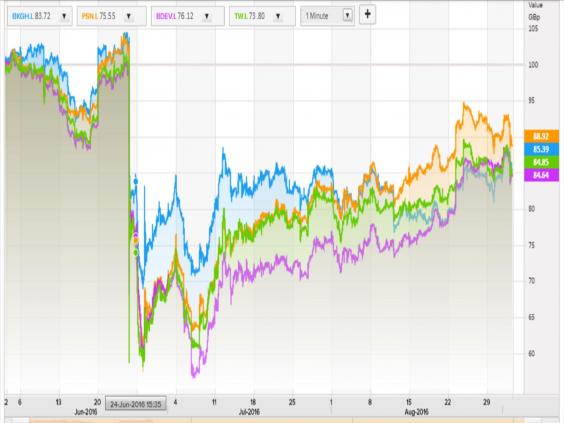
The share prices of the UK's big four housebuilding firms have fallen hard since the referendum result, with Berkeley Group this week relegated from the FTSE 100 bluechip index due to the steep decline in its market value.
Housebuilders share prices since Brexit vote