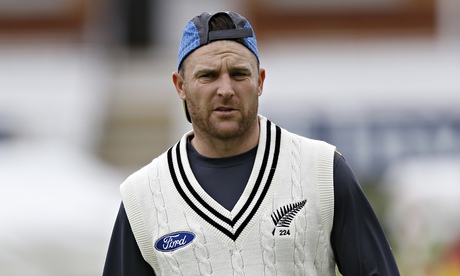
It might seem odd that the two best captains this correspondent has seen in international cricket this past three decades both happen to be Kiwis. Perhaps it has to do with the capacity to get the maximum performance out of a minimum of resource. Stephen Fleming was astute, calm (although Graeme Smith might well remember that he could be volcanic if he thought it helped the cause), calculating and canny enough to come within an umpiring error of upsetting the Australians in their own backyard. And then there is Brendon McCullum, the Southlander, who is far and away the most creative, proactive, galvanic leader of a cricket team in the world today.
Sixteen years ago, Fleming led New Zealand to a series win in this country that left England cricket stunned, as if sandbagged. The memory still lingers, and a bad one at that, of Nasser Hussain, three matches into what was to become a distinguished career as the most significant England captain of recent times, standing bewildered on the balcony at the Oval and listening to the boos of the crowd who had just witnessed his side sink to an 83-run defeat by the team ranked bottom of the heap. But it kickstarted a revival: that winter, Hussain teamed up with Duncan Fletcher for the first time and a new era had begun.
The cyclical nature of sport means that England have been through peaks – four Ashes wins including one in Australia; a series win in India – and troughs, most notably the retaliatory Ashes whitewashes. And now here are England once more dragging themselves up by their Test match bootstraps, in the midst of a period of turmoil in which the coach and managing director of England cricket have both been given P45s, and a new role created for Andrew Strauss.
New Zealand are, then, the opposition at the start of one of the most intensive, challenging spells of Test cricket any England side, perhaps any side in their position, has ever had to face – with each of the top three ranked teams to be played, as well as a Pakistan side in a familiar environment on the dustbowls of the Middle East.
The Kiwis are all assembled now, flown in from New Zealand and India, the lack of red-ball cricket for some of them less of an issue in this age of total adaptability than once it might have been.
The bowlers playing in the IPL have been practising in India with the Duke ball that is used in this country (the one manufactured for use in England rather than that specifically developed for the more abrasive surfaces elsewhere) and essentially the skills are the same in any case.
They are on a wave of confidence, swaggering without being arrogant, arguably the best side they have ever produced, with superb seamers, a high-class middle order (Martin Crowe, the finest New Zealand batsman of all, believes Kane Williamson to be heading inexorably towards that status), McCullum’s leadership allied to Mike Hesson’s understated management, and an ingrained freedom of expression that England never quite seem able to capture.
It may be the first time in a series between the two sides that England are viewed as the underdog, for history backs up their superiority overall. This will be the 100th Test between them of which England have won 47 and New Zealand eight. But history, as Henry Ford remarked, is bunk, meaningless. Those two wins in 1999 show what can happen: they may have lost seven and drawn one of their last eight Tests in this country, but the last encounter in New Zealand was a last-ball-of-the-series humdinger with Matt Prior and Monty Panesar hanging on for grim death to secure a draw.
England will enjoy home advantage now, something playing an increasing part in modern series condensed into a tight schedule, but New Zealand will feel the difference less than most sides. England have lost only two of their last 18 matches at Lord’s. These promise to be close matches.
For England, it represents an opportunity to further develop a new side, a process that has been ongoing for a year and a half. If, at times, it appears to be greasy-pole cricket, then that is the nature of playing with a core of inexperienced players learning the vagaries of international competition.
The loss in Bridgetown was poor, and a less pragmatic, not to say dogmatic, approach to selection might have paid dividends, not least in the public eye. But there is a new coach in place, Paul Farbrace, albeit a temporary appointment, and he will have his own ideas. Of those who might reasonably have played in Barbados, Adam Lyth will get his first cap and the Durham paceman Mark Wood might well play as well.
Should this be the case (and Lord’s, where the pitch tends not to deteriorate as the match progresses but rather gets easier for batting, is a ground where his skiddy pace and, in particular, reverse swing could play a part) then it would most likely be at the expense of their current third seamer, Chris Jordan.
It would be unfortunate, for Jordan, a fine young talent who soaks up information, has made significant improvements to his bowling in terms of his run-up and nicely controlling high action, and his close catching is nothing short of remarkable. He needs to develop more lateral movement and will be a high-class cricketer. This being said, Stuart Broad was irritatingly inconsistent in the Caribbean and needs to turn up more often this summer.
One issue that will be debated is the order in which Ben Stokes, Moeen Ali and Jos Buttler bat. They are each capable of batting at six, and both Stokes and Moeen have Test match hundreds. There is little point in playing Stokes, a batsman first and foremost, as fourth seamer who bats at eight, so a practical solution would be him at six, Buttler reprising Matt Prior’s role at seven, and Moeen, a ubiquitous cricketer and batsman, given free rein at eight.