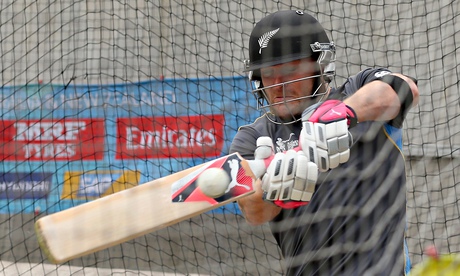
There was a moment in the semi-final that illustrates exactly why New Zealand have become the neutral’s World Cup favourite and Brendon McCullum the pre-eminent captain in the ODI game. South Africa were 31 for 2 in the eighth over, a very useful start for the bowling team but hardly a position of complete dominance. The new batsman, Rilee Rossouw, strode to the wicket, took guard and examined the field.
What he saw was something quite remarkable. Four slips, a gully and a man at point positioned threateningly close – a ring of six catchers looking for a thick or thin edge. Rossouw would have been forgiven for thinking that he had inadvertently wandered into a Test match.
It was that attacking instinct that led to Tim Southee being immediately brought back to rip through the England middle order during the group stage game in Wellington as soon as Daniel Vettori had broken the Eoin Morgan-Joe Root partnership. It’s why Vettori himself was given six catchers when bowling for a hat-trick against Afghanistan, why Southee bowled at Steve Smith with three slips in place against Australia. And it’s why McCullum and New Zealand will attack at all costs when they meet those opponents again at the MCG on Sunday.
So far in this tournament it has proven a virtuous circle, the bowlers thriving on the confidence placed in them by their captain and finding deliveries that have allowed the strategy to pay off. In the field it has been infectious – during New Zealand’s opening game of the tournament the Sri Lanka opener Tillakaratne Dilshan was, slightly embarrassingly, captured on the stump mic telling his batting partner Lahiru Thirimanne “they get to the ball quicker than our blokes” – and it has been effective: the Black Caps are in the World Cup final for the first time.
The road to Melbourne has not been all that smooth. In late 2012 McCullum replaced Ross Taylor as captain in all three formats, a move that was not exactly popular with either Taylor or the New Zealand supporters. A year on from that controversial decision, New Zealand travelled to Bangladesh for an ODI series and, without the injured McCullum, were whitewashed 3-0 in what was perhaps the low point of Mike Hesson’s reign as coach. Thereafter results improved, the aggression levels cranked up, but only in the final tinkering in the months leading up to the tournament did New Zealand find a blend that backed up the captain’s approach.
McCullum returned to the top of the order only at the start of 2015, his explosive talents having been under-utilised in the middle order for two years. Trent Boult established himself as Southee’s opening bowling partner as recently as October last year. No one who had noticed their improvement considered them dark horses for this tournament – they were clearly too good for that tag – but few anticipated just how thrilling a side McCullum and Hesson had at their disposal.
McCullum’s blunderbuss style has always been well known, but the surprises have dazzled too. Martin Guptill was supposed to provide the cool head in the fire-and-ice opening partnership with the captain, but then he went and smashed a world record 237 from 163 balls against the West Indies in the quarter-finals.
Kane Williamson and Taylor are up there with the best No3 and No4 combinations in the world, but it was Corey Anderson and Grant Elliott – a player who made his ODI debut in 2008 but has been so in-and-out that he did not make any international appearances in 2011, 2012 and 2014 and was a gnat’s wing away from missing out on the squad for the tournament – who made the crucial contributions against South Africa in the semi. And then, of course, there is Vettori, a player who seems to have had more retirements than George Foreman. Vettori initially called it a day in ODIs in 2011, was tempted back but then had more than a year out of the side after suffering an ankle injury in 2013. His return solved the spin problem that New Zealand had struggled to resolve in his absence and he goes into the final described by MS Dhoni as “the key factor” in the match. Not bad for a player who has been around so long that he first faced England when Michael Atherton and Phil Tufnell were part of the side.
But this is McCullum’s team, one chiselled in the image of its captain. And if he leads his side to victory in Melbourne on Sunday, this tournament will deservedly go down as McCullum’s World Cup.