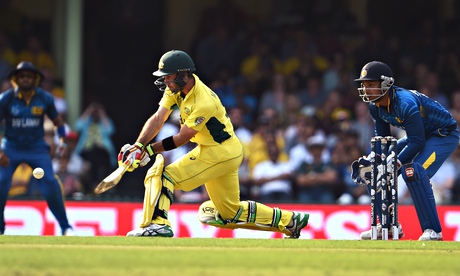
It has been a tournament for the super‑swingers, whether they are batsmen or bowlers. Now that we have finally reached the sudden-death stage there may be a bit more caginess around but expect the big boys to keep swinging.
Some of the batsmen have demonstrated spectacularly how the game has evolved. Watch AB de Villiers taking a step 18 inches outside his off stump before the bowler releases the ball and hitting everything over backward square leg. Then there is Glenn Maxwell with his tungsten wrists slog-sweeping, reverse-hitting and inside-out driving with awesome power; or Brendon McCullum running down the wicket to his first ball and somehow smiting it over long-off wherever it has pitched. The new rule is that there are no rules, which does not stop Kumar Sangakkara purring to another century with strokes that the old classicists can recognise.
Meanwhile, the containing one-day seamer has been banished. To survive aggression, pace and swing have been the key. Trent Boult and Mitchell Starc have been outstanding, bowling fast and full in search of swing. It’s all right to be a tearaway now in ODI cricket; the headlong pursuit of wickets has replaced any yearning for neat economy. So Tim Southee, Wahab Riaz, Morne Morkel and Mohammed Shami hare up to the crease intent on dismissing the batsmen, rather than containing them. Every team play their specialist Test bowlers, which makes one wonder whether England’s insipid attack in this tournament may be on the wane in the Test arena.
Only the spinners adhere to the old philosophy of keeping it tight and building pressure. In the absence of the mystery men such as Saeed Ajmal and Sunil Narine, they have to be clever and calm to prevail. Daniel Vettori has been invaluable to New Zealand without turning a ball; so too Shakib al Hasan for Bangladesh. Meanwhile Ravichandran Ashwin and Imran Tahir can still bamboozle.
So what happens next? Now we must acknowledge our debt to Rumsfeldspeak. At the time of writing there are known knowns and known unknowns. We know the make-up of two of the quarter-finals. Most surprisingly India play Bangladesh in Melbourne.
Bangladesh, fourth in pool A, are not supposed to reach this far, but they deserve to for the spirited way in which they defeated England; India were not expected to top Pool B but have done so easily. Attach the words “World Cup” to an upcoming ODI and India are transformed. In the Tri-Series before the tournament they barely looked interested. Now even cool cat MS Dhoni is animated. The India pace bowlers are vibrant and accurate, the fielding is sharp, the batsmen suddenly avaricious.
In Sydney there is an intriguing contest between Sri Lanka and South Africa, in which both sides will be eager to bat first if the sun is out. Sri Lanka will hope that Sangakkara and his senior cohorts can do their stuff again to give a threadbare bowling attack a chance. Meanwhile the South Africans can look so omnipotent with the bat, but on a bad day surprisingly impotent, as demonstrated by their capitulation against Pakistan. De Villiers stands apart but he is in danger of having to do too much. The South Africa captain even ends up bowling a few overs as they nervously include the extra batsman.
De Villiers has taken to pronouncing that South Africa are the best team in the world. Not yet they aren’t but they will be favourites to win their quarter‑final despite the fact they have never won a sudden death match in the World Cup.
We know Australia and New Zealand are quarter-finalists against two teams out of Pakistan, West Indies and Ireland. Both the hosts have played technicolour, high intensity cricket. Between them they produced the most exciting match of the tournament in Auckland when New Zealand won by one wicket with 26.5 overs to spare.
New Zealand have several match‑winners but their opponents know that they have to dispatch McCullum early. It seems that the best way to do that is to bowl a spinner against him early on. Likewise Australia have strength in depth but it is imperative to get rid of Maxwell quickly in order to beat them. In his case the best bet is probably to let loose the nastiest, fastest hairy quick available as soon as he arrives at the crease. Both McCullum and Maxwell can turn a match within 40 balls. Some players will be more wary now that we have reached the knockout stages, but I doubt this applies to this pair.