From bed to bed, a worn-out medical worker is busy looking after coronavirus patients in a crowded hospital. He observes their condition and scribbles details in medical records. An oversight could mean their condition gets worse. However, this is all taking place on a screen.
"Staff can move the cursor onto each bed and care for patients in home isolation. They can monitor treatment virtually," said Kitti Wongthavarawat, head of the Health Innovation and Information Research Team at the Assistive Technology and Medical Devices Research Centre.
Funded by the National Science and Technology Development Agency, developers built the telehealth program from scratch in the first wave of the pandemic last year. Health workers used it for monitoring cases in a quarantine centre in Narathiwat. Then it was tested, but not deployed by other field hospitals because it needed further improvement.
Kitti eventually saw his brainchild come into play at the field hospital for patients with disabilities at the Sirindhorn Science Home in June. One month later, Thammasat University Hospital decided to use it for patients in home isolation. The program has not changed much, except for the addition of food and drug delivery.
"After giving prescriptions, staff would write them on a big whiteboard, but they worried that they would slip up because cases were increasing. That is where our dashboard came in," he said.
Free back office for home isolation
Basically, hospitals use their own programs or services from private developers. However, the team has streamlined this back office for user-friendliness and non-commercial purposes. Health workers can see the number of patients and beds, leaf through records and sort them out in colour on the dashboard.
"Green patients are asymptomatic, yellow-orange patients show specific symptoms, and red patients are emergency cases that need hospitalisation. Those who recover can be discharged from the home isolation system," Kitti said.
The dashboard includes a special feature for increasing co-ordination between medical personnel around the clock. Doctors can order staff to follow some cases closely.
In fact, the coronavirus treatment involves social aspects. If patients who are placed in home isolation are breadwinners, they will be unable to support their families. Some community residents also object to home isolation because they don't understand the nature of the pandemic. In response, the team has installed an assessment form on the dashboard.
"Doctors can learn their personal issues ranging from unemployment to child care. Then social workers will come in to tackle these problems," Kitti said.
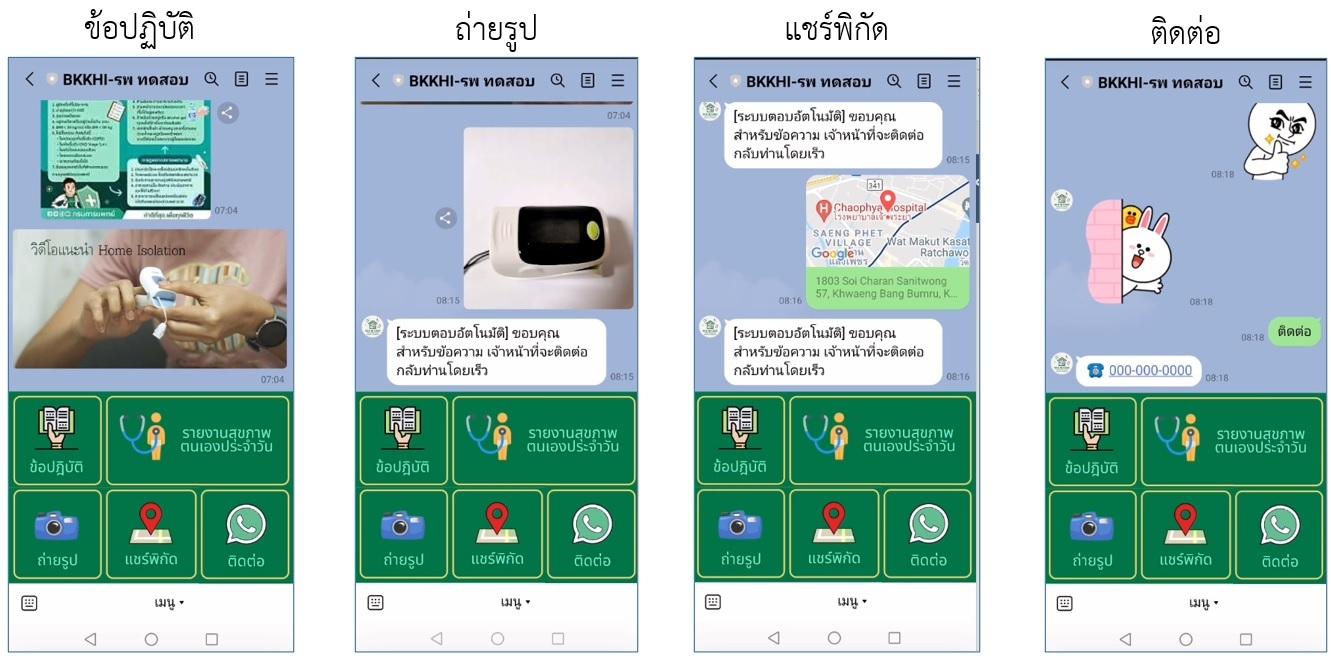
On the part of patients, they can access the virtual hospital via Line. It offers accessibility and also includes special features, including chat and video call, that guarantee personal privacy. In the past, users found it difficult to use the website and mobile app.
"Our program was initially designed for patients at field hospitals. When it is adopted for a large number of people in home isolation, the crisis needs a stable system," Kitti said.
After patients enter the home isolation system, they will be remotely looked after by local hospitals, which will record cases on the telehealth platform. Patients are required to report their vital signs and communicate with staff via Line for checkups. They can tick the box that describes their symptoms.
The platform builds on cloud computing. The number of virtual beds depends on the capacity of medical personnel on the ground. Basically, one staff can look after around 20 patients per day. "We have prepared 500 virtual beds for each hospital," Kitti added.
The program is free of charge. Those interested in the software can contact Kitti's centre for installation.
Many hurdles on the road
"We have developed 65 versions so far," Kitti said. The team has received constructive comments from medical personnel and used them to improve their prototype. It is difficult to identify pain points because even users cannot articulate their needs, most of which involve patient care.
"They worry that they will slip up. In the end, we have managed to figure out that they want indicators for priority cases. We are now working on prescriptions because we did not design that in from the beginning," he said.
At least 350 hospitals and clinics have used the tech for home isolation, with 290 under the Bangkok Metropolitan Administration and the rest under the Department of Medical Services.
Kitti doesn't know what the final version will look like. The program has been widely adopted, but the team must continue to improve it to meet the user demand.
"Otherwise, their pain points won't be solved," he said.
For him, the program development is a "work of imagination". It is a kind of system design that requires high agility. The team must pay attention to requirements from users and generate practical solutions. "We must envisage what it is and looks like," he said.
In recent months, developers have rolled out many gadgets and applications to tackle the pandemic, but some of them broke down, for example the Mor Prom platform. However, Kitti can put himself in their shoes.
"I understand developers. They were asked to conjure it in one week but the development of innovation takes time. In our case, if we had not built it in the first wave, we would not be able to pull it off now. We designed several features, but when we tested the water, we had to change them," he said.
When asked about the future of telehealth, he said it will be a common practice for doctors and patients. Medical personnel once opposed the idea, but when the situation changes, they find it convenient. After this, the health information system will be simplified for hospital staff.
"Nowadays, it contains too much data. It causes stress when doctors look at medical records. It will become friendlier," he said.