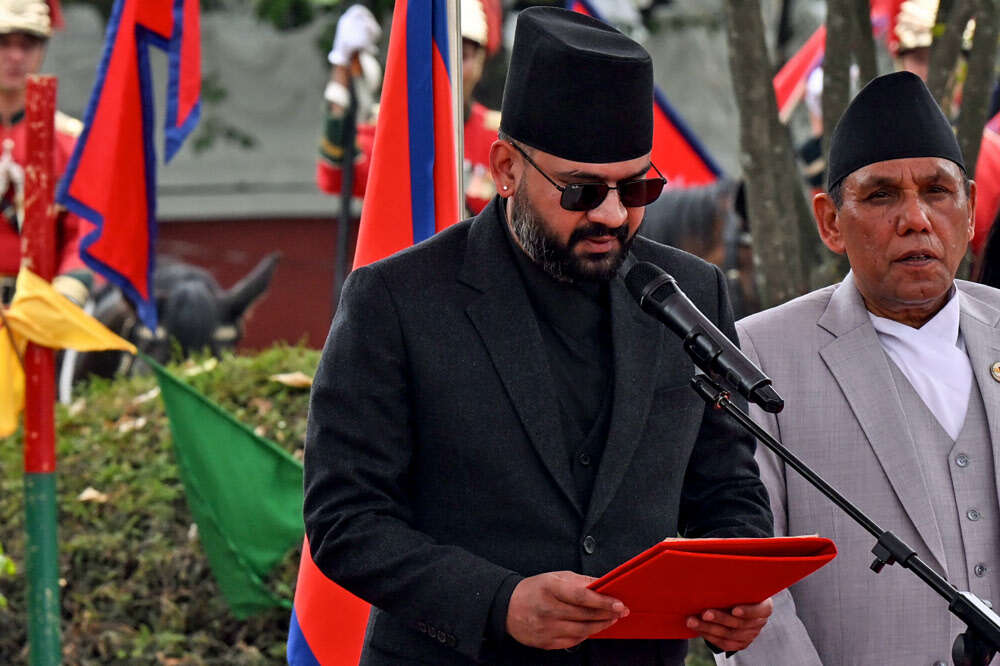
Calls for Nepal to allow its citizens to join the Indian Army under its Agnipath scheme have grown louder ahead of Indian Army chief General Dhiraj Seth’s scheduled participation in an ex-servicemen rally for Gorkha veterans in Pokhara on Wednesday, bringing the stalled recruitment issue back into focus during his three-day Nepal visit.
Get breaking news anytime, anywhere. Download the TOI app now!
Days before Gen Seth's arrival, hundreds of former Indian Army personnel, their families and Gorkha aspirants marched in Pokhara, urging Nepal prime minister Balen Shah to permit recruitment under Agnipath. The rally was organised by Indian Ex-Servicemen Gorkha Brigade Nepal, which submitted a memorandum to Shah and home minister Sudan Gurung.
The recruitment deadlock has remained an unresolved backdrop to Gen Seth’s visit, though official accounts of his talks with Nepal Army chief General Ashok Raj Sigdel have made no mention of the issue. Gen Seth was conferred the honorary rank of General of the Nepal Army by President Ramchandra Paudel on Monday, continuing a decades-old reciprocal military tradition between the two countries.
Gen Seth met Shah in Kathmandu on Tuesday, but the official statement stayed with familiar phrases on "defence cooperation and military ties". Agnipath found no public mention.
Colonel Krishna Bahadur Khatri (retd), chairman of the organisation, told TOI from Kathmandu that Nepal’s stand had "deprived its youths of an opportunity still seen by many Gorkha families as far better than low-paid employment overseas". He added: “After India introduced the Agnipath scheme, Nepal govt, citing various reasons, deprived Nepalese youths of the opportunity to join Indian Army,” Khatri said.
In its memorandum, the organisation said, “We once again request govt to immediately restart the process of recruiting Nepalese youths into Indian Army under the Agnipath policy. This profession is hundreds of times better than going to the Gulf, working in temperatures of 50 degrees Celsius and receiving minimum wages.”
Retired Captain Rudra Thapa said the freeze had pushed many young men from Gorkha families towards low-paid, physically demanding jobs in the Gulf and other countries when they could have earned a far higher and more stable income through military service. “Our youths are going abroad for menial jobs, working in harsh conditions and earning very little. If they were allowed to join Indian Army as Agniveers, they could have earned around Nepalese Rs 45-50 lakh, including benefits, in four years,” Thapa said. “If govt does not permit recruitment into foreign armies, it must be able to provide employment at home.”
A similar appeal was made last month by Lamjung Indian Ex-Servicemen Development Committee. In a memorandum signed by its chairman Chitra Bahadur Gurung, the committee said the prolonged freeze had cost thousands of youths employment, created uncertainty among Gorkha families and weakened one of the oldest institutional links between Nepal and India.
India introduced Agnipath in June 2022, under which recruits serve for four years and up to 25% may later be absorbed into regular service. Nepal declined to allow recruitment under the new terms, arguing that the four-year contractual model marked a departure from the long-term service and pension arrangement that underpinned the 1947 tripartite agreement between Nepal, India and Britain. No Nepal-domiciled Gorkhas have been recruited since Nepal put the process on hold in 2022.
The deadlock matters because Nepal-domiciled Gorkhas have long formed an important part of the Indian Army’s Gorkha regiments. Nepalese soldiers constitute about 60% of each battalion, while Indians make up the rest. Around 12,000 Gorkha soldiers from Nepal have retired since 2021, but no fresh Nepal-domiciled recruitment has taken place to replace them after Nepal blocked the first round of recruitment in July 2022, followed by later rounds.
Kathmandu has also raised concerns that 75% of Agniveers who are released after four years could return home without jobs or pension despite military training. Indian officials, however, have maintained that Agnipath is now the only recruitment route into the Indian Army and that resumption of Nepal-domiciled Gorkha recruitment depends on Nepal’s consent.
There has been some softening in Kathmandu’s tone under the Shah govt. During a visit to New Delhi in June, Nepalese foreign minister Shisir Khanal said the issue had not figured in his formal discussions but indicated willingness to engage. “The recruitment used to be done through a tripartite agreement. In the most recent conversations, we have not gone into those dialogues and discussions,” Khanal said. Asked whether Nepal would reopen talks, he added, “If India wants, we can discuss.”