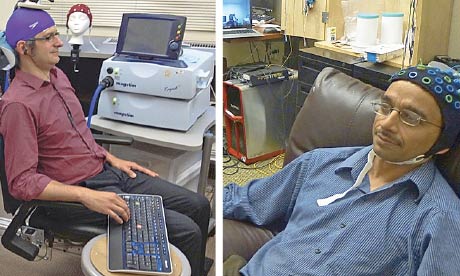
It's a milestone breakthrough you would think came straight from science fiction, but a recent study conducted by the University of Washington claims to have demonstrated direct brain-to-brain communication between humans. Via an elaborate internet setup between two labs, scientist Rajesh Rao sent a signal into his colleague Andrea Stocco's brain that caused him to involuntarily move his right hand. Pretty cool, yes. But should we be as excited about this latest development as the men in white coats are?
Well, yes and no. While any advancement in brain-reading technology should be applauded – after all, the human brain is the most complex thing in the universe – there are several aspects of this study that should be kept in mind (no pun intended). For one, claims that this experiment demonstrates direct brain-to-brain communication really stretch the definition of "direct"; the procedure requires complex technology, including electroencephelography, transcranial magnetic stimulation and the internet. The information undergoes numerous conversions before it arrives at the brain of the recipient. Speech is more direct.
The information conveyed is also somewhat simple – a basic hand movement. While still impressive, we are a long way from conveying internal dialogue, hidden secrets or mental images, the sort of thing usually associated with telepathic mind reading. The individual who "transmitted" the information also underwent training, so this isn't something just anybody could do.
When we make recordings from the brain via technology – such as functional magnetic resonance imaging scanners – the data obtained has to be extensively processed and analysed in order to obtain any sense from it. And even then, it's not an exact science. Still, that has not stopped us. Some parts of the brain behave consistently enough for us to use their processes: for example activity in the motor cortex is, logically, associated with voluntary movement. We have the technology to read and transmit these signals which allows us to, using only our brains, control a computer, a prosthetic limb or – as revealed in the study – another human.
The process is still crude. We are a long way from becoming Star Trek's Borg, but it is still an interesting step to have made. For now though, if you want to insert your thoughts into someone else's brain, you will have to make do with talking to them.