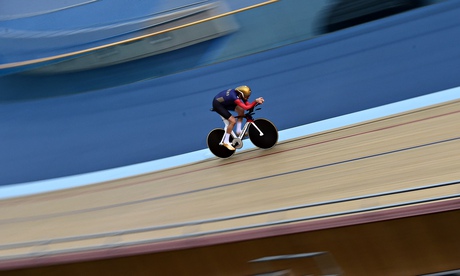
Dating back to 1876, it is cycling’s most prestigious record: one man alone against the clock, silently battling the increasing mental and physical torment that comes with repeatedly pedalling lap after lap after lap of a velodrome in a bid to discover if he can ride further than anyone else in exactly one hour. Cycling at its purest, it could scarcely be simpler and yet it could scarcely be more difficult.
America’s Frank Dodds was the first to have his effort recorded, cycling 26.508km on a penny farthing 17 years before the French journalist and keen cyclist Henri Desgrange posted the first officially recognised distance of 35.325km in 1893, not long after the formation of the International Cycling Association.
Although the idea was not his, Desgrange would go on to launch the first Tour de France. Subsequent maillot jaunes as famous as Fausto Coppi, Jacques Anquetil, Eddy Merckx and Miguel Indurain, winners of 17 Tours between them, are among the most celebrated warriors of the French highways to have taken on and beaten the hour record over the years.
On Sunday, at Lee Valley VeloPark, the scene of so many British track cycling triumphs during London 2012, Sir Bradley Wiggins will attempt to become the latest Tour winner to break the hour record by wrestling it from his compatriot Alex Dowsett, who has had little time to revel in the impressive 52.937km he travelled just over a month ago in Manchester.
Already boasting four Olympic gold medals, the 2012 Tour de France and a world time-trial championship on his palmarès, at 35 Wiggins has few personal cycling ambitions left to realise. His achievements to date have already earned him a knighthood and recently enabled him to achieve another notable career milestone: a guest appearance on Desert Island Discs, where he raised eyebrows by failing to list a single song by his friend and hero Paul Weller among the records with which he’d soundtrack his time in exile as a castaway. Discussing this weekend’s tilt at the hour record, he was characteristically bullish about his chances of breaking it.
“I’m very confident,” he told Kirsty Young, the show’s presenter. “I wouldn’t [try it] if I didn’t think I could do it. But it’s also part of the challenge. These are the things that have always driven me; these huge goals. I’m only going to do it once, to top off everything else that I’ve done and doing it in London as well, where it all started, it’s kind of fitting really.”
Earlier this week, when asked where breaking the hour record would rank in his list of personal achievements, Wiggins said it will depend on how fast he goes. Pressed on whether a particularly brilliant effort could top his past heroics, he admitted it might. “Depending on how far I go, yeah,” he said.
Using the magnificent 1994 hour record of the Swiss rider Tony Rominger as his template, Wiggins has publicly targeted a distance of 55.250km, which would obliterate Dowsett’s effort but still leave him more than a kilometre short of the 56.375km famously posted by Chris Boardman in 1996. It is here things get complicated. After Merckx broke the hour record in 1972, advances in technology led to new scientifically assisted assaults which have since been deemed illegal.
Francesco Moser nudged it past the 50km mark in Mexico City on an aerodynamically enhanced bike featuring disc wheels, before Scotland’s Graeme Obree and his fellow Briton Boardman went toe to toe in the 1990s using innovative aerodynamic equipment and riding positions that prompted the International Cycling Union (UCI) to reset the record to the 1972 effort recorded by Merckx on a comparatively bog-standard bicycle with dropped handlebars and spoked wheels. It was decreed that all future efforts should be attempted on similar machines and this change all but ended interest in the hour record until the UCI president, Brian Cookson, amended the rules again last year. Now it is legal for anyone to try it as long as they use the modern track pursuit bike du jour, which is similar enough to the conveyance on which Rominger posted his – since wiped by the UCI – distance of 55.291km to make Wiggins feel, that he can beat it.
The popular German rouleur Jens Voigt was first to step up in the new era, posting a distance of 51.110km. His mark has since been passed by Matthias Brändle, Rohan Dennis and, most recently, Dowsett. Given the right conditions, Wiggins is cautiously optimistic that he can not only beat the current holder, but also challenge the greatest distance of all posted by his friend Boardman. “The only [uncontrollable] thing that really affects how fast you go on the day is the air pressure, which is going to be one of the highest recorded on Sunday … which doesn’t help,” Wiggins explained. “That could be the difference between doing Chris’s record and doing 55km. It could make a kilometre difference so if I get low pressure, then it’s game on.”
Probably as fed up of the asterisk that blights his magnificent achievement as those tasked with explaining its presence beside his time, Boardman has been more kind to Wiggins than the weather forecast. Upon deciding last year to have what he expects to be his one and only crack at the record, cycling’s Modfather canvassed both the Olympic individual pursuit gold medallist and his childhood hero Indurain for their opinions on the viability of Sunday’s effort. The counsel of the two men could not have been more contrasting. During a long chat in January, Boardman and Wiggins discussed the excruciating minutiae of an endeavour in which the devil resides in the detail, with Wiggins revealing that Boardman eventually told him: “It’ll either be the worst thing you ever do or the best.”
By contrast, brooding, enigmatic Spaniard and five-times Tour de France winner Indurain had little advice to offer, but has thrilled Wiggins by accepting an invitation to the VeloPark. “I spoke to Miguel about it last year and he didn’t really give any … I mean, he was so raw,” said Wiggins. “He had no real experience on the track and he only had three weeks to get ready for it after the Tour and he’d never really ridden a track bike. All he wanted to do was just get the record. He wasn’t interested in putting it out of sight, he just wanted to tick the box and get his name on it, which he did. We got the impression from him that he …” At this point, Wiggins tailed off, momentarily lost for words: “You know, he never used to warm up or anything, he’d just get on the bike and go.”
Similarly shoddy preparation would be anathema to Sir Dave Brailsford, the margins-obsessed boss of Wiggins at Team Sky until the cyclist left after his unsuccessful attempt to win this year’s Paris-Roubaix. Asked if it is easier being his own man in pursuit of the hour record after years of reliance on the fabled Sky support network, Wiggins did not hesitate. “It’s easier, yeah,” he said. “A hell of a lot easier. You’re just like a one-man band. I’ve been the head of it for the last seven weeks, dictating to everyone. It’s like being in charge of the company, really, telling everyone what to do.”
Giving his progress report to a small clutch of journalists, Wiggins looked relaxed and good humoured as he went about the necessary business of drumming up public interest in watching a lone man engaged in the solitary pursuit of cycling around and around and around the timber track of a velodrome for 60 minutes on live television. With the maintenance of a perfect, controlled pace imperative, he wryly conceded that his attempt is unlikely to prove particularly riveting viewing for many of the 4,500 spectators at Lee Valley or other viewers tuning in to watch his efforts on Sky Sports.
“It’s not really a very inspiring thing to watch … until the last 10 minutes,” he said. “In some ways, I wish I’d done it behind closed doors. It’s a bit like a wedding, you know. There’s some people you have to invite but you don’t want to invite and then you’ve got to look after it all.”
In the interests of keeping all present informed in the buildup to the agonising final 12-minute chunk of the five into which he has mentally divided his imminent ordeal, Wiggins has requested that the British commentator Hugh Porter be enlisted. “I think it’s his job to tell the people what they’re seeing and just how hard it is,” he explained. “Some of the hour records have been appalling from a coverage point of view and understanding what’s going on and seeing time splits and where they are in comparison to Rominger or Dowsett [is important].”
In the closing minutes of Wiggins’s record attempt, the viewing public will not need to be told how hard it is, as the grimace across the clenched jaw beneath his golden helmet will convey more information than any commentator. Merckx described his record-breaking hour as the toughest ride of his career, while Wiggins expects his to take him “to the edge of death”. He can at least console himself with the knowledge that Dowsett found his easier than he’d been warned.
“I was expecting it to be horrific but it was just terrible,” he said, after taking the crown. Should Wiggins find himself on course to beat Dowsett at the climax of his own ride, he unsurprisingly insisted he will do everything in his power to set the benchmark for future challengers as high as possible. “Oh definitely, yeah,” he said. “I mean I always empty it anyway, whatever.”