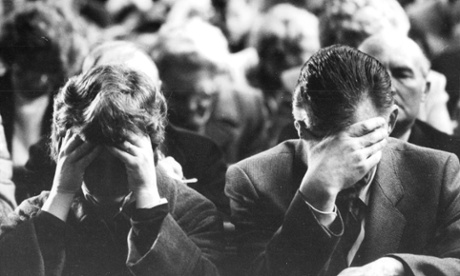
In Bradford, fans were reeling from the revelations in Martin Fletcher’s book, many angry at what they saw as unnecessary muck-raking.
At the time of the blaze on 11 May 1985, Alan Wintersgill was financial director of Tebro, the soft toy company run by Stafford Heginbotham, Bradford City’s flamboyant chairman. Then 34, Wintersgill was at the fateful match, sitting in the directors’ box with Heginbotham’s family. His father was in the stands and was burnt, but survived.
Wintersgill is adamant that three of the eight fires said by Fletcher to be linked to Heginbotham were indisputably not Heginbotham’s fault. The first of these three was at the five-storey Douglas Mills on Manchester road in 1977. He claimed a young man called John Disley admitted arson and was prosecuted.
Two further fires, in 1981 and 1982 or 1983, hit a single-storey unit next to Douglas Mills occupied by a company called AB Plastics. Heginbotham had sold the unit by the time it went up in flames, according to Wintersgill.
Mike Harrison, editor of City Gent, the Bantams fanzine, who was also at the ground when the fire took hold, said fans accepted the findings of judge Oliver Popplewell’s inquiry. “No Bradford City fan wanted to blame the club at the time. We all felt it was handled respectfully … there was nobody clamouring to apportion blame.”
He cautioned against equating the apparent acquiescence of fans with an unwillingness to face the truth. Until now, City Gent had never written about the fire, he said, “because it’s one of those things people don’t want to talk or write about”.
He added: “They see what’s happened with Hillsborough. We have been quite stoical about it. We don’t outwardly show our pain. We just got on with our lives. Probably it’s a particularly Bradford thing. But the Scousers had an injustice to fight. We haven’t, until now, with Martin Fletcher’s book.”