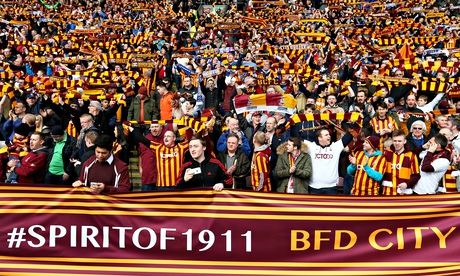
The lunchtime sun was strong enough to persuade a few Bradford City fans to dispense with coats, while a few more went as far as rolling up their sleeves.
As invariably happens on the first warm-ish day of any year, those welcome rays highlighted acres of pasty flesh but the brightness of the afternoon light also served to highlight the horrific state of the pitch. At a stage of the competition when the combatants are within touching distance of Wembley’s pristine turf the tie often seemed primarily about how the teams coped with a playing surface so patchy that some park sides might have turned their noses up at it.
It dictated that the ball spent rather more time in the air than most people would wish. Not that the rather sketchy quality of much of the football diminished the exuberance of a 24,000-plus crowd crammed into a wonderfully atmospheric and evocative arena.
Visits to Valley Parade always prompt memories of the fire here three decades ago and the presence of Phil Parkinson’s team in this season’s FA Cup final, 30 years to the month on from the disaster, would add particular resonance to the occasion.
After bundling the Premier League’s Sunderland and, more significantly, Chelsea out of the Cup in earlier rounds, dispatching the Championship plodders Reading was supposed to be a cake-walk for Parkinson’s League One side. In reality it represented a tripwire and Parkinson – still a cult hero at Reading where he is remembered as one of the club’s best all time central midfielders – knew it. Recovering, as Bradford did, from being two goals down at Stamford Bridge is one thing but the difference between José Mourinho’s players and Reading was that Steve Clarke’s team refused to succumb to the sort of complacency that undid Chelsea. Significantly Clarke also took the precaution of deploying an extra man in midfield and his hosts were clearly hampered by an unusual lack of room for manoeuvre.
Tactics apart, the visiting body language suggested that, in marked contrast to Sunderland last month, they were up for it, with Pavel Pogrebnyak’s advances sporadically sending frissons of fear rippling through the stands, most notably when his shot hit a post. Much as Bradford upped their game – and the tempo – in the second half, Clarke’s defence held ominously firm.
James Hanson is one of those home players who has benefited from working with John Muranka, Bradford’s sports psychologist, but here Parkinson’s leading goalscorer was denied the chances he required to show off his finely tuned penalty area reflexes. Alongside him Jon Stead, a scorer in every previous round, found himself similarly frustrated.
As the sun began dropping a little and, almost imperceptibly, the shadows lengthened, home fans started pulling jumpers, hoodies and coats back on. Even so there were probably a few involuntary shivers as the blue-and-white-clad away support suddenly found their voice.
“Feed the Yak, feed the Yak,” came the chorus from the Reading contingent and, sure enough, on trotted Yakubu. The former Middlesbrough and Everton striker may be routinely described as a veteran these days but the urgent instructions exchanged between Parkinson’s defence and his back line suggested they were not underestimating the Nigerian’s capacity to wreak attacking havoc.
Sure enough there were odd moments when only Yakubu’s habit of straying offside seemed to be keeping the Yorkshire dream alive while Reading’s Oliver Norwood hit a post.
Somehow, though, Bradford hung on with a first semi-final place since 1911 still awaiting Parkinson’s players. Anyone placing a significant bet against them achieving it will be taking quite a risk.