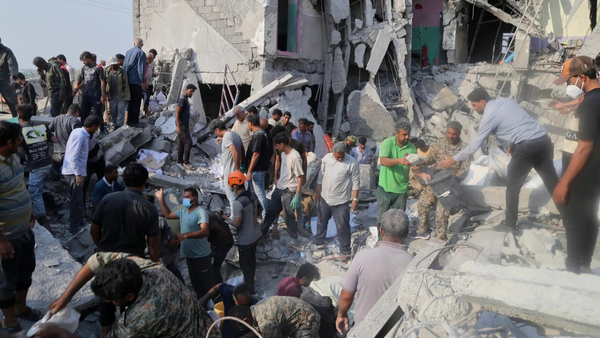
Black Friday morning in Ferguson, Missouri, was a somber affair. Snow on the ground, few people on the streets, most businesses still closed and boarded up. Burned-up cars sat in a row in the parking lot of a used car dealership on West Florissant Avenue. They were the remnants of protests and riots last Monday night, following the news that police officer Darren Wilson would not be indicted for killing unarmed black teenager Michael Brown.
Over at Ferguson’s Walmart, there were no lines circling outside for a 7am opening, no stampedes to buy the last pair of pink, sparkly $12.99 shoes, no rushes for the colossal television sets on sale for $498.
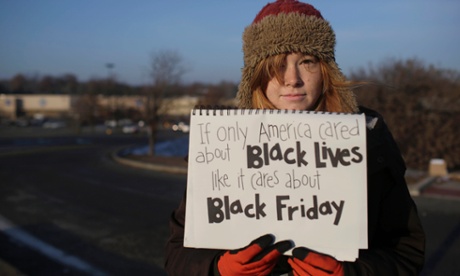
The few customers heading towards the superstore were greeted at the entrance of its car park by half a dozen protesters carrying signs reading: “If only America cared about black lives like it cares about Black Friday” and “Ferguson is everywhere, police brutality and murder must stop.”
Many in their cars honked in solidarity.
“We are calling for a boycott of Black Friday,” one elderly activist shouted towards a passing motorist. “This is not Black Friday; this is Black Lives Matter Friday.”
Aided by the hashtags #BlackOutBlackFriday and #HandsUpDontSpend, activists around the country have been organizing for the large-scale boycott of Black Friday – a day on which Americans traditionally head to malls and superstores for one-of-a-kind deals and discounts.
In Ferguson, people seemed to have read the boycotting memo.
The parking lot in Walmart was one-tenth full, as was Target’s, just a few minutes down the road. Inside Walmart, staff and security outnumbered customers. Clearly, the customer turnout was much smaller than expected.
“Black Friday is traditionally an orgy of shopping. And it’s a tradition. But there is another tradition in America: the killing of black and brown youth,” said one protester, Lou Downey, a 60-year-old Chicago native, who says he moved down to Ferguson the day after the shooting of Michael Brown.
Back inside Walmart, five activists gathered in the toy aisle, discussing tactics. Minutes later, holding their signs, they marched through the store chanting: “No shopping as usual. Black lives matter.”
Shoppers smiled and nodded. Security guards watched on, bemused and slightly stunned.
The protesters were all white, and most of the workers, customers and security personnel – except for the police – were black. But black Ferguson residents were far from absent from the demonstrating ranks in the region.
Delaware-based history professor Jahi Issa, 46, most of whose relatives live in Ferguson, said his whole family was gearing up for a day of protest at another Walmart 15 minutes away. “The entire clan.”
“The only dollars we’ll be spending today are at black-owned businesses,” he stated firmly.
“How did we let that happen? How did they get in?” one of the many security guards at the front of the store asked his colleague after the banner-carrying group had exited.