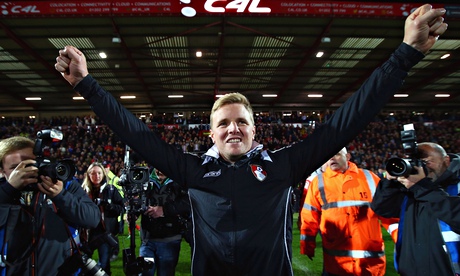
Bournemouth’s fairytale rise from near-extinction to the near-certainty of a place in next season’s Premier League has been causing most of the excitement this week, partly because no one can actually agree whether it counts as a fairytale or not.
On the one hand Eddie Howe’s remarkable rise through the ranks to lead his boyhood club to the promised land is clearly the stuff of legend as is the foresight and public spirit of the consortium which, with scant funds, kept the club going for long enough to attract serious investment in 2011. On the other hand there are those who argue fairy godmothers should not be multimillionaire Russian businessmen and that the Cherries have escaped the Championship on the back of Maxim Demin’s money rather than the footballing ability of Howe and his players.
One can see both sides of this story, though it is certainly not all Grimm. Bournemouth have not exactly been throwing their money around in recent seasons, even if the (actually quite inspired) loan deal for Kenwyne Jones works out as extraordinarily expensive per minute of football played. The club’s biggest signing is Callum Wilson at £3m, worth more now after scoring 20 goals this season but more of a good spot than a luxury item having been picked up from League One Coventry. Other clubs in the promotion race have spent similar amount on players and Bournemouth were able to raise a broadly similar sum through the sale of Lewis Grabban to Norwich. The Cherries might have a rich owner but so do Queens Park Rangers, and there is no comparison in the spending levels between the two clubs. Although Howe has profited from a certain amount of financial stability no one could seriously argue Bournemouth have bought their way to success.
The big question is what happens to the fairytale next season? Can a Dorset club with a ground that holds 12,000 survive among the big bad wolves of the Premier League? What should the strategy be? Batten down the hatches and try to escape with dignity and a couple of seasons’ worth of parachute payments, spend big in the hope of staying up for a while or attempt something in between?
Were Bournemouth to look at the bottom three of the Premier League at the moment they might judge that QPR’s high-spending, high-risk policy has not really worked and neither has changing manager so often. Yet Burnley’s solid, sensible, let’s-stick-together approach has hardly paid dividends either. It would appear you can only get so far with team spirit and do-or-die determination.
Burnley have rarely been disgraced at any time this season. They have given most opponents a run for their money, yet look like going back down to possibly reform for another try under the same manager, minus Danny Ings – who for all his Premier League admirers has found goals difficult to come by. QPR look like joining them and if they do end up in the Championship perhaps there ought to be more emphasis on putting together a team for the long term, one that can not only achieve promotion but arrive in the Premier League as if they intend to stay there.
That is most promoted team’s goal, naturally, though it is easier to plan for the long term if you can take the club’s finances and a degree of support and stability for granted. Leicester have actually executed a survival plan quite well this season. They have kept the same manager, maintained a strong squad of players and posted one or two notable results. It is only because they have left it so late in the season to climb the table that people have been surprised. Leicester are a decent-sized club after all with significant backing, a long tradition and players of Premier League quality. They won the Championship last season with a massive 102 points, nine ahead of Burnley, yet took six months or more to properly find their feet in the Premier League and even now are not certain to survive.
But Leicester are a big-city club with a degree of experience. The best models for Bournemouth to look at from recent years, in terms of small-town Premier League virgins finding themselves blinking in the sudden spotlight, are Blackpool, Oldham and Wigan. Blackpool because when they were promoted via the playoffs in 2010, Brett Ormerod, then in his second spell with the club, described the feeling of earning Premier League status as “like finding yourself on the moon without a space suit”. That is a good analogy for anyone in Bournemouth’s position to remember even if Blackpool subsequently soured all the feelgood factor surrounding promotion by starving the manager and the team of funds and suffering double relegation as a consequence.
A far better example to study is Oldham Athletic under Joe Royle, who were never actually promoted to the Premier League but found themselves in it when the divisions were rebranded in 1992 after winning the old Second Division title a year earlier. Though initially playing at a Boundary Park with an even smaller capacity than Bournemouth’s home, Oldham thrived for a few seasons in the Premier League – many will remember how they came within a last-gasp Mark Hughes semi-final volley of sabotaging Manchester United’s first league and cup double in 1994 – mainly through Royle’s adroit management and eye for a player. Oldham had excelled in the second tier, using players such as Paul Warhurst, Earl Barrett and Denis Irwin who moved on to bigger clubs.
By the time of the 1994 Cup semi Irwin was lining up for United and Royle was referring to Alex Ferguson as a robber for stumping up only around £600,000 for him. Royle had picked up the Irishman on a free from Leeds four years earlier but for Oldham that was the name of the game. They did not really expect to hang around at the highest level all that long but while they were up they could certainly make a go of it and turn a profit on players.
That was broadly the approach Paul Jewell used when taking Wigan up in 2005. No one gave them a prayer in the Premier League, everyone predicted instant and ignominious failure, yet in that first season the Latics hit the ground running. They gave José Mourinho’s Chelsea a scare in their first Premier League game, then proceeded to pick up enough points to be quite comfortable by Christmas. In the seven seasons of Premier League football that followed Wigan became synonymous with late runs and last-minute escapes, but their first season up was a dream, apart from the result in the Carling Cup final against Manchester United. And look at the number of Wigan players, either from the promotion season or the first couple of Premier League campaigns, who moved onwards and upwards.
Leighton Baines, Pascal Chimbonda, Jimmy Bullard, Arjen de Zeeuw, Antonio Valencia, Jason Roberts and others. Even Emile Heskey got a leg up but he was the exception rather than the rule. Very few of the others were established Premier League performers when they joined Wigan though they went on to be.
That seems to be the way to do it. You need to cast your net a little wider than Burnley have done but there is no need to throw masses of money at the problem. Wigan, like Bournemouth, had a generous benefactor, though throwing masses of money at anything is not in Dave Whelan’s character. He was willing to sanction spending on the right players, by the right manager, always with a long-term view. Easier to say than to put into practice, but there is a safe middle ground for small clubs to seek out.
• This article was amended after initially being launched with an incorrect photograph