TAKARAZUKA, Hyogo -- The Osamu Tezuka Manga Museum in Takarazuka, Hyogo Prefecture, reopened in April after undergoing renovations for the 25th anniversary of its opening.
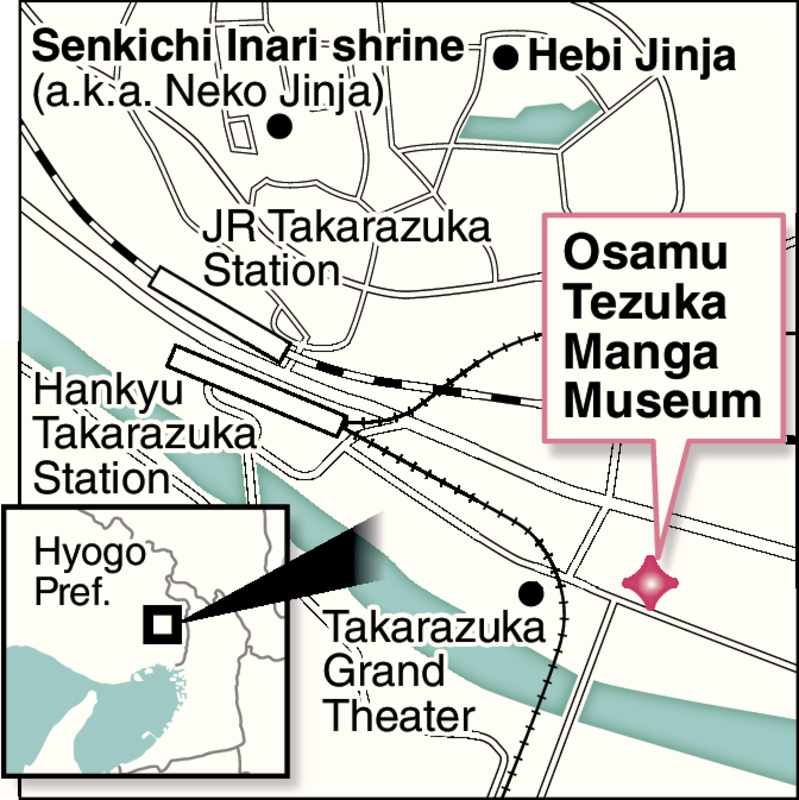
Tezuka lived in Takarazuka for about 20 years from the age of 5. There are a number of spots related to the manga artist around the train stations in Takarazuka, including those nicknamed Neko Jinja (Cat shrine) and Hebi Jinja (Snake shrine).
Tezuka fans can get a map from the museum and walk around these attractions, and I took my own trek through these sacred sites for fans of Tezuka's work.
A source of brightness
To reach the museum, visitors get off the Hankyu Line at Hankyu Takarazuka Station, pass along "Hana no Michi" (Flower road), and walk east for another several minutes, passing by the Takarazuka Grand Theater.
Tezuka was born in what is now Toyonaka, Osaka Prefecture, in November 1928, and lived in Takarazuka from age 5 to 24.
In his collection of essays, "Garasu no Chikyu wo Sukue" (Save Our Mother Earth), Tezuka described the city thus: "In my childhood, I ran around in mountains, beside rivers and wild fields, and I concentrated on collecting insects. This left unforgettable memories and a brightness in my mind and deep in my body."
Museum director Shinichi Kawai, 43, said: "Two major themes -- 'love for nature' and 'the preciousness of life' -- underlie all 700 works by Mr. Tezuka. This museum was built because these two themes stemmed from his experiences in Takarazuka."
The renovation of the museum further emphasizes the relationship between Tezuka and the city.
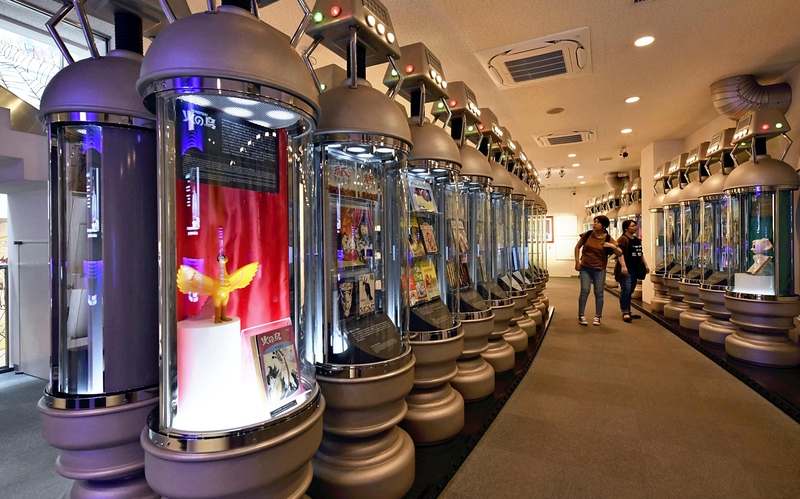
On the first floor, items in 40 capsules divided into such categories as "favorite tools," "insects and boys" and "the end of the line" are displayed as part of the museum's permanent exhibition.
The written descriptions of his connections with Takarazuka are also interesting.
About "Janguru Taitei" (Jungle Emperor Leo), the description says, "Aiming to publish it as a comic book series, [Tezuka] drew and stored the original cartoons for more than a year at his home in Takarazuka."
About "Tetsuwan Atom" (Astro Boy): "The series was drawn in Takarazuka until spring 1952, when [Tezuka] moved to Tokyo."
On the second floor, the renovations created a new exhibition space in which manga works that Tezuka created in Takarazuka from around the age of 8 are displayed in chronological order.
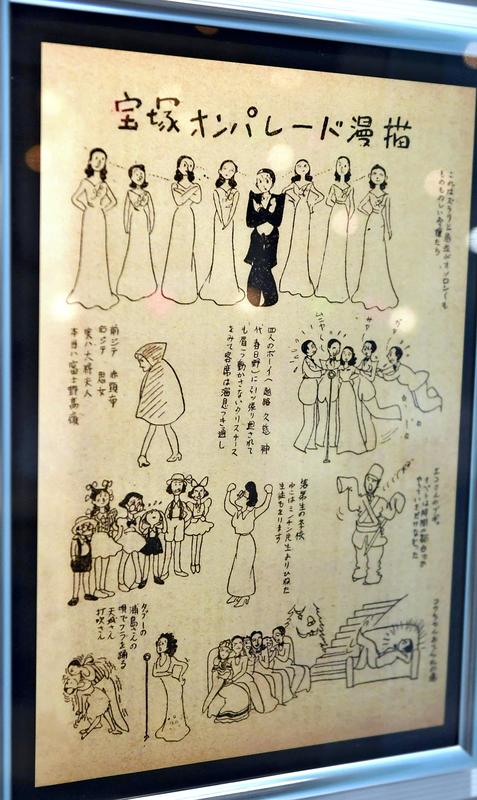
They include "Oyaji Tantei" (Old Man Detective), a manga Tezuka drew at age 14. It contains an early appearance of the famous mustached character Higeoyaji, who is featured in many of Tezuka's works. There is also a manga work that Tezuka contributed to an internal newsletter of the Takarazuka Revue troupe.
Collecting bugs in the forest
The museum distributes copies of a B4-size map that introduces spots related to Tezuka. Going out the north exit of JR Takarazuka Station, I climbed up a slope and reached one of the spots in less than 10 minutes.
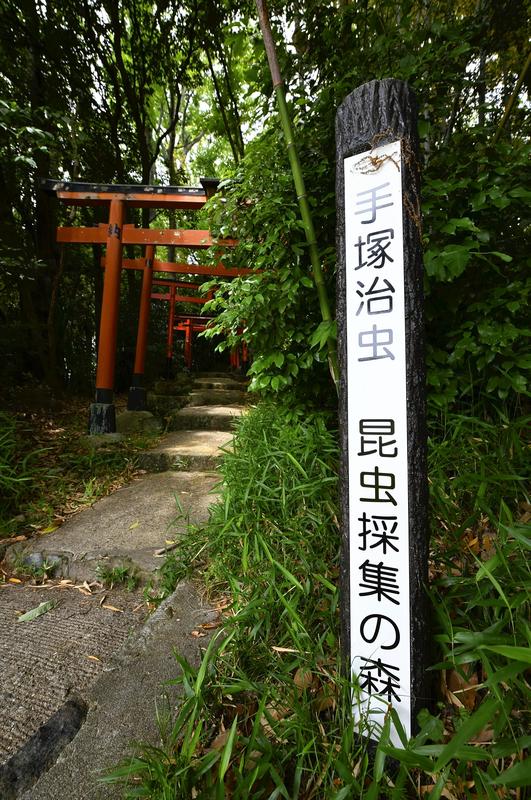
The whole zone is now a residential area, but a small forest is in sight. It's called "Senkichi Inari no Mori" (Forest of Senkichi Inari shrine). At the entrance of the shrine is a monument bearing the words "Tezuka Osamu Konchu Saishu no Mori," or "a forest where Osamu Tezuka collected insects."
The monument was created by members of Senkichi Inari Sewaninkai, a local residents association comprising about 10 households in the area. Generation after generation, members of the association have held annual events related to the shrine.
According to members Satoshi Minami, 75, and Kenji Adachi, 67, the shrine originated in the last years of the Edo period (1603-1867). A now-deceased male member of the association who had ties with the Tezuka family proposed establishing the monument in 2010.
Minami and Adachi also participated in building the monument. They said the forest is a precious place where trees grow the same way as in the past, and thus the members have a strong desire to pass on its history.
The shrine is nicknamed Neko Jinja. Tezuka's younger brother, Hiroshi, 88, who now lives in Osaka, said he began visiting the shrine when he was a fourth-grade elementary school student.
Hiroshi remembered those days, saying: "There were two sawtooth oak trees, and many insects like stag beetles, nymphalids and similar varieties gathered over sap on the trees. My brother Osamu told me about it. And he also told me there was a cat inside the sanctuary house of the shrine deep in the area."
The Tezuka family house was near the shrine, to the southeast. A camphor laurel tree remains there, and about 500 meters north from the tree, there is a small shrine sanctuary house. Tezuka called it Hebi Jinja and featured it in his short manga work.
Hiroshi said: "There was a 'chodo' along which swallowtail butterflies fly in cirles. My brother and I waited for them for a long time."
While walking around based on such pieces of information, I passed a small butterfly. It made me imagine the past scenery full of living creatures, and I felt a little excited.
-- Osamu Tezuka Manga Museum
The museum is about a 10-minute walk from Takarazuka Station on JR or Hankyu lines. As a new service following its renovations, a theater on the first floor screens unique "Jikken" (experimental) animation works as monthly specials.
On the second floor is search equipment visitors can use to watch anime videos from the past and a library containing about 2,000 manga and related books.
On the underground floor, visitors can experience the basics of making anime movies in a corner named Anime Kobo.
The museum is closed on Wednesdays. Call (0797) 81-2970 for more information.
Read more from The Japan News at https://japannews.yomiuri.co.jp/