Amid many recent news stories headlined with such discouraging words as "feeling depressed," "stagnation" and "collapsed" due to the coronavirus outbreak, here's good news for you: You may be able to enjoy eel dishes at reasonable prices this summer, thanks to bountiful catches of glass, or young eels, which will be used to farm Japanese eels.
Although the eel industry has been suffering from poor catches in recent years, some areas have already stopped fishing for young eels this season due to excessive catches. The eel industry hopes that the nation will see the end of coronavirus outbreak by summer so many people can appreciate the nourishing food.
The bountiful catches of young eels are surprising people in the industry. Prefectures nationwide have seen greater catches this season between November last year and April.
By April 27, Aichi Prefecture had seen 1.86 tons (4.7 times larger than last season); Shizuoka 1.63 tons (3.4-fold increase); Tokushima 0.7 ton (5.3-fold increase) and Kagoshima 0.73 ton (5.4-fold increase), according to a recent survey by The Yomiuri Shimbun. Overall catches in the nation amount to at least 7.7 tons, more than double the record low 3.7 tons recorded last season.
Born near the Mariana Islands in the Pacific Ocean, young eels drift with the current and arrive in the waters near Japan. However, their life patterns remain unknown and it is unclear what brought good catches this season and poor catches last season.
"We see good catches every few years, but [the abundance of] this season is something we haven't experienced in the last several decades," said an eel distributor in Western Japan.
Young eels caught in the sea or estuary are cultivated in aquaculture ponds. Those that grow fast become adults in about half a year and are shipped to market. Aquaculture ponds in various parts of the country are already full, and fishing in Chiba and Shizuoka prefectures has already ended, one to two months earlier than scheduled.
To prevent an oversupply, the Fisheries Agency has called for a nationwide suspension of fishing young eels as abundant catches push down market price. In recent years, young eels have become expensive and are dubbed as "white diamonds," however, this season saw a great decline in prices. In Tokushima Prefecture, young eel was priced at 920,000 yen per kilogram (last season 1.55 million yen) and in Kagoshima Prefecture, it fetched a price of 350,000 yen (900,000 yen previous season).
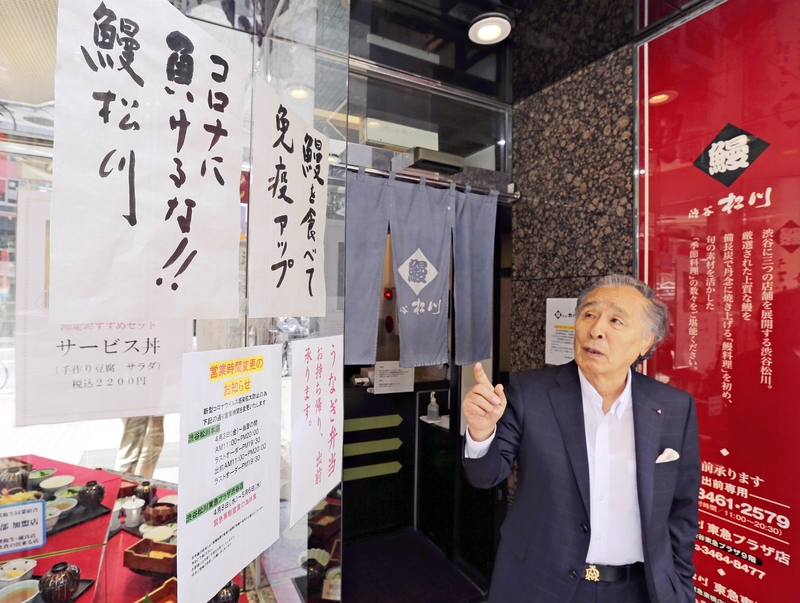
"The number of customers has never decreased this much since the restaurant opened immediately after World War II," said Shunsuke Sanda, the 77-year-old president of a long-established eel restaurant, Shibuya Matsukawa, in Shibuya Ward, Tokyo, recently.
Although it was about lunchtime, the restaurant located very close to the famous scramble crossing in front of Shibuya Station was empty.
Foreign tourists have stopped coming and the number of customers to the restaurant has dropped by more than 70% since the government declared a state of emergency in Tokyo and six other prefectures on April 7.
Hoping to cover the loss by taking delivery orders, the restaurant made about 30,000 flyers. Chefs and other staff distributed them to neighbors because they have time due to shorter business hours, which was caused by the COVID-19 pandemic. However, such efforts are insufficient to cover the loss.
Sanda serves on the board of a Tokyo-based association comprised of about 150 eel restaurants nationwide.
"Some [eel] restaurants are experiencing a loss of customers by more than 90%. Their businesses are in a critical situation," Sanda said. "Yet, we can't ask customers to dine out because people are refraining from going out [to help halt the pandemic]. If eel prices fall, we'll offer dishes at lower prices, which will lead to a revival of the restaurants."
The Union of Eel Farmers Cooperatives of Japan said that eel retail prices will likely start to decline as early as ahead of Doyo no Ushi, the traditional eel-eating day, in late July and the trend could continue next year.
Read more from The Japan News at https://japannews.yomiuri.co.jp/