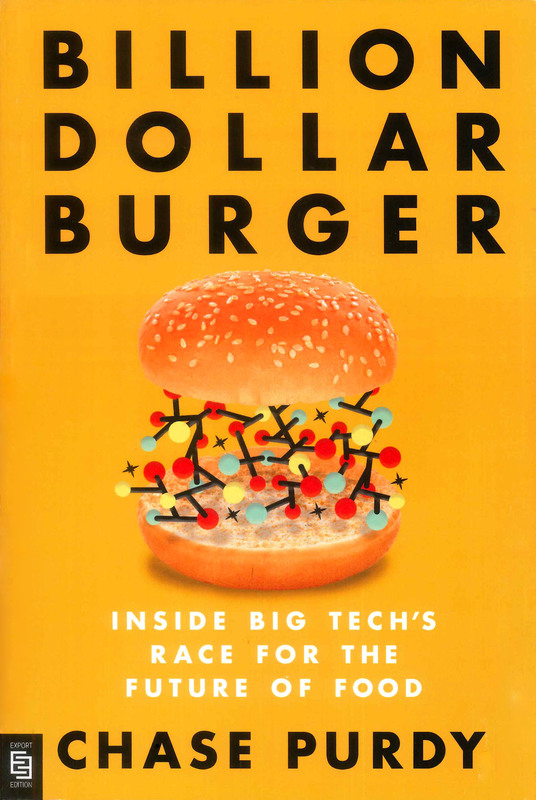
Livestock agriculture is a major source of greenhouse gases and a driving force behind deforestation. But meat is delicious. Pathogens such as salmonella and E. coli are often spread via meat. But meat dishes are cherished in many cultures. Factory farming is horrific. But many people love the aroma of beef on the grill.
Wouldn't it be great if meat could be produced cleanly and efficiently -- perhaps even grown in a laboratory vat?
Business and technology journalist Chase Purdy has visited the labs and offices of many of the companies now working to make that sci-fi dream a reality. In his new book, "Billion Dollar Burger," he writes, "I look forward to a day when I might be able to ethically make my mom's pot roast without the guilt of knowing it came from an unsustainable segment of the larger food system."
But is that vision realistic?
As Purdy describes it, the production of cell-cultured meat (one of many terms used for this new kind of flesh) requires three basic things: animal cells, a medium to grow them in and a "bioreactor." Of course, the devil is in the details.
For instance, bird cells are easier to cultivate than mammal ones, Purdy tells us. Prototype cell-cultured chicken nuggets exist now, but it will be years before you can taste a convincing lab-grown steak (or pot roast).
Concocting a medium in which cells can grow quickly is the main technical challenge.
"It's a witch's brew of macromolecular 'growth factors' such as amino acids, sugars, lipids, and hormones that cells need to survive and proliferate ... The most advanced start-ups have their own custom-tailored potions ... the recipes are closely guarded intellectual property."
As for the bioreactors, they are big containers that must be "able to maintain a constant temperature, regulate pH levels, ensure that enough oxygen is moving around the tank, and manage nutrient concentrations and acidity."
Almost as daunting as the technical challenges are the regulatory ones. A chapter titled "Food Fight" describes how, in the United States, the Department of Agriculture and the Food and Drug Administration got into a bureaucratic power struggle over who would be in charge of this nascent industry. (They ended up agreeing to joint oversight.)
In another chapter, Purdy describes the misfortune of a European science museum that merely planned to display a sample of cell-cultured meat, only to be admonished by food safety officials over trafficking in illegal goods. It was "a clear sign that the pathway to market would be a slow and arduous one as governments looked at [the] products with skepticism."
The book looks at cultured-meat start-ups in several countries, including Israel, where food security is part of the motivation for developing a new protein source that is not land-intensive.
A more common motivation is money -- or at least the potential for it. Investors in the field include chicken giant Tyson Foods and pharmaceutical giant Merck.
The most frequently mentioned motivation for individuals in the field is concern for animal welfare. Many of those involved in cultured-meat start-ups are vegans. Josh Tetrick, cofounder and CEO of California-based Eat Just, Inc., is a notable example. His company's main products are eggless mayo and plant-based "eggs," both of which can already be found in U.S. supermarkets.
Purdy gives this company the lion's share of attention in his book. As he explains, it is the only cultured-meat start-up "that is already an operational food company. Tetrick has years of experience working with suppliers, retailers, food service companies, restaurant chains and distributors -- and those relationships are going to be invaluable as the company looks to introduce new food products to the market."
The author sometimes seems enamored of his subject, but he makes a visible effort to include varying views, such as those of former employees who called Tetrick "a lying, manipulative, attention seeking, reactionary, incompetent, Steve Jobs wannabe." Ouch.
So far, most companies have focused on growing muscle cells. But real meat also includes vascular "scaffolding" to help give it form and fat to give it flavor. Less work is being done on those aspects, so most of the cell-cultured meats described in "Billion Dollar Burger" are suited to products with no inherent form, like sausages, pates, nuggets and of course burgers.
Even so, in one brief but intriguing passage, Purdy describes amazement at a visit to California-based Memphis Meats, where he was served a piece of chicken that could be pulled apart into stringy, fibrous pieces, just like part of an actual dead bird.
As for myself, I love a juicy steak. But after reading this book, if I knew that the animal it could have come from was still mooing contentedly in a clovery meadow, I just might enjoy it even more.
-- By Tom Baker, Japan News Staff Writer
Read more from The Japan News at https://japannews.yomiuri.co.jp/