

Rising anxiety over swelling household debt has prompted the Bank of Thailand's rate-setting committee to pause hikes Wednesday after December's tightening, which was meant to ward off potential financial stability risks.
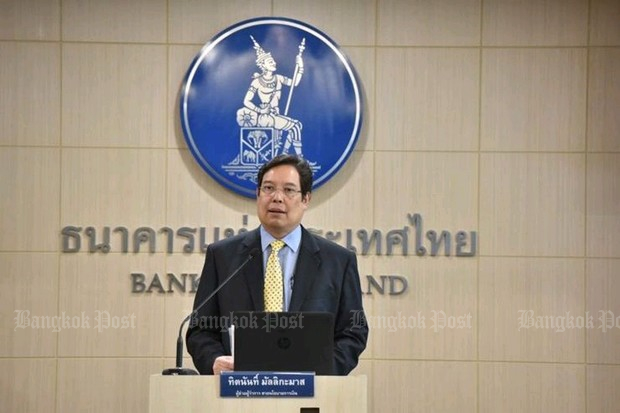
Households have run up debt again, as seen by the uptick in the household debt-to-GDP ratio in the third quarter last year. The figure is expected to increase again in the final quarter of 2018, said Titanun Mallikamas, secretary of the Monetary Policy Committee (MPC).
"Among several downside risk factors, MPC members are concerned about financial stability risk after the country's household debt has started to pick up," he said.
The MPC voted 4-2 to maintain the policy rate unchanged at 1.75%. Two members voted to raise the policy rate by 0.25 percentage points from 1.75% to 2%, while one member was absent.
The increase in household debt could be attributed to rapid growth in auto loans, in line with the country's solid car sales, Mr Titanun said.
More stringent lending measures are not needed, but the central bank will monitor the situation, he said.
The country's household debt ratio was a tad higher at 77.8% in the third quarter of last year, up from 77.7% in the previous quarter.
Mr Titanun said the accommodative monetary policy stance contributed to continued economic growth and was appropriate, given subdued inflation.
In deliberating the policy decision, the MPC assessed that the economy would continue to expand based on domestic demand, despite a slowdown in external demand.
Headline inflation was restrained by lower energy prices and subject to increased downside risks, while core inflation would edge up in line with previous projections.
Overall financial conditions remain accommodative and conducive to economic growth.
The economy as a whole was expected to continue expanding to its potential despite increased downside risks as the global economic slowdown, trade protectionism measures between the US and China, and the slump in electronic products dealt a blow to merchandise exports growth.
Tourism is projected to improve, mainly on the back of a faster-than-expected recovery in the number of Chinese tourists.
The central bank will also monitor property and the mortgage loan market after the announcement for the more stringent requirements on loan-to-value ratio, which will be effective from April this year.
Condo purchases by Chinese buyers amid weaker global economic growth, particularly in China, also warrant monitoring, Mr Titanun said.
He said the country's general election will have an impact on economic direction, for which the central bank will monitor the political situation.
Tim Leelahaphan, an economist at Standard Chartered Bank Thai, said: "In 2019, we forecast two 25-basis-point interest rate hikes, one each in the first half and the second half, versus the consensus view of an on-hold stance. The Bank of Thailand has emphasised financial stability risks from prolonged low rates."













