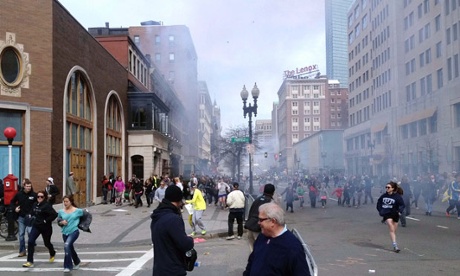
It has been almost two years since two backpack bombs, made from pressure cookers and stuffed with nails and ball-bearings, were detonated at the finish line of the Boston Marathon, killing three people and injuring hundreds of others in the most jarring terror attack on US soil since 9/11.
On Wednesday, just two miles from where the bombs went off, the trial of the younger of the two alleged perpetrators is finally set to begin.
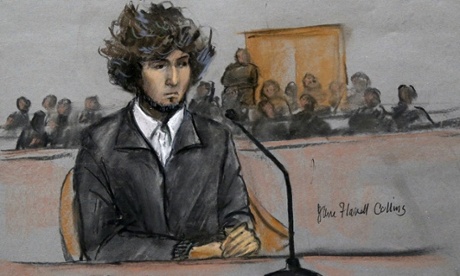
Dzhokhar Tsarnaev, 21, a Kyrgyzstan-born naturalised US citizen from nearby Cambridge, is the younger of the two brothers accused of perpetrating the 2013 attack.
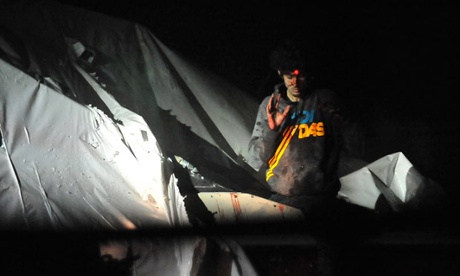
His elder sibling, Tamerlan, was killed in a shootout with police four days after the bombing; less than 24 hours later, Dzhokhar was captured by police after a manhunt of unprecedented scale, drenched in blood and near-unconscious, hiding under a boat’s tarpaulin in a backyard in the Boston suburb of Watertown.
In a case expected to provide unvarnished answers to an episode thatcaptivated the world, Tsarnaev faces 29 charges, including the use of a weapon of mass destruction, conspiracy to bomb a place of public use resulting in death, bombings of places of public use resulting in death, and possession and use of a firearm in relation to a crime of violence.
On Tuesday in court, presiding judge George O’Toole said the long-awaited words to 12 Massachusetts citizens: “You have now been selected as the trial jurors.”
And so begins the highest-profile federal terrorism trial on American soil since the 1997 conviction – and later execution – of Timothy McVeigh, the Oklahoma City bomber. Like McVeigh, Tsarnaev faces the possibility of the death sentence if convicted.
The Boston Marathon trial is expected to drag out through a lengthy sentencing phase, but Wednesday’s opening statements follow a jury selection process which has taken several months. In January, more than a thousand potential jurors were summoned for the first stage, in which they each filled out a 28-page, 100-question form.
After the first stage began six weeks of voir dire, interrupted intermittently by the record-breaking winter weather, 256 potential jurors were cross-examined by the court to establish their suitability, finally whittling the potential jury pool down to 75.
Because the charges carry a potential death sentence, the jury must be what is known as “death-qualified”, meaning that anyone who confesses an absolute philosophical opposition to capital punishment – or an absolute philosophical commitment to it – is automatically ineligible.
On Tuesday, in the final stage of jury selection, the defence and prosecution rejected more people from the jury pool without giving a reason before the final group and six alternates – eight men and ten women – were seated.
With the jury finally ready, all eyes turned to possible tactics available to the defence. It is considered fairly likely that they will not aim to argue for Tsarnaev’s innocence outright, but instead look to paint him as a junior partner in the attack, an impressionable stoned teenager in thrall to his elder brother.
So far, Tsarnaev’s defence team had filed a barrage of motions to delay, defer and relocate the trial. They have claimed that Tsarnaev can never receive a fair trial in Boston, and that the jury pool does not contain enough minorities. They even requested on Monday that the boat in which Tsarnaev was eventually found hiding in should be brought into the courtroom to be admitted as evidence.
In the defence’s latest motion for a change of venue – its fourth – filed on Tuesday, Tsarnaev’s attorneys observed that 42 of the 75 qualified jurorsself-identified as having a connection with the events or people at issue in the case, and 23 of them stated in their questionnaires that in their opinion Tsarnaev is guilty.
So far, however, Judge O’Toole has rejected all such requests, and an appellate court has also turned down two appeals. O’Toole is acting – and questioning the jury pool – from an oft-stated belief that, even in Boston, jurors can be found who can honestly and in good faith put aside their biases, ignore the blanket media coverage and return a fair verdict based on the facts presented to them in court.
It will remain to be seen whether the judge is correct in his insistence.