Corporate travel spending reached $1.48 trillion globally in 2026, and ground transportation remains central to executive mobility. In Boston, corporate clients increasingly prefer professional chauffeur services for executive transfers instead of on‑demand rideshare, driven by heightened duty of care, security, and strict timing requirements. Local firms such as Blue Nile Livery, based at 175 William F McClellan Hwy, Boston, MA 02128, have adapted fleets and operating practices to meet executive expectations across the Financial District, Seaport, Kendall Square, and the city’s medical and university corridors, with a car service Boston option that supports reliable airport transfers and scheduled executive trips.
This article examines Boston corporate ground transportation statistics, 2026 trends, executive mobility patterns, and airport transfer demand to show how companies balance cost, reliability, and sustainability.
What Are the Key Boston Transportation Trends in 2026 for Corporate Travel?
Executive travel behavior shifts and fleet choices define Boston mobility patterns in 2026. Seventy-three percent of Fortune 500 firms now require black car service for C-suite travel to reduce exposure to risk and guarantee privacy. Corporate travel budgets grew modestly, with U.S. travel managers estimating a 4.9% rise in 2026 that supports higher spend on ground transport reliability. Business travel continues to drive 50% to 70% of hotel demand in Boston, indicating potential corporate room revenue increases and reinforcing steady demand for premium transfers.
Airport transfer demand at Logan International Airport rose with passenger volumes. Logan handled nearly 44 million passengers in fiscal 2025, a 5% increase year over year, and 22% of passengers used MBTA, Logan Express, or private bus services—an all-time high for transit share. Corporate travelers now prioritize precise pickup timing, and professional operators offer guaranteed arrival windows for Terminal A, Terminal B, Terminal C, and Terminal E. Private Car Service to Logan Airport remains the preferred option for executive pickups because it combines predictability with trained chauffeurs familiar with Logan’s terminal staging and tunnel access routes.
Business district patterns show concentrated demand. The Financial District produces heavy morning and evening chauffeur bookings tied to institutional finance and consulting clients. The Seaport District grows rapidly and could surpass 50,000 workers by 2030, boosting midday and evening transportation. Kendall Square’s cluster of Google, Biogen, Pfizer, and other biotech firms generates frequent executive trips between lab sites, investor meetings, and hotels. Back Bay and the Longwood Medical Area maintain consistent corporate mobility needs due to major hospitals and life sciences companies.
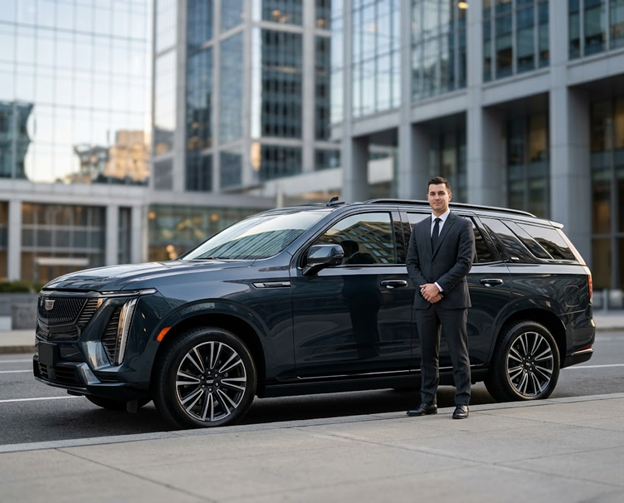
Luxury transportation usage reflects sustainability and comfort priorities. Corporate requests for electric vehicle (EV) options rose to 35% in 2026 from 12% in 2023, and 28% of professional fleets include at least one electric vehicle. High-demand premium models include the Mercedes-Benz S-Class, Cadillac Escalade, Lincoln Navigator, and Mercedes-Benz Sprinter for groups. Fleet modernization continues, with the all-electric Cadillac Escalade IQ entering service in late 2026 and shifting fleet composition in the luxury SUV segment.
How Much Do Companies Spend on Boston Corporate Ground Transportation?
Corporate ground transportation spending varies by traveler frequency, sector, and negotiated contract terms. Average annual spend per frequent traveler ranges from $2,400 to $4,800. Per-employee averages across all staff fall between $340 and $680. Financial services, consulting, and legal firms spend the most on frequent travelers—$4,200 to $6,500 annually—while technology and healthcare companies average $2,100 to $3,400 per frequent traveler.
Market rates influence corporate budgeting. Sedan services in major U.S. markets charge $85 to $165 per hour, and airport transfer pricing for Boston ranges from $125 to $225 depending on vehicle class. Companies negotiating annual spend above $50,000 commonly secure 15% to 25% discounts. Travel managers track reliability with on-time arrival percentages, model cost predictability, and measure duty of care compliance rates. Contracts for Private Transportation Service increasingly define service levels, insurance requirements, and cancellation protections to avoid rideshare cancellation risk and to meet corporate compliance standards.
Regional travel context supports growth. U.S. corporate travel spending exceeded pre-pandemic levels by about 12% in 2026, and passenger volumes are expected to rise 6% to 10% in 2026. These dynamics sustain demand for consistent chauffeur-driven transfers and incentivize companies to lock in predictable pricing with established providers.
What Business Traveler Preferences Are Reshaping Boston Ground Transportation?
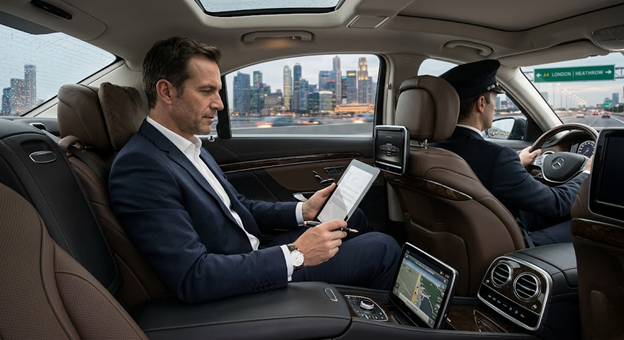
Core executive expectations shape the service design for Boston Car Service providers. Executives require absolute privacy during travel, with no conversations permitted in the vehicle unless initiated by the passenger. Punctual arrivals matter for board meetings and client pitches, and guaranteed pickup windows reduce the risk of missed engagements. Executives expect premium seating, precise climate control, reliable Wi-Fi, and professional luggage assistance, especially for Terminal E international arrivals. Local route familiarity proves essential for timely trips across Interstate 90, Interstate 93, Storrow Drive, and the Massachusetts Turnpike.
Technology adoption moved from optional to standard. AI-assisted global logistics networks integrate corporate account booking, while real-time transit analytics optimize routes around commuter rail and backlog conditions. Urban mobility platforms connect South Station, Back Bay Station, and North Station to provide end-to-end itineraries that combine chauffeur service with rail or shuttle legs when appropriate. Car Service Boston providers deployed booking apps with corporate account billing and live ETA updates to satisfy travel managers’ reporting needs.
Sustainability considerations influence procurement decisions. SEC climate disclosure rules enacted in 2026 require companies to report emissions, motivating travel managers to prefer tracked low-emission transportation and to include EV options in supplier scorecards. Municipal and state EV incentive programs eased fleet modernization costs, accelerating short-haul EV adoption in chauffeur fleets.
Chauffeur service demand strengthened against rideshare alternatives. Travel managers prioritized licensed, insured carriers that reduced enterprise risk and offered consistent duty of care compliance. Chauffeur-driven transportation service contracts expanded across biotech and financial sectors that require secure, private transport for high-value personnel.
Companies Choosing Professional Car Service Over Rideshare
Security and risk mitigation drive the majority of corporate decisions favoring professional services. Seventy-eight percent of corporate travel managers prefer traditional car services for executive airport transfers because they deliver dedicated drivers vetted for corporate security protocols. Professional services guarantee reliability and eliminate rideshare cancellation risk that undermines tight meeting schedules. Licensed and insured services satisfy corporate procurement and legal teams who require documented compliance for executive travel.
Operational advantages increase the value proposition. Chauffeur-driven airport car service providers stage vehicles near terminals and use dedicated pickup processes to reduce wait times and navigate Ted Williams, Sumner, and Callahan Tunnel access on arrival. Drivers trained in Logan’s terminal routing reduce misdirected pickups and speed baggage handling for Terminal A through Terminal E. Corporate event transportation to Boston Convention and Exhibition Center, Hynes Convention Center, TD Garden, and Fenway Park also benefits from coordinated staging and fleet allocation strategies that rideshare cannot reliably deliver, and many companies now include point to point transportation service in their supplier agreements to ensure consistent transfer quality.
Cost considerations favor contracted services for heavy corporate users. Negotiated rates and volume discounts yield clear per-trip savings for firms with regular transfer needs, while predictable billing simplifies budget forecasting. Private Transportation Service contracts also provide service-level agreements covering on-time performance, vehicle specifications, and emergency response protocols preferred by risk-conscious employers.
Major Companies Driving Boston Corporate Transportation Demand
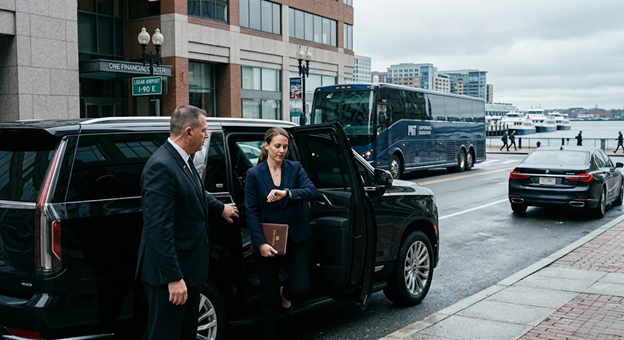
Financial services leaders and large institutional employers create persistent demand. State Street, Fidelity Investments, Bain Capital, and Liberty Mutual generate daily chauffeur needs for investor meetings, client travel, and executive itineraries. Technology and biotech employers, including Vertex Pharmaceuticals, Boston Consulting Group, General Electric, Amazon, Google, and Microsoft, source executive transport for campus-to-campus transfers and investor roadshows. Universities and research institutions such as Harvard University and Massachusetts Institute of Technology book coaches and private transfers for donors, visiting scholars, and conference delegations. Hospitals and medical centers, including Massachusetts General Hospital, Brigham and Women’s Hospital, Beth Israel Deaconess Medical Center, Dana-Farber, and Boston Children’s Hospital, require specialized routing for medical leadership and conference travel.
Infrastructure and Route Patterns for Corporate Ground Transportation
Key transportation hubs anchor corporate routing. Logan International Airport remains the primary arrival point for corporate visitors, supported by South Station and Back Bay Station for commuter rail connections to the Financial District and Back Bay. Route 128 Station supports suburban commutes, while North Station facilitates event transfers to TD Garden.
Major roads and tunnel routes shape timing and contingency planning. Interstate 90 links Logan to downtown corridors, Interstate 93 connects north-south business nodes, and Storrow Drive links Back Bay to Fenway event zones. Operators plan routes around peak congestion windows and tunnel restrictions to minimize delays.
Business district travel patterns follow predictable peaks. Downtown Boston exhibits morning peaks between 7:00 and 9:00 AM for chauffeur arrivals, while the Innovation District sees afternoon meeting clusters from 2:00 to 5:00 PM. Beacon Hill serves government and legal sector needs, and Copley Square acts as a fulcrum for hotel pickups during conferences and corporate events.
Conclusion
Corporate transportation in Boston shifted decisively toward private transportation service models in 2026, driven by duty of care, precise timing needs, and sustainability reporting requirements. Providers such as Blue Nile Livery demonstrate how fleets modernize with Mercedes-Benz S-Class sedans, Cadillac Escalade SUVs, and electric options to meet executive demands across the Financial District, Seaport, and Kendall Square. Airport transfer demand at Logan International Airport will continue to grow as corporate travel budgets expand, and licensed Logan Airport Car Service operators will dominate executive pickups by offering guaranteed arrival windows, terminal staging, and documented compliance.
Car Service Boston companies that integrate EV options, AI logistics, and sustainability tracking will meet 2026 corporate procurement criteria and maintain competitive positioning. Professional chauffeur services will remain preferred over rideshare for Fortune 500 travel programs because they deliver security, reliability, and contractual protections. Corporate event transportation to Boston Convention and Exhibition Center, TD Garden, and Hynes Convention Center will drive seasonal peaks, while hospitals and universities will continue to require specialized routing and coach services. The Boston transportation trends 2026 landscape rewards licensed, insured chauffeurs with local route familiarity, consistent service levels, and fleet modernization focused on low-emission and premium vehicle choices.