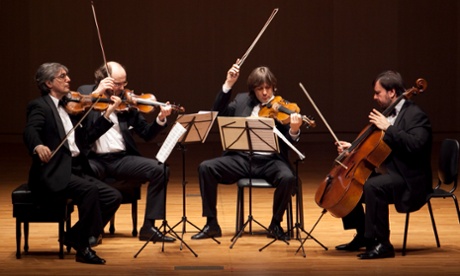
Beethoven and Shostakovich have been the twin poles by which the Borodin Quartet has steered its collective career throughout its long history, and in London the group is marking the 70th anniversary of its formation with a cycle of the quartets of both composers spread across three seasons.
With changes of personnel inevitable in the quartet over such a long period (though the cellist Valentin Berlinsky was a member for 62 years, replacing Mstislav Rostropovich in the original lineup just a few weeks after the group was formed), the Borodin can sometimes seem more like a musical brand than a group of players that has matured together and shared its creative ideas. As this latest recital showed, there is still very much a Borodin way of doing things, a corporate approach to music-making that is entirely homogeneous and, to my ears at least, rather dull.
Whether in Shostakovich (the rather innocuous First Quartet in C, and the death-haunted 13th in B flat minor) or Beethoven (Op 130 in B flat, with its replacement Allegro finale rather than the Grosse Fuge), there was little sense of give and take, of players listening to each other or striking new creative sparks. Each work seemed to receive what was the authorised Borodin performance: wonderfully suave, rich-toned and technically assured, certainly, but leaving no room at all for spontaneity or creative risks.
Everything was just a bit too safe. Even the spectral dance of the central section of Shostakovich’s 13th, with its skeletal tappings and forced gaiety, lacked a real shiver, while nothing in the Beethoven seemed to be given quite the expressive space it needed; the Presto second movement was a scramble, the Alla Danza Tedesca fourth short on lilting grace, while the Cavatina was just a shade too fast to convey the emotional weight it can.