The next global battery race may not be fought over electric vehicles.
As governments seek to reduce dependence on China's lithium supply chain and artificial intelligence fuels a surge in electricity demand, a new battleground is emerging: long-duration energy storage.
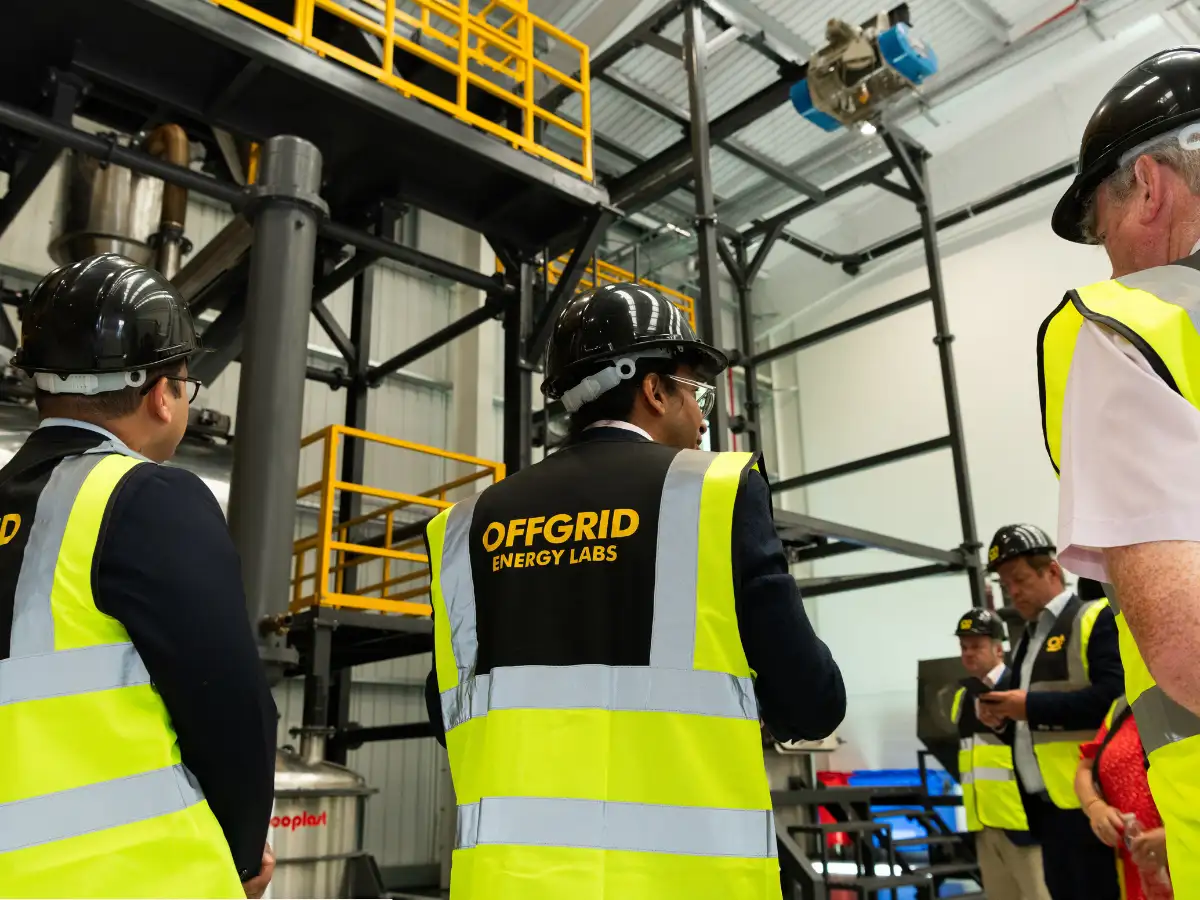
That is the opportunity Offgrid Energy Labs is chasing. The company traces its origins to IIT Kanpur, where its founders met and began developing the battery technology before taking it to global markets. Today, its first manufacturing facility is in the UK, while its technology—developed through years of R&D in India—is being positioned for applications ranging from AI data centres to renewable energy storage, where the company believes alternative chemistries can complement lithium rather than replace it.
"Many years back when we started this, the four of us had this dream of building a battery which is not only sustainable but also commercially viable—and can be built anywhere in the world," Rishi Srivastava Co-founder, Offgrid Energy Labs, said.
Offgrid's ZincGel platform is built on zinc-bromine chemistry, which the founders say offered the best balance of safety, longevity and commercial viability for stationary energy storage after evaluating multiple battery chemistries.
"Everybody knew that this battery chemistry works, but how do we make it commercially viable? The entire innovation has been on materials chemistry, design of the battery and manufacturing... bringing down the cost and improving the performance," Tejas Kusurkar, Co-founder & CEO, Offgrid Energy Labs, said.
The company says zinc-bromine batteries are non-flammable, can operate across a six-to-sixteen-hour discharge range and are designed for more than 20 years of operation.
Also Read| India-origin battery tech powers Offgrid's first UK manufacturing facility
The company's thesis comes as countries including India, the US and members of the European Union invest heavily in building domestic battery manufacturing ecosystems and reducing reliance on imported critical minerals and battery technologies. India's ₹18,100-crore Advanced Chemistry Cell (ACC) production-linked incentive scheme is among those efforts, although much of the country's current strategy remains centred on lithium-ion technology.
Betting where China is less dominant
“One of our key design goals was to make stationary energy storage both sustainable and commercially viable,” Srivastava said.
China has spent years building a commanding position across the lithium-ion battery value chain—from refining critical minerals and processing battery materials to manufacturing cells at scale. According to the International Energy Agency, the country accounts for the majority of global battery cell production capacity and dominates several stages of battery materials processing, prompting governments elsewhere to diversify supply chains.
Offgrid isn't trying to take on lithium across every application.
Instead, it is targeting long-duration stationary energy storage, where batteries store electricity generated from renewable sources for six-to-sixteen hours before discharging it when demand peaks. Unlike electric vehicle batteries, where energy density is paramount, long-duration storage places greater emphasis on lifecycle, safety and cost over repeated daily charge-discharge cycles.
"Energy storage would become a geopolitical issue... More and more countries are becoming very wary of putting all their eggs in the lithium basket," Srivastava added, arguing that battery supply chains are increasingly becoming an energy security issue rather than just a manufacturing challenge.
The company says its batteries use materials such as zinc, bromine, carbon and polymers that are widely available across geographies, allowing manufacturing to be localised instead of relying on concentrated supply chains. That proposition, it argues, offers governments and utilities an additional option as they seek greater resilience in battery supply chains.
Lithium-ion batteries, however, remain the dominant technology globally, backed by decades of manufacturing scale, falling costs and a mature supply chain. Alternative chemistries such as zinc-bromine, sodium-ion and vanadium flow batteries are still at much earlier stages of commercial deployment and will need to prove they can compete on cost, reliability and scalability.
Choosing zinc over the periodic table
According to the founders, the team spent years evaluating multiple battery chemistries—including lithium, aluminium, manganese and carbon-based supercapacitors—before narrowing its focus to zinc-bromine. The decision was driven less by inventing a new chemistry and more by identifying one that could be made commercially viable for long-duration storage.