Afternoon summary
- The BBC has agreed to pay the £600m-plus annual cost of providing free TV licences for the over-75s in return for being allowed to increase the fee in line with inflation. John Whittingdale, the culture secretary, told the Commons that the BBC had offered to start paying the cost of the free licences, but Labour critics described the deal as an “assault on BBC independence” and a “shabby backroom deal”.
-
George Osborne, the chancellor, has told MPs that the prospects of a “happy resolution” to the Greek crisis are “sadly diminished” by yesterday’s referendum. He told MPs:
The situation risks going from bad to worse. Britain will be affected the longer the Greek crisis lasts and the worse it gets. There is no easy way out but even at the 11th hour, we urge the eurozone leaders and Greece to find a sustainble solution. Meanwhile, here in Britain we must redouble our efforts to put our house in order.
- John Bercow, the Commons Speaker, has granted a request from Alistair Carmichael, the Lib Dem former Scottish secretary, for an emergency debate on the government’s plans for English votes for English laws (Evel). The debate, which will take place under standing order 24, will take place tomorrow.
-
A poll of Londoners has shown that only 21% of them support cutting the top rate of income tax to 40p in the pound. Two thirds of respondents were in favour of keeping it at 45p, or raising it to 50p.
That’s all from me for today.
Thanks for the comments.
The BBC Trust has released the text of a letter from Rona Fairhead, its chair, to George Osborne and John Whittingdale about the BBC settlement. She says the trust accepts the decision, but objects to the way it was taken, because licence fee payers were not consulted.
Here’s an extract.
We accept this decision is a legitimate one for the government to take, although we cannot endorse the process by which it has been reached ... The trust has a specific duty to represent the interests of licence fee payers. We are disappointed that they have not been given any say in the major decisions about the BBC’s future funding.
And here’s the text.
Letter from @bbctrust Chairman Rona Fairhead to @George_Osborne and @JWhittingdale on over 75s TV licence concession pic.twitter.com/Dq1Sq1q8AW
— BBC Trust (@bbctrust) July 6, 2015
Updated
Here’s an update on John Whittingdale’s tie. (See 4.07pm and 4.17pm.)
Sources from the parenting community disclose Whittingdale was in fact not wearing a Wallace and Gromit tie, or apparently a Shaun one.
— Isabel Hardman (@IsabelHardman) July 6, 2015
Ruth Davidson, the Scottish Conservative leader, is joking about doing a Sturgeon. (See 12.41pm.)
@IsabelHardman to IPSO with you for that gross error!
— Ruth Davidson MSP (@RuthDavidsonMSP) July 6, 2015
And George Osborne, the chancellor, has also put out a statement about the BBC agreement.
The BBC is a valued national institution that produces some of the finest television and radio in the world. But it is also a publicly-funded body, so it is right that it, like other parts of the public sector, should make savings.
The deal we have agreed with the corporation means that it will take on the significant cost of TV licences for the over-75s, easing some of the pressure on taxpayers who have to meet the country’s welfare bill, while also ensuring that our promise to maintain pensioner benefits is met in full over the next five years.
The decisions the BBC and the government have reached together will also secure its long-term future, with a funding model that is sustainable and can adapt in an age where technology is rapidly changing.
Tony Hall, the BBC director general, has put out this statement about the BBC settlement.
We have secured the right deal for the BBC in difficult economic circumstances for the country. This agreement secures the long term funding for a strong BBC over the next charter period. It means a commitment to increase the licence fee in line with inflation, subject to charter review, the end of the iPlayer loophole and the end of the broadband ring-fence. In the circumstances, the BBC has agreed take on the costs for free licence fees for over-75s, and after the next parliament, will take on the policy.
And here is some more Twitter comment on the BBC announcement.
From Peter Preston, the media commentator and former Guardian editor
Free? The BBC has become a wholly bullied adjunct of HMG...
— Peter Preston (@PJPrest) July 6, 2015
From Newsnight’s Chris Cook
TBF, if BBC switcheroo were part of the £12bn of benefit reductions, pedants like me would point out that's cutting the BBC, not benefits.
— Chris Cook (@xtophercook) July 6, 2015
This is from General Boles, a spoof political account.
Due to BBC cutbacks, 2016's Glastonbury coverage is just @xtophercook on Periscope at the side of the John Peel stage.
— General Boles (@GeneralBoles) July 6, 2015
And here is an exchange between Peter Oborne, the former Telegraph columnist, and Nick Robinson, the BBC’s political editor.
.@OborneTweets BBC asked for series of guarantees re future income - licence fee link to CPI & needed for iPlayer + end digital subsidy
— Nick Robinson (@bbcnickrobinson) July 6, 2015
Ben Bradshaw, the Labour former culture secretary, says the Tory assault on the BBC is a reward to the rightwing papers that backed the party at the election.
Osborne rewarding Tories' newspaper proprietor backers by hacking back BBC & forcing licence payer to fund free licences for over 75s
— Ben Bradshaw (@BenPBradshaw) July 6, 2015
And this is how Chris Bryant, the shadow culture secretary, started his Commons response to John Whittingdale.
What an utter shambles. It is not even the chancellor who comes to give the budget any more. Elements are briefed out to the Sunday newspapers, and then the chancellor goes on the BBC to tell the BBC and the nation what’s going to be in his budget three days later. There was a time when chancellors were forced to resign because elements of their budget were leaked. Now we actually get every single element of it briefed deliberately, and he has the chutzpah then to pretend that this is a proper process ... This is no way to run a whelk stall, let alone the the world’s most respected broadcaster.
Bryant also made the point about Whittingdale going back on the point his committee made in his BBC report about the need for licence fee settlements to be properly debated. (See 4.38pm.)
During John Whittingdale’s statement the Labour MP Paul Farrelly quoted from a report the Commons culture committee produced earlier this year (pdf), when Farrelly was a member and Whittingdale was chair. Farrelly said this was a recommendation that Whittingdale proposed. He read it out. It is from paragraph 50, on page 124.
It was wholly wrong that 2010 licence fee settlement, which permitted the licence fee revenue to be used for new purposes, was not subject to any public or parliamentary consultation. We recommend that income from the licence fee (or the broadcasting levy) be used only for the purpose of broadcasting or the production of public service content on television, radio and online.
Farrelly asked why Whittingdale had changed his mind.
Whittingdale said the licence fee settlement would be subject to consultation and debate. What he was announcing today was not a licence fee settlement, he said. But he did not address the point about the report saying licence fee money should only be used for broadcasting or content, where he clearly has ignored his own committee’s recommendation.
Updated
Here’s Ben Bradshaw, the Labour former culture secretary, on John Whittingdale’s announcement.
Forcing licence-payer to fund over 75's concession turns BBC into branch office of Pensions Department & badly undermines its independence
— Ben Bradshaw (@BenPBradshaw) July 6, 2015
John Whittingdale's statement - Extracts
Here is an extract from John Whittingdale’s statement.
Under this agreement, the BBC will take on the cost of providing free television licences for those households over 75 and this will be phased in from 2018/19, with the BBC taking on the full costs from 2020/21.
Having inherited a challenging fiscal position the government is pleased that the BBC has agreed to play its part in contributing to reductions in spending like much of the rest of the public sector, while at the same time further reducing its overall reliance on taxpayers.
As part of these new arrangements, the government will ensure that the BBC can adapt to a changing media landscape.
The government will therefore bring forward legislation in the next year to modernise the licence fee to cover public service broadcast catch-up TV.
In addition the government will reduce the broadband ring-fence to £80 million in 2017/18, £20 million in 2018/19, £10 million in 2019/20 and to zero in 2020/21.
The government will consider carefully the case for decriminalisation in the light of the Perry Report and the need for the BBC to be funded appropriately. No decision will be taken in advance of charter renewal.
The government anticipates that the licence fee will rise in line with the CPI over the next charter review period, subject to the conclusions of the charter review in relation to the purposes and scope of the BBC and the BBC demonstrating that it is undertaking efficiency savings at least equivalent to those in other parts of the public sector.
The “broadband ring-fence” refers to money set aside by the BBC to pay for the roll-out of broadband under a previous settlement with the government. Previously that money had been set aside for the digital TV switchover.
Updated
Here’s a picture of that Wallace & Gromit tie.
John Whittingdale announces BBC must pay for £650m of pensioner licenses. While wearing a Wallace & Gromit tie. pic.twitter.com/dMvjwsg6hG
— David Singleton (@singersz) July 6, 2015
Here is the start of the Press Association story about the BBC statement.
The BBC has agreed to fully fund free TV licences for over-75s from 2020/21, the culture secretary has said.
John Whittingdale said the process will be phased in from 2018/19, adding the Government is pleased the broadcaster has agreed to “play its part in contributing to reductions in spending like much of the rest of the public sector” while further reducing its “reliance on taxpayers”.
He also announced legislation will be brought forward in the next year to “modernise the licence fee” to cover public service broadcast catch-up TV - an apparent nod towards allowing charging for people who opt to use the iPlayer.
The BBC licence fee of £145.50 is also expected to rise in line with the consumer price index (CPI) measure of inflation, Whittingdale said.
The Tory frontbencher added the government will “consider carefully” the case for decriminalising non-payment of the licence fee.
Labour labelled the “backroom deal” as “shabby”.
Ben Bradshaw, Labour’s former culture secretary, also accused the Government of attempting to make the BBC a “branch office” of the Department for Work and Pensions.
BBC settlement - Verdict from the Twitter commentariat
Here is some Twitter comment on the statement.
From the Guardian’s Dan Sabbagh
Every time the BBC licence fee is renegotiated it ends up as a shabby back room deal between the Treasury and the corporation...
— Dan Sabbagh (@dansabbagh) July 6, 2015
BBC takes on £500m+ pa cost of taking on free licence fees for the over 75s in return for inflation linking (last seen at 0.1% in May)
— Dan Sabbagh (@dansabbagh) July 6, 2015
Game plan seems to be to make BBC responsible for restricting cost/eligibility of free TV licences whilst taking cost from govt's books
— Dan Sabbagh (@dansabbagh) July 6, 2015
From CapX’s Iain Martin
If the government wants to gift free TV licences to the over 75s (stupid idea), why should the BBC pay for it?
— Iain Martin (@iainmartin1) July 6, 2015
For years the Tories have talked to each other about cutting down the BBC to size. Think they may be surprised by the extent of the backlash
— Iain Martin (@iainmartin1) July 6, 2015
From the Guardian’s Matt Wells
The BBC has 'agreed' to take on £600m cost of free TV licences. Quote marks essential ...
— Matt Wells (@MatthewWells) July 6, 2015
Why did the BBC accept this shabby deal? In the small print, is it merely lightly stained?
— Matt Wells (@MatthewWells) July 6, 2015
From Ben Fenton, a former Financial Times media correspondent
BBC deal seems to pit uncerainty (CPI rises/iPlayer revenues) against certainty (Baby Boomers turning 75 from 2020 onwards). I fear for BBC
— Ben Fenton (@benfenton) July 6, 2015
Updated
Good spot by Isabel Hardman.
In the Commons, John Whittingdale is wearing a Wallace & Gromit tie as he announces changes to BBC licence fee and so on.
— Isabel Hardman (@IsabelHardman) July 6, 2015
Whittingdale's statement - Summary
Here are the key points from John Whittingdale’s statement.
- Whittingdale confirmed that the BBC would take responsibility for funding free TV licence fees for the over-75s. It will start bearing the cost in 2018-19, and pay the full cost from 2020-21.
- He said the government would allow the BBC to charge for iPlayer services.
- He said the government would consider decriminalising non-payment of the licence fee.
-
He said the government expected the licence fee to rise in line with CPI inflation over the next charter period.
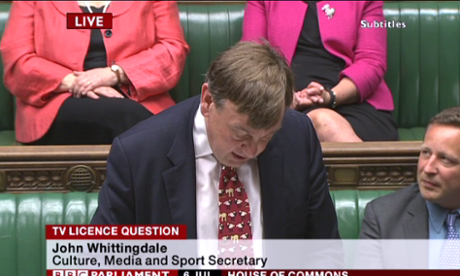
Philip Davies, a Conservative, says if the BBC ever gets tired of sucking on the teat of the licence fee payer, it can always try its luck with a subscription model.
Paul Farrelly, the Labour MP, says he served with Whittingdale on the Commons culture committee. In a report five months ago, the committee said that licence fee decisions should be decided by parliament, and it said the licence fee money should all go on programmes.
Whittingdale says the licence fee settlement will be subject to debate and consultation.
Peter Bottomley, a Conservative, asks if the age at which people get free TV licences will be fixed forever at 75.
Whittingdale says it will be fixed at that level for this parliament. After that, it will be up to the BBC.
The SNP’s John Nicolson asks if the BBC will be allowed to means-test free licence fees for the over-75s.
Whittingdale says all over-75s will continue to get free TV licence fees during this parliament. After that, it will be a matter for the BBC.
Whittingdale says the government plans for the BBC licence fee to rise in line with CPI inflation over the next charter period, subject to the charter review.
Whittingdale is responding to Bryant.
He says he is surprised Bryant is so hostile when he has answered his question.
He says the BBC is satisfied with this deal.
But it does not pre-empt charter renewal, he says. Before the summer recess, he will publish a green paper on charter renewal. He also says he will publish the Perry report.
He says he will consider the case for decriminalising non-payment of the licence fee.
Bryant is responding to Whittingdale.
He says this is chaotic. In the past chancellors had to resign for leaking details of the budget. But these details came out at the weekend, and Whittingdale has just given a mini budget statement.
He asks what the full value of the BBC cuts will be?
Will the licence fee stay?
Will the BBC be allowed to charge for the iPlayer?
Whittingdale's statement on the BBC
Chris Byrant, the shadow culture secretary, asks for an urgent statement on the government’s policy on free TV licences.
John Whittingdale, the culture secretary, says there will be a budget statement on Wednesday, but he will make a statement now.
The BBC will start taking on the cost of free TV licence fees from 2018-19, and will take on the full cost from 2020-21.
He says the government will bring forward legislation to modernise the licence fee next year.
It will allow charging for public service catch-up TV (ie, iPlayer).
The broadband ring-fence will be cut, falling from £80m in 2017-18 to zero in 2020-21.
-
Whittingdale confirms that BBC will have to start paying the cost of free TV licences from 2018-19.
Updated
Matthew d’Ancona had an interesting line on the BBC story in his Guardian column today.
The plan to make the BBC pay for free television licences for the over-75s is part of the process of charter renewal and (I am told) will only be fully comprehensible in the context of the full deal that is being brokered. The political twist is that Osborne has long wanted to reform pensioner benefits but in a rare instance of true disagreement he has been overruled by David Cameron. This will make both men happy. The benefit will remain in place, but not at the expense of the Treasury.
On the Andrew Marr show yesterday (pdf) George Osborne was asked about the Sunday Times story saying he wanted to get the BBC to meet the cost of free TV licences for the over-75s. He did not deny it, but said that the BBC had a history of being able to find savings.
I remember five years ago doing a deal with the BBC where actually the BBC did make around £500 million of savings or took on £500m’s worth of responsibilities, including things like the BBC World Service. I was told at the time by people they’re going to shut down BBC2, they’re going to close Radio 4. They always seem to pick the juiciest fruit on the tree.
Osborne also complained that the BBC’s website was providing unfair competition for newspapers.
If you look at the BBC website, it’s a good product but it is becoming a bit more imperial in its ambitions.
John Whittingdale's statement on BBC facing £600m cuts to fund free licence fees for over-75s
John Whittingdale, the culture secretary, is responding to an urgent Commons question at 3.30pm on reports that the government, in the budget, will get the BBC to meet the £600m-plus cost of paying for free licence fees for the over-75s.
Here is the Guardian version of the story. And here’s how it starts.
The BBC could close a channel the size of BBC2 or the whole of its radio division if it were required to shoulder the £600m-plus burden of free licence fees for the over-75s in Wednesday’s budget.
Chancellor George Osborne is expected to announce in Wednesday’s budget that the corporation will have to meet the cost of free TV licences for the elderly, which could amount to about a fifth of the BBC’s total £3.7bn income. Having announced plans to cut 1,000 jobs last week, the BBC is expected to have to cut services to pay for such a charge.
The cost of free licence fees for over-75s was £606m last year. Currently paid for by the government, it is forecast to rise to £631m this year.
BBC2, the home of Top Gear, Wolf Hall and Newsnight, cost £522m last year, less than the total needed to cover the cost of free TV licences for the over-75s.
The story was broken by the Sunday Times yesterday. And here is what Tim Shipman, the Sunday Times’ political editor, said about it in his Red Box email briefing.
That’s a sizeable chunk of cash (a fifth of the BBC’s licence revenue) towards the £12 billion of welfare cuts promised, at least £8 billion of which will be unveiled in Wednesday’s budget. In return, the BBC will be allowed to make up some lost revenue by charging customers who use the BBC iPlayer and other online catch-up services in an attempt to stem the loss of revenue caused by people abandoning their televisions. That’s a major development for consumers who don’t usually care about the minutiae of budgets.
Under the plans, free TV licence will remain in place until 2020, because that was a Tory manifesto promise. But the most delicious element of all this, for sharp-incisored Osbornites, is that it will then be up to BBC bosses - who have gleefully encouraged negative stories about cuts over the last five years - whether to maintain the free licences for the elderly or enact a welfare cut of their own.
Alistair Carmichael, the Lib Dem former Scottish secretary, is going to make an application later today for an emergency debate on English votes for English laws.
Mr Speaker has granted to hear an application from Alistair Carmichael (after UQ & Statement) on having an emergency SO24 debate on EVEL
— Labour Whips (@labourwhips) July 6, 2015
If John Bercow, the Speaker, allows a debate, it would be held within 24 hours. But @ParlyApp thinks Bercow is more likely to say no.
As #EVEL debate already scheduled for next week, difficult to see the Speaker granting SO24 debate pic.twitter.com/xgtYlLouBU
— PARLY (@ParlyApp) July 6, 2015
The Labour MP Sarah Champion has also praised Simon Danczuk for speaking out about his depression.
Really admire @SimonDanczuk for being open & honest about the pressure MPs are under. Good for him for seeking help & not ignoring symptoms.
— Sarah Champion MP (@SarahChampionMP) July 6, 2015
Simon Danczuk's World at One interview - Summary
Simon Danczuk, the Labour MP, has been in the news recently because his marriage has broken up. That’s a private matter, and I haven’t covered it on the blog, but his World at One interview is worth reporting, because it is rare to find MPs talking openly about the psychological pressure that come under at work.
-
Danczuk said that campaigning against child abuse, and listening to so many stories from victims, had made him depressed, and even at times suicidal.
It’s made me depressed, there’s no doubt about that. I would say I’ve been suffering from depression, to the point where I’ve decided to seek help for that. I was getting angry at stuff I shouldn’t be getting angry at, fairly mundane things; getting aggressive, not violently aggressive, just getting angry about things; perhaps drinking a bit too much, a full bottle of wine of an evening, especially on Fridays when I would meet with a number of the victims. At times suicidal thoughts as well ...
But he stressed that what he was experience was nothing compared to what abuse survivors had suffered.
- He said that the problem had been going on for about 12 months, but that he had recently sought medical help and been referred to a psychiatrist. He said that he came from a background where people were not expected talk about being depressed, but he said he had found talking about the problem helpful.
- He said that he was stepping back from his child abuse campaigning. He said that he had been reluctant to do this, but that the psychiatrist had effectively given him “permission”, and that he had found this helpful.
-
He said the problem had contributed to the break-up of his marriage.
I think it took its toll on our marriage, there is no doubt about that ... On a practical level, Karen [his wife] would say, ‘Why don’t we not talk about this tonight, can we have a night off talking about child sexual abuse?’ Because I would be coming home some nights wanting to download some of what I’d heard ... Not everyone wants to listen to it, quite understandably.
-
He said depression was a problem for some MPs. Asked if there were many at Westminster with similar problems, he replied:
There’s no doubt about it. It’s inevitable with the lifestyle, with the nature of the job, with the types of issues that you are dealing with.
- He praised John Bercow, the Commons Speaker, for ensuring that help is now available within parliament for MPs with problems like this.
-
He said there was too much emphasis on politicians having to be tough.
There’s a thing in politics about being tough. You’ve got to be tough, you know what I mean. Well, I don’t think that’s such a virtue, is it, not in this day and age.

Updated
John Woodcock, another MP who has been willing to talk openly about his struggle with depression, has commended his Labour colleague Simon Danczuk for being prepared to talk about his difficulties.
Very sorry to hear, @SimonDanczuk. Well done for taking time to get sorted. https://t.co/5bKM9wRmRx
— John Woodcock (@JWoodcockMP) July 6, 2015
The World at One has just broadcast its interview in full. I will post some more excerpts from it shortly.
Danczuk says campaigning against child abuse made him depressed
The BBC website has more details from Simon Danczuk’s interview.
-
Danczuk says that campaigning against child abuse made him depressed and that, as a result, he sought psychiatric help. Here is an extract from the BBC’s write-up of Danczuk’s interview with the World at One’s Becky Milligan.
He previously investigated allegations against former MP Cyril Smith, and has pressed the Home Office for action in relation to other historical abuse cases.
“I would say I have been suffering from depression to the point where I have decided to seek help for that,” he said, revealing that he had experienced suicidal thoughts at times.
He said he was “getting angry at stuff I shouldn’t be getting angry at, fairly mundane things” and becoming “aggressive - not violently aggressive - but getting angry about things”.
Mr Danczuk, who has been an MP since 2010, said he was “perhaps drinking a bit too much”, particularly after his meetings with abuse victims.
He said Parliament offered a regular “MOT” with a doctor who had referred him to a psychiatrist, who had given him “permission” to step back from the work, he said.
Mr Danczuk, who recently separated from his wife, said he was “in no doubt” it had take its toll on his marriage.
Updated
Here is a quote from Simon Danczuk, the Labour MP who has told the World at One that is he is stepping back from his child abuse campaigning because it is making him depressed.
Well, it’s made me depressed, there’s no doubt about that, to the point where I’ve decided to seek help for that ... I was getting angry at stuff I shouldn’t be getting angry at, getting aggressive, perhaps drinking a bit too much.
I will post more when I’ve heard the full interview.
Lunchtime summary
- Downing Street has called for a “sustainable solution” to the Greek crisis - but stopped short of saying that Greece should remain in the euro. David Cameron has chaired a meeting on contingency planning on the Greek crisis, and George Osborne, the chancellor, will make a statement to MPs at 3.30pm, which I will be covering in detail. The Foreign Office has also warned Britons travelling to Greece that cash machines and credit cards could stop working. (See 12.01pm.)
-
The Labour MP Simon Danczuk has told the World at One that he is stepping back from campaigning on child abuse because dealing with the issue is making him depressed. In an interview to be broadcast shortly, he also said it was making him drink too much.
Coming up on #wato, @SimonDanczuk tells @beckmilligan he's stepping back from his campaign against child sexual abuse pic.twitter.com/oyuIEVv42R
— The World at One (@BBCWorldatOne) July 6, 2015
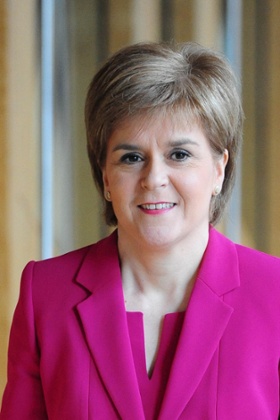
Nicola Sturgeon, Scotland’s first minister, has welcomed a ruling from the Independent Press Standards Organisation (Ipso) criticising the Daily Telegraph for its handling of the story from a leaked memo claiming that Sturgeon privately wanted Cameron to win the election. Ipso said the story was “significantly misleading” because it did not acknowledge that the memo itself contained a line from the author casting doubt on whether Sturgeon really had said what she was meant to have said, and because the Telegraph did not contact Sturgeon for a comment before publication. Sturgeon said the claim was untrue. The Telegraph has published the adjudication today, and flagged it up on the front page.
Sturgeon said:
I welcome today’s unequivocal verdict by Ipso on the Daily Telegraph’s story, which is a victory for effective regulation of the press - and for the truth. The complaint was lodged on the basis that the Telegraph’s conduct in producing this story fell short of the expected journalistic standards. Subsequent events have proven conclusively that the story was entirely untrue, and today’s ruling simply underlines that.
The press have a vital job to do in scrutinising the work of government and of the political process in general. That is a role which is essential for democracy, and it is scrutiny which I welcome. But that does not mean that the press themselves are above and beyond scrutiny and oversight. They have a duty to ensure, as far as possible, that the stories they present to readers are fair, balanced and - above all - accurate. The Daily Telegraph, in failing to carry out the most elementary of journalistic checks and balances, failed in this case to meet that duty.
As the Scotland bill enters its forth and final day of line by line scrutiny in the Commons, there are two amendments up for debate that are interesting not because they face any likelihood of being adopted but for the ramifications for policy up here in Scotland.
First is the amendment to devolve abortion law, including embryology and surrogacy, to Scotland, which has been put forward by three pro-life MPs. You may remember that devolution of abortion was left out of the Smith Commission proposals at the last minute following strong objections from women’s campaigners.
The assumption in much of the reporting has been that this transfer would allow Scotland to take a much more conservative line (this is bound up with fairly basic prejudice about Catholic influence over policy-making), and that’s clearly what the Westminster pro-lifers hope.
In fact, social attitudes to abortion are if anything more progressive in Scotland than in the rest of the UK, but there were worries about shoe-horning the changes into Smith without adequate consultation time, and now concerns about the capacity for Scottish civic society to advance pro-choice arguments when there’s not even one organisation up here publicly funded to do so.
Meanwhile, there are two amendments regarding women’s representation: a generic one from the SNP on devolution of equalities legislation and a specific one proposed by the only Labour MP Ian Murray, devolving the requirement to have 50/50 representation in Holyrood and on public boards.
There is some uncertainty about whether the SNP will support Murray’s amendment, which would seem rather self-defeating given that Nicola Sturgeon herself has signed up to Scotland’s cross-party 50/50 campaign, launched earlier in the year.
50/50 campaigners are disappointed that the SNP appear to be putting party politics ahead of principle on this one. Again, it may seem moot given that neither amendment is likely to pass, but it does set the tone both for Labour-SNP cooperation on women’s issues both in Westminster and Holyrood, where such proposals may have a greater chance of becoming law.
Updated
Number 10 lobby briefing
Here are the main points from the Number 10 lobby briefing.
- David Cameron has chaired a meeting looking at contingency planning around the Greek crisis. It went on for around 45 minutes and it included George Osborne, the chancellor, Mark Carney, governor of the Bank of England, Sajid Javid, the business secretary, Iain Duncan Smith, the work and pensions secretary, Oliver Letwin, the Cabinet Office minister, and David Lidington, the Europe minister. The ambassador to Greece, John Kittmer, and the permanent representative to the EU, Ivan Rogers, took part by video link. The participants discussed what might happen to Britons living or holidaying in Greece, and what impact the crisis might have on the UK. Osborne will update MPs in a statement to the Commons at 3.30pm.
-
Britain wants Greece and its eurozone partners to find a “sustainable solution” to the crisis. The prime minister’s spokeswoman would not say whether or not the government thought Greece should remain in the euro. Asked about this, she said:
There should be discussions between Greece and the eurozone [countries]. [Cameron] thinks that Greece and the eurozone [countries] need to sit down and talk about the implications of the result and what happens next. They need to find a sustainable solution.
But she suggested that Cameron did not want Greece to leave the EU. “We supported Greece becoming a member and we support the EU at 28,” she said.
- The meeting was told that the situation in Greece was “calm”. ATM machines are still dispensing cash and there has been no “significant increase” in the length of queues for cash since last night’s result, the ambassador said.
- Foreign Office advice for people travelling to Greece has been updated since yesterday’s referendum. It says cash machines and credit cards are working now, but could stop working “at short notice”. It also says there are “currently” no restrictions on people taking euros out of Greece, implying this might change.
-
The spokeswoman downplayed suggestion that the Greek crisis could affect Cameron’s EU renegotation. One theory is that the crisis will make it easier for Cameron to demand sweeping reform.
Cameron’s luck is in, Greece has voted No—strengthening his hand in the EU renegotiation http://t.co/mquioaF0Mn
— James Forsyth (@JGForsyth) July 5, 2015
A counter theory is that, with Greece taking up so much attention, EU leaders do not have time to fully focus on Cameron’s demands. Asked what Cameron thought, the spokeswoman refused to back either theory, and instead said Greece and the renegotiation were “two distinct issues”.
Updated
In a good blog for the Resolution Foundation thinktank about low pay, tax and the issues facing George Osborne in the budget, Gavin Kelly, the foundation’s chief executive, dismisses the suggestion that tax cuts (in the form of an increase to the basic rate threshold) could compensate those who lose out from welfare cuts (in particular, the expected reduction in tax credits). Here’s an excerpt.
Perhaps the biggest misconception is the voguish notion that if tax credits are cut, employers will somehow decide to offer pay rises to fill the gap. This is saloon-bar economics espoused by some on both left and right. The available evidence suggests that the great majority of the gains from tax credits flow through to employees, not employers.
What about the claim that those working families should be able to absorb cuts in tax credits and other benefits by securing a commensurate pay rise? It doesn’t wash either. To illustrate, consider the idea that’s been floated of cutting Child Tax Credit by £5 billion (accounting for under half of the proposed welfare cuts). A single parent with one child, working 16 hours a week on the NMW could experience a cut in annual income of £845. To prevent this income fall they would need to boost their earnings by nearly £1,500 (due to high effective tax rates) – equivalent to a 26 per cent pay rise. Alternatively, it would take 12 years of incremental 2 per cent real pay rises (well above the pre-downturn trend) simply for this family to recover their position. If the family had two children then we can practically double the figures in this particular example.
We should also bear in mind that under Universal Credit it will become harder, not easier, for this sort of family to claw their way back to today’s position as the effective tax rate they face will rise. And are tax cuts going to fill the gap? No. As we’ve often pointed out, a higher personal tax allowance (PTA) won’t give a penny to almost 6 million of the lowest earners. Only about 1 per cent of the cost of the planned increases in the PTA will actually be spent lifting the lowest earners out of income tax (the rest is spread between all tax-payers). The measure that would be most useful – raising the National Insurance threshold – has hitherto been shunned.
I’m off to the Number 10 lobby briefing now. I’ll post again after 11.30am.
Applications close today for people wanting to be the Conservative candidate for London mayor. According to a ConservativeHome survey of nearly 900 party members, Zac Goldsmith is the runaway favourite.
[Goldsmith] scoops up 56 per cent support and Syed Kamall, generally viewed as the other main contender, takes 28 per cent. Sol Campbell (who has now withdrawn from the selection), Ivan Massow, Stephen Greenhalgh and Andrew Boff come in with 5, 4, 3 and 2 per cent respectively.
Two or three candidates will go forward to the open primary which will select the candidate, and the winner will be announced in September.

We’re going to get a Commons statement from George Osborne about the Greek crisis at 3.30pm.
Chancellor to make Commons statement on Greek crisis
— norman smith (@BBCNormanS) July 6, 2015
On the top rate of tax issue, it is worth quoting what Anthony Atkinson, the economist, inequality expert and LSE professor, says in his major new book, Inequality: What Can Be Done. He proposes a 65p top rate.
This would represent a considerable increase on the current top rate of 45%, but it is not high by historical standards. The UK has had a top rate of income tax of 65% or higher for nearly half the past 100 years, and for more than half of those years we have had a Conservative prime minister ... For many years, high marginal tax rates on high incomes were seen as a hallmark of a progressive tax policy.
Atkinson acknowledges that some studies suggest the Treasury will collect more in tax if the top rate is 40p, but he says there is “considerable uncertainty” about what the “revenue-maximising” income tax rate actually is. One study that put it at 40% had such a wide margin of error that it could have meant the ideal rate being anywhere between 24% and 62%, he says.
In his interview on the Andrew Marr show yesterday (pdf) George Osborne signalled that he would not use the budget to cut the 45p top rate of tax. Asked about this, he said that his priorities were to take more people out of income tax together, and to raise the amount people can earn before they start paying the higher, 40p rate. He told Marr:
We’ve set out our tax priorities. And, again, I know this is going to sound a bit like a stuck record, but we made some promises in the election and I want to deliver on the promises. And the promises we made in the election were on the thresholds. We want to take people on the minimum wage out of income tax, raise that tax free allowance to £12,500. For people earning a bit more, we want to raise the higher rate to £50,000. Those are our priorities.
The Financial Times today quotes one unnamed minister suggesting that, as a compromise, Osborne will commission a study into the revenue implications of cutting the top rate from 45p to 40p, in the hope that its conclusions could provide cover for a cut next year.
In his Marr interview, Osborne also rejected the idea of compelling firms to force workers to pay higher wages. He said the best way to increase people’s take-home pay was to cut their tax.

Updated
John Redwood, the Conservative MP, used an interview on the Today programme earlier to join Boris Johnson, Lord Lawson and others in calling for the top rate of income tax to be cut from 45p in the pound to 40p. Here are the key points he made.
-
Redwood rejected claims that it would be politically impossible for George Osborne to cut the top rate of tax to 40p in the pound. Cutting the top rate from 50p to 45p showed that cutting the top rate could lead to the rich paying more in tax, he said.
The economic arguments are what it’s about. I’m not trying to give the rich a tax break because I think they need more money. i’m trying to get more money in for other tax payers. And we’ve just proven the way to do it is to cut the rate from 50 to 45, and that has brought a lot of extra revenue in. And the top 1% are now paying 28%, or 27 and a bit percent, of all the income tax paid, whereas they were only paying a quarter, 25%, at [the 50p tax rate]. So it makes sense; if you want to tax the rich more, that is the way to do it.
-
He said that he wanted to cut welfare spending by ensuring that people were better paid.
The kind of welfare cut I like is when people don’t need welfare any more because they’ve got a good pay packet.
-
He said that he was not in favour of forcing firms to pay higher wages. Asked if he agreed with Steve Hilton, the former Number 10 head of strategy who used a Guardian article last week to advocate a compulsory national living wage, Redwood said he did not favour this approach. But he said market pressures could force wages up.
But I don’t think you can legislate for much higher pay. That way you destroy jobs as well as boosting some other people’s pay packets. What we want is an economy where it is natural for companies to work with their workforces so that they are higher skilled, and they are achieving more, and they can then be paid more. And I think that’s exactly what this recovery is now going to make happen, because we already learn, as [there are] skills shortages, companies are having to think more carefully about how they use labour intelligently. And they are going to have to work with their employees more to get them better skills.

There are just over 48 hours to go until George Osborne delivers the first fully Conservative budget for almost 20 years - expected to be a landmark “biggie”, one that will set “set the compass” for the government until 2020, in the words of a senior Number 10 source quoted by Matthew d’Ancona in his Guardian column - and Osborne has received a last-minute submission from Boris Johnson. The mayor of London, a rival to Osborne for the Tory leadership when there is a contest, is joining those calling for the top rate of income tax to be cut from 45p in the pound to 40p. Johnson said this in his Telegraph column.
Nigel Lawson has recently argued that the top rate should go back down to 40p, and many Conservatives agree. I am among them.
But Johnson also said that this should only happen if it were combined with measures to improve low pay.
It is outrageous that multi-billion-pound companies are mainlining money from the welfare system and using it to subsidise low pay ...
Of the staggering £76 billion now being paid in in-work benefits, £11 billion is going to those who work in retail. Think of that. These are companies whose chief executives now earn vast multiples of the wages of the majority of their staff ...
And as for low pay, it isn’t a function of market forces. It’s being propped up by the taxpayer. That needs to end. And that means business has got to start paying its people a wage they can live on.
Yes, we should be cutting taxes all round – cutting the top rate as well as lifting the thresholds and taking the poor out of tax. We should have the most competitive tax regime in Europe. But we need to make clear to the business leaders of this country that we can only cut tax for them at the top if they do the right thing: treat their workers properly and pay them a living wage.
I will be covering more pre-budget comment as it comes in.
Otherwise, the main focus of the day is Greece. We have got a separate live blog covering all the latest developments, but if there is any specific British political reaction, I will cover it here.
Here is the agenda for the day.
11am: Number 10 lobby briefing.
12pm: Applications close for the Conservative London mayoral candidacy.
2.30pm: Theresa May, the home secretary, takes questions in the Commons.
As usual I will be covering the breaking political news as it happens, as well as bringing you the best reaction, comment and analysis from the web. I will post a summary in the afternoon.
If you want to follow me on Twitter, I’m on @AndrewSparrow