Afternoon summary
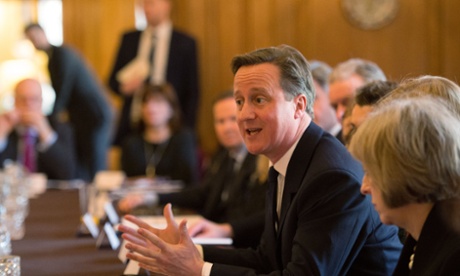
Today, I am sending an unequivocal message that professionals who fail to protect children will be held properly accountable and council bosses who preside over such catastrophic failure will not see rewards for that failure.
Offenders must no longer be able to use the system to hide their despicable activities and survivors of child sexual abuse must be given the long-term therapeutic treatment they need to re-build their lives. But it is not just about introducing new policies. It is about making sure that the professionals we charge with protecting our children – the council staff, police officer and social workers – do the jobs they are paid to do.
We owe it to our children, and to the children who survive horrific sexual abuse, to do better and ensure the mistakes of the past are never repeated again.
- Theresa May, the home secretary, has been accused of allowing the “state-sponsored abuse of women” at the Yarl’s Wood detention centre after a Channel 4 investigation uncovered guards ignoring self-harm and referring to inmates in racist terms. As Rowena Mason reports, Yvette Cooper, shadow home secretary, said it was a “disgrace” that May had refused to come to the House of Commons to answer an urgent question about the mistreatment of detainees, sending a junior minister instead. She also laid into the home secretary for last November extending the contract for Serco to run Yarl’s Wood, despite allegations about abuse, sexual exploitation, rape and self-harm at the centre in Bedfordshire.
- Jeremy Hunt, the health secretary, has told MPs he is asking the NHS England medical director to review the professional codes of both doctors and nurses to prevent future cover-ups in the light of today’s report into unnecessary deaths at a Morecambe Bay hospital.
-
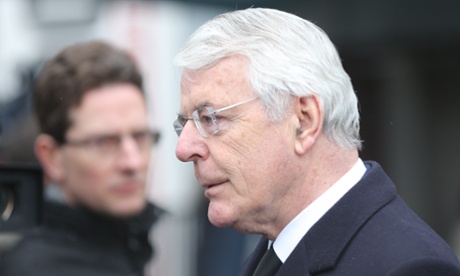
Sir John Major, the former prime minister, has represented the British government at the funeral in Russia of opposition leader Boris Nemtsov, who was shot dead near the Kremlin on Friday. Speaking in Moscow, Major, who knew Nemtsov, said:
I very much admired what [Nemtsov] did and what he stood for. He stood for the rule of law, he stood for freedom of speech - in a word, he stood for liberty. And the things he stood against were very important as well - aggression, repression and corruption. And if anyone believes that his voice will be silenced by his murder, then I believe they have made a very serious error.
-
Philip Hammond, the foreign secretary, has said the wide-ranging, so-called tier 3 sanctions against Russia will be extended to the end of this year. At Foreign Office questions, he told MPs:
We need an extension of the existing tier 3 measures through to the end of December.
Putin has been telling oligarchs around Moscow that sanctions will be over by the end of July - ‘just hold your breath and it will all be fine’. We need to show him that is not going to be the case.
Alongside that we need to have a credible set of options available to implement immediately if there is failure to comply with milestones in the Minsk implementation agreement or a serious further outbreak of conflict in the region.
Even if all milestones are complied with, we believe the tier 3 sanctions should be extended now to last until the end of the year so that we have a tool to ensure compliance.
We can always suspend them or partially suspend them if milestones are being met, but we need to have that tool in place right the way through the programme.
-
Hammond has said the European Union “went off the rails” in recent years. He told MPs:
We have to seize this opportunity to shake the European Union in a way that works for Britain. It went off the rails somewhere over the last 20 years and we’ve got to take this opportunity of reform, of renegotiation, to get it back on the rails and then crucially let the British people have the final say on whether the package we’ve renegotiated is good enough or not.
That’s all from me.
Thanks for the comments.
David Cameron has been speaking to the BBC about the child abuse summit.
Here are the key points he made.
-
Cameron said that he wanted to see a big change in attitudes towards child abuse.
The most important thing apart from all the policy changes and the legal changes is a big change in culture. We need to say loudly and clearly: abuse of children under the age of 16 is wrong – it’s not consent, it’s not normal relations, it’s wrong, and we have to be intolerant of it and not walk on by as happened in too many cases in the past.
-
He rejected suggestions that extending the scope of the wilful neglect offence might discourage people from going into social work.
We’re doing great work to encourage good people into social work in the first place. We’re having an equivalent of Teach First into social work. At the end of the day if professionals fail there need to be consequences. One of the problems in Rotherham was that there was failure after failure by social workers, council officials and by the police and not enough consequences flowed from that.
-
He rejected the idea that the government had not done enough on this.
I don’t accept that we haven’t done a lot about it: we have, we’ve put in place better police training, we’ve put in place longer sentences, more help for victims, a whole set of things. These events in Rotherham and Oxford have happened after the last manifesto was written. They’ve happened during this parliament and what I’m determined as Prime Minister is that we end the walk-on-by culture that too many police forces and social work departments have demonstrated.
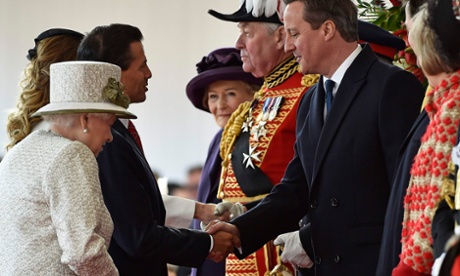
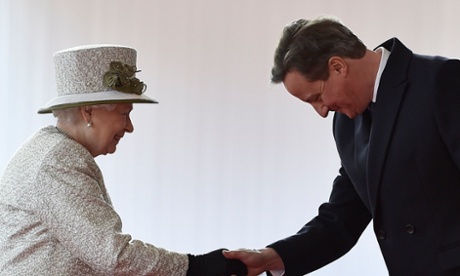
As well as hosting his child abuse summit, David Cameron has also been attending a ceremonial welcome for Enrique Pena Nieto, the Mexican president, who is on a state visit to the UK.
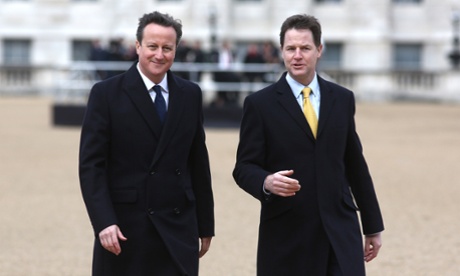
Here’s a Guardian video of Boris Johnson talking to Asim Qureshi from Cage on LBC.
David Cameron has been tweeting about his child abuse summit at Number 10.
PM: I'm sending unequivocal message - professionals who fail to protect children will be held accountable #CSEsummit http://t.co/FHeRfXPydi
— UK Prime Minister (@Number10gov) March 3, 2015
PM: We owe it to our children & survivors of child sexual abuse to do better & ensure that mistakes are never repeated #CSEsummit
— UK Prime Minister (@Number10gov) March 3, 2015
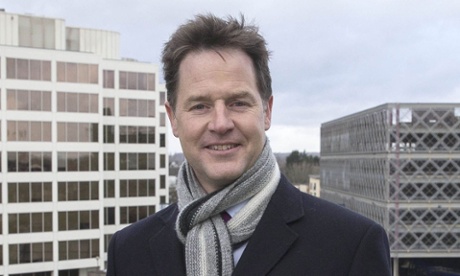
Clegg says being infused with religious faith would be 'wonderful'
Nick Clegg is an atheist. But he has a “complex attitude to faith”, he told Premier Christian Radio in an interview. He said that his family was “infused with faith” and that, if he got religion, that would be “wonderful”.
My family is infused with faith - my grandmother on my father’s side was devout Russian Orthodox, my mother converted to Catholicism in adult life and is a devout Catholic, my brother studied theology and is a devout Anglican and Miriam is, of course, a Catholic - and I committed to bring my children up as Catholics, that was what I undertook to Miriam before we got married. I now accompany Miriam and the children, and do so with great joy, to Mass pretty well every weekend.
I sometimes think it must be the most wonderful thing to be infused with faith. It’s not something that’s happened to me, it’s not happened to me yet and I would embrace it.
I know labels get attached to you, but I’ve never had that much time for what I call vociferous secularism. I’m always a bit sceptical of anyone who acts with raging certainty about anything. I suppose in that sense I’m liberal to my fingertips. I’m constantly questioning.
I still question, including about one’s spiritual life. I believe we are spiritual beings as well as physical beings and I hope I’ll continue to search and think about that and grapple with that until my dying day.
Lunchtime summary
- Theresa May, the home secretary, has announced that a new single national point of contact for whistleblowers trying to expose child abuse and to spot patterns of failure across the country is to be set up in the wake of the Rotherham scandal. As Alan Travis reports, the measure, along with a specialist national taskforce to help local authorities struggling to tackle this issue, is part of the package to be announced at the Downing Street summit on child sexual abuse. May said it was clear that the huge scale of child sexual exploitation in Rotherham was “only the tip of the iceberg” and that a national response was required to the series of failures exposed by the inquiries conducted by both Prof Alexis Jay and Louise Casey. “We need to address the culture of inaction and denial that led to victims being dismissed and ignored,” said the home secretary as she published the official report responding to the Rotherham scandal.
- A report has blamed a “lethal mix” of problems at a “seriously dysfunctional” maternity unit for the unnecessary deaths of 11 babies and one mother in a Morecambe Bay hospital. (See 12.12pm.)
-
Jim Murphy has been accused of “shameless hypocrisy” after he announced that university tuition would remain free in Scotland if Labour wins power, despite backing the introduction of fees south of the border under Tony Blair. In an interview with Holyrood magazine, he has also denied being a Westminster politician, despite being an MP rather than an MSP. He said:
I’m not a Westminster politician and I’ve not come up from Westminster. I have come across from Glasgow today and I am not a Westminster politician, I am a Scottish politician.
- Boris Johnson, the Conservative mayor of London, has called for the BBC licence fee to be scrapped. (See 10.44am.)
- Downing Street and the German chancellery are embroiled in a worsening dispute over intelligence-sharing and the covert counter-terrorism campaign because of conflicts arising from the surveillance scandals surrounding the US National Security Agency and Britain’s GCHQ. As Ian Traynor reports, according to German newspaper reports citing government and intelligence officials in Berlin, the Bundestag’s inquiry into the NSA controversy is being jeopardised by Britain’s refusal to cooperate and its threats to break off all intelligence-sharing with Berlin should the committee reveal any UK secrets.
Updated
Morgan is replying to Hunt.
There should be no holding back in prosecutions because of people’s background, she says.
Ofsted inspected Oxfordshire children’s services last year. But ministers have sent a letter to the council today saying an expert should go back to the council to check what it is doing in response to the report.
The concept of “wilful neglect” is already set out in the Mental Health Act, she says. It involves a failure to act when an individual has a duty of care.
On the call for a new child sexual exploitation offence, she says this is already covered by existing offences.
She says she agrees on the need for excellent sex education in schools. But it has to be excellent sex education, she says.
Tristram Hunt, the shadow education secretary, says the heinous crimes of the abusers in Oxfordshire needs to be condemned.
But the report also shows that the police and the council let these victims down.
The voice of victims was not listened to, and prejudicial views were taken about lifestyle choices.
There must be no cultural tolerance of the abuse of young girls, he says.
Is Morgan satisfied that the safeguarding procedures in Oxfordshire are satisfactory?
Will there be an independent review of what is happening in Oxfordshire?
How does the government define “wilful neglect”?
Will the government support stronger laws on child abduction? And will it back a specific offence on child sexual exploitation?
And does she back age-appropriate sex education in schools?
Morgan is replying to Smith.
She says he is right to say the victims’ concerns are paramount.
On accountability, she says it is not for her to apportion blame. The purpose of this case review was to show what went wrong, and why.
Maggie Blyth, the report’s author, said today that the lack of understanding of those at the top about what was happening meant this continued.
There will be many more questions that need to be answered.
She says the council has taken action.
Some further steps will be revealed at the summit taking place later.
It is not just about lessons learnt; there needs to be action, she says.
(She ignores completely Smith’s call for an independent inquiry.)
Andrew Smith says the victims are owed answers to questions this review did not address.
How did a culture develop where professionals tolerated these crimes?
Who is taking responsibility?
Smith says various key officials have moved. Does Morgan agree that the commendable work done by the council recently must not distract from what went wrong.
There was a professional disregard for the interests of the young girl.
Shouldn’t there be a wider review of what went wrong? Will the government set up an independent inquiry so that lessons are learnt?
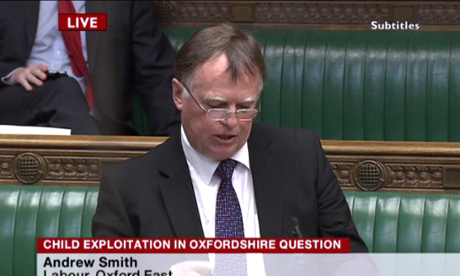
Urgent question on the Oxfordshire child abuse report
Andrew Smith, the Labour MP for Oxford East, asks for a statement on the report.
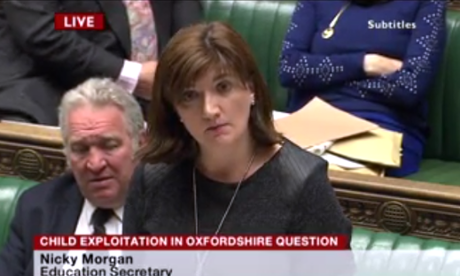
Nicky Morgan, the education secretary, is replying.
She says the details of the report are truly shocking.
The children’s minister has written to Oxfordshire today asking for an assessment of what it is doing in response to the report.
Today the government is publishing an action plan for safeguarding children. (See 11.17am.)
She confirms that the government will consult on extending the offence of “wilful neglect”. And she says she will be attending the Number 10 summit later.
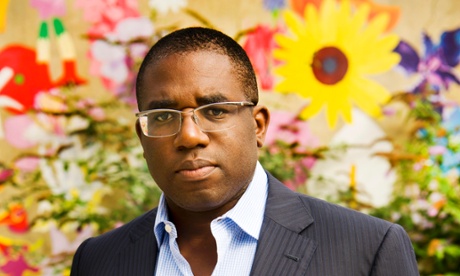
Lammy warns that shoplifting has effectively become decriminalised
In it, he claims that property crime (especially shoplifting) has effectively been decriminalised.
Members of the public consistently report a lack of confidence in the ability or willingness of police to investigate and prosecute incidents of property crime. A quarter of small business shoplifting victims we surveyed said that police do not respond when called, and that they are unable to catch shoplifters.1 35 per cent said that they have no confidence in the ability of police to adequately prosecute shoplifters.2 One small business owner I spoke to claimed that police did not even record shoplifting incidents he reported, as ‘it is not worth the paperwork’.3 Despite the proliferation of CCTV, security guards and electronic tags, shop theft is increasing.4 Shopkeepers are reporting no more than ten per cent of shoplifting incidents, and police do not investigate shoplifting much of the time. In the face of an increasingly widespread (and necessary) debate about terrorism, violent crime and cybercrime, the property crimes that blight lives across the country are being quietly ignored. They remain criminal acts in law but in practice are increasingly dismissed as inevitable and unavoidable.
He is also calling for a revival of community policing to tackle the problem. Here are some of his recommendations.
1 - Restoring ward-level neighbourhood policing teams consisting of a sergeant, two constables and three Police Community Support Officers and ensure they focus their efforts on preventing and solving local property crime.
2 - Giving magistrates flexibility to enforce unpaid court fines through means other than six months imprisonment
3 - Implementing a penalties escalator for repeated theft. Courts should be able to break the caution-fine-reoffending cycle by increasing the sentence for reoffending.
4- Making it compulsory for new police recruits to walk the same beat for at least a year – and preferably two years – after they complete training.
5 - Introducing New York Compstat-style data sharing between police forces to pinpoint crime trends and hotspots
6 - Establishing a Crime Prevention Academy to improve crime prevention expertise within police forces
The report into deaths at the maternity unit at Furness general hospital in Morecambe Bay has now been published. Here’s the start of the Press Association story.
A “lethal mix” of problems at a “seriously dysfunctional” maternity unit led to the unnecessary deaths of 11 babies and one mother, an independent inquiry has found.
The investigation of serious incidents at Furness general hospital in Barrow, Cumbria, between 2004 and 2013 uncovered a series of failures “at every level” from the maternity unit to those responsible for regulating and monitoring the trust which runs the unit.
Among the “shocking” problems found were substandard clinical competence, extremely poor working relationships between different staff groups and repeated failure to investigate adverse incidents properly and learn lessons.
Dr Bill Kirkup, who chaired the Morecambe Bay investigation, said his report detailed a “distressing chain of events” which led to avoidable harm to mothers and babies.
He said: “What followed was a pattern of failure to recognise the nature and severity of the problem with, in some cases, denial that any problem existed, and a series of missed opportunities to intervene that involved almost every level of the NHS.
“Had any of those opportunities been taken, the sequence of failures of care and unnecessary deaths could have been broken. As it is, they were still occurring after 2012, eight years after the initial warning event, and over four years after the dysfunctional nature of the unit should have become obvious.”
There will be an urgent question at 12.30pm in the Commons on the report into child sexual abuse in Oxfordshire published this morning.
Here’s my colleague Sandra Laville’s story about the report. And here’s how it starts.
Police and social services blamed vulnerable girls who were being subjected to sexual torture and abuse for years by older men in Oxfordshire for putting themselves at risk, an independent report into the failure to stop their exploitation says.
The serious case review into why professionals ignored multiple warning signs and failed to act rigorously to stop years of rape, torture and extreme sexual violence against six girls, said police and social services were gripped with the mindset that they were “very difficult” girls who had come to harm as a result of their own actions. The report said there were grounds for believing around 370 girls had been sexually exploited in Oxfordshire in the last 15 years.
Maggie Blyth, author of the serious case review into the failures of Thames Valley police and Oxfordshire social services, called on the government to research why the perpetrators of such child abuse – which has been seen in Rochdale, Rotherham, Derby, Bristol and Oxfordshire – were predominantly from a Pakistani and/or Muslim heritage. She also called for the government to examine whether its guidance on the age of consent fed attitudes that made it easier for perpetrators to abuse victims, in a culture were children are given contraceptives before the age of 16, and young girls are over-sexualised.
Theresa May, the home secretary, has published a written ministerial statement (pdf) this morning, ahead of the child abuse summit at Number 10, setting out what the governnment is doing in response to the reports from Alexis Jay and Louise Casey into child exploitation in Rotherham.
Here are some of the measures that she says the government is taking.
- The establishment of a new independent taskforce, bringing together specialists in social care, law enforcement and health, which will be deployed in local authorities where child abuse is a concern. Linked to the taskforce, will be a new centre of professional expertise, which will develop better approaches to tackling sexual abuse.
- The launch of a £1m communications campaign, to promote a wider understanding of what people should do when they suspect a child is being abused. This will be accompanied with revised guidance, What to do if you’re worried a child is being abused, for professionals, the public, and children.
- The creation of a new single point of contact for child abuse related whistleblowing, which will monitor patterns of failure across the country. We will make clear that all organisations with safeguarding responsibilities should have internal whistleblowing policies.
- A new system of multi-agency inspections, to examine whether local agencies are working in a co-ordinated manner, sharing information and taking joint decisions to protect children.
Failure of agencies to share information about children at risk was a critical element of what happened in Rotherham. Today, my ministerial colleagues and I have written to the leaders of every local authority, directors of children’s services, police and crime commissioners, local safeguarding children’s boards, health and wellbeing boards and GPs, making clear that there can be no justification for failing to share personal information about a child when that information could be used to protect that child’s life.
The government is clear that child sexual exploitation must be stopped. Work is already underway to put into practice these and other proposals.
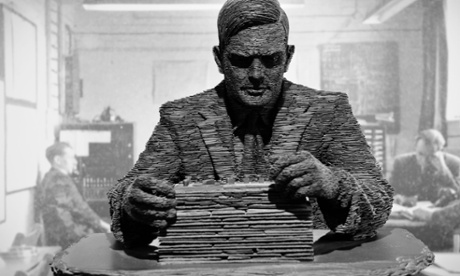
Miliband says Labour would pass a 'Turing's law'
Ed Miliband has announced that a Labour government would pass a “Turing’s law” allowing the relatives of deceased gay men convicted under now-repealed indecency laws to obtain a pardon. Alan Turing, the gay Enigma code-breaker, was convicted of gross indecency in 1952 and subsequently received a posthumous royal pardon. Under the Labour plan, the family and friends of dead men would be able to apply to the Home Office to have gross indecency convictions quashed where they involved consensual same-sex relationships
Under legislation passed three years ago people still alive with convictions of this kind can already have them expunged from the record.
Miliband said:
What was right for Alan Turing’s family should be right for other families as well.
The next Labour government will extend the right individuals already have to overturn convictions that society now see as grossly unfair to the relatives of those convicted who have passed away.
Boris Johnson's LBC phone-in - Summary
Here are the key points from Boris Johnson’s LBC phone-in.
-
Johnson said he favoured the abolition of the BBC licence fee.
I have to say I can’t see how it can go on forever, having a tax on TVs that not everybody uses anymore ... The licence fee is plainly anachronistic.
The Commons culture committee recently said the licence fee should stay for another 10 years, but that was too long, he said. He said he was still in favour of some form of state funding for public service broadcasting. But he said that the BBC could be “extremely anti-competitive”, that it demolished local papers, and that it did not need quite the level of funding it gets now.
I happen to think that there is a case for having a very high standard of public broadcasting. Now, whether you need the full whack of the licence fee, all that money, I must say I somehow doubt, and I think that there is going to have to be a change.
He also said that he did not watch TV news himself anymore because he got all his news from the web.
-
He told Asim Qureshi from the advocacy group Cage that he was “moved to anger” by Qureshi’s suggestion at a press conference last week that the security services were to blame for radicalising Mohammed Emwazi. Qureshi called the programme to speak to Johnson, and Johnson told him:
I really, really think that the focus of your indignation and outrage should be on people who go out to join groups that throw gays off cliffs, that behead people who don’t subscribe to their version of Islam, that glorify in the execution of innocent journalists and aid workers.
These should be the object of your wrath, not the security services who are trying to keep us safe.
If you are a human rights group funded by charity, then you should be sticking up for the human rights of those who are being beheaded in Syria and northern Iraq. That should be the focus of your concern.
-
Johnson renewed his attack on Theresa May’s decision to scrap control orders and replace them with terrorism prevention and investigation measures (Tpims).
My information, from the Met, from the people who look after us who come to brief me about it, is that they think the Tpim system did have defects and they want to go back to a system of control orders which will allow them to remove people from their support networks.
Asked what Tpim stands for, he said he could not remember.
I cannot remember [what Tpim stands for]. Whatever it is, it’s inadequate ... They don’t work and they need to be replaced by control orders.
-
He said that he was “encouraged” by two recent polls giving the Conservatives a three-point lead and that he thought the party could be pulling ahead of Labour.
If you look at the polls, you had two yesterday that are giving us a three-point lead. I’m encouraged by that.
People are basically making a calculation, that the economy is turning around, that things are getting betters, jobs are being created at a rate that we have not seen for a long time, and I don’t think they’re going to want Labour to screw it up ...
David Cameron is doing a fantastic job. He’s cut out to be prime minister. He is plainly made from prime ministerial timber, unlike, I think, Ed Miliband.
-
He said he thought female cyclists were more likely to be involved in accidents with lorries than male cyclists. Cyclists had to be aware of other road users, he said.
One thing we are particularly concerned about is cyclists who do get caught up in heavy good vehicles turning in one direction or the other, particularly turning left, and I’m afraid it’s very often particularly female cyclists who seem to be the victims of these types of terrible accidents ... Given the proportion of male and female cyclists, I have it in my head that there’s a higher proportion [of female victims].
It may be because women are naturally more cautious, or hang back more. I can’t explain it. But what you need to do is get in front of Vincent [the caller] and his lorry, make sure that the truck driver knows you are there, indicate, wave. Be like Simon Rattle with the Berlin Philharmonic. Show the [driver] that you are there.
Updated
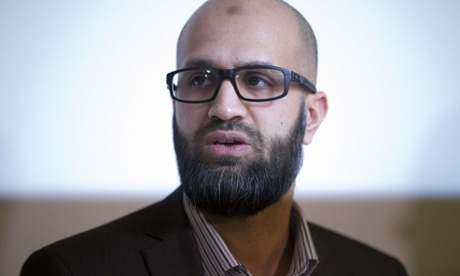
Johnson in telephone confrontation with Asim Qureshi from Cage
Q: [From Asim Qureshi from Cage] What Mohammed Emwazi did was horrific.
Johnson says Cage needs to make that clear. It was not clear from their press conference.
What moved him to anger was the impression that the blame for the radicalisation of Emwazi lay with the security services. He says Qureshi implied that the security services were stopping him pursuing a career overseas. Actually, Emwazi was off to join a terrorist group. The focus of Qureshi’s indignation should be terrorist groups that throw gays off cliffs. Cage should make this clear, and differentiate themselves from these terrorists.
Q: The whole of the Muslim community is against these crimes.
Johnson says he watched the press conference. Qureshi was asked to condemn Islamic State. But he started talking about Tony Blair and George Bush instead. Focus on what these people have got wrong about Islam.
Qureshi says he never said Emwazi was radicalised by MI5.
You did say that, says Johnson.
Qureshi says he was just asking for an inquiry into how the security services alienated people like Emwazi.
Johnson says that, if Cage is a human rights group, it should be sticking up for the human rights of the people who are victims of Isis.
And that’s it.
I’ll post a summary shortly.
Q: What is the future for the BBC licence fee?
Johnson says he does not see how it can continue. He can barely work his TV now. Many people now no longer watch TV on TVs.
The culture committee said recently the licence fee should stay for another 10 years. That is too long, he says.
Q: The committee wanted a levy on every home.
Johnson says the basic question is, do we need public sector broadcasting.
We support the arts, he says, so we probably do need to support quality broadcasting.
But whether you need to support the whole machine is a different matter, he suggests.
The BBC can be “deeply uncompetitive”, he says. In local news, for example, it can destroy competitors.
It would be a shame to lose quality public broadcasting in this country.
Q: I’m a Ukip supporter. If you ran for prime minister, I would vote Conservative. And are you capable of being prime minister?
Johnson says he is campaigning for David Cameron. Two polls have given the Tories a three-point lead. (See 7.01am.) He is encouraged by that. People are calculating that the economy is turning round, jobs are being created, and they don’t want Labout to “screw it up”.
As for being prime minister, that is “not going to materialise”.
Q: Cameron is not cut out to be prime minister.
Johnson says Cameron is doing a great job. He is made from “prime ministerial timber”. Having Ed Miliband as prime minster would be “a shocker”.
Q: Do what extend to you support eavesdropping on terror suspects?
Johnson says a balance has to be struck. He does no want junior officers searching everyone’s email accounts. There has to be proper oversight. But, if people think suspects are going to commit atrocities, the police need to access their communications quickly. He does not have a principled objection to that.
On control orders, we need to get away from Tpims and get back to control orders.
Ferrari asks Johnson if he can remember what Tpim stands for. He can’t.
Q: How many times has the Thames cable car been closed this year?
Johnson accuses Ferrari of waging a campaign against the cable car. It is the only piece of transport infrastructure in London that will cover its capital and running costs over the next 10 years.
Ferrari says it has closed 20 times this year.
Johnson says there has been a “stunning increase” in the number of people using it.
Q: Do you regret not getting Malcolm Rifkind’s seat?
No, says Johnson. He is thrilled to be a candidate for Uxbridge. He discovered just the other day that a firm making the world’s hottest, coolest electric cars is there.
Q: Name a pub on the high street.
Johnson says it would be invidious to pick out one.
Q: But Kensington is cooler, isn’t it?
Johnson says he does not accept that.
Q: Is David Lammy right when he says shoplifting is not being treated seriously enough? He is after your job.
Johnson says he is not the only one. Lots of Labour MPs want to be mayor. They are like rats leaving a sinking ship.
Q: Is he right to say shoplifting should not be judged by the value of what is taken, but by the impact on the shop?
Johnson says he is not sure that that is what Lammy meant, but if he did mean that shoplifting should not be taken seriously, he is wrong.
Burglary is a vile crime. People feel shattered when they discover they have been burgled.
Q: Is Theresa May doing the right thing on control orders?
Johnson says May has been doing the right thing.
Most people would support relocation (which May has reintroduced). We should go back to control orders, he says.
Experts he speaks to say that Tpims (terrorism prevention and investigation measures) are too weak. They are “inadequate” and “defective”.
Q: What does Tpim stand for?
Johnson says he can’t remember. But they are too weak, he says.
Updated
Q: What do you feel about 20mph limits?
Johnson says, if councils want to introduce these, that is fine by him. A 20mph limit is not the worst thing in the world. He is happy to abide by them.
He tells the caller that, if he feels strongly about this, he should stand for election as a councillor.
Q: These limits are slowing down the buses.
Johnson says he has not heard this, but would be interested to hear evidence on this. The average traffic speed in London is 9.4 mph.
Q: What will you do about corruption in the police?
Johnson says the police are cracking down on corruption wherever they can.
Q: I was involved in an accident recently when a cyclist died under the back of my truck. Drivers need training. But anyone can ride a bike.
Nick Ferrari says the caller is talking about this case. The driver was not found to be at fault.
Boris Johnson says we need to continue to educate cyclists about dealing with trucks on the road. He says he thinks that female cyclists are more likely to be involved in these kind of accidents with lorries. He is not sure why, but he thinks it may be because men are more assertive, and more likely to more in front of the lorry and make themselves visible. There was an accident recently involving a driver who did not see a female cyclist because she was in his blind spot.
Q: What about making cyclists sit a road traffic exam, or forcing them to wear high-vis jackets. Drivers are being punished.
Johnson tells the driver he was not punished in this case.
Overall, the number of accidents is coming down, he says.
From September a safer lorry scheme will mean that lorries cannot come into London unless they have safety equipment.
Johnson says the biggest problem is that cabs are high, and it is hard for drivers to see cyclists. But cabs can be fitted with mirrors so they do see people.
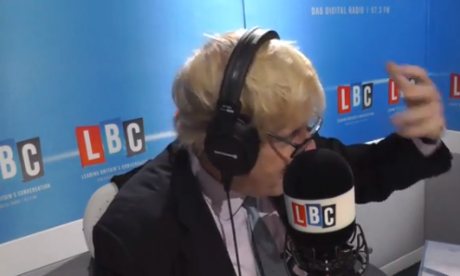
Boris Johnson's LBC phone-in
Boris Johnson is about to start his LBC phone-in.
It’s conventional to illustrate pieces about Johnson with a picture of him looking like a chump, so here goes. It’s from last week.
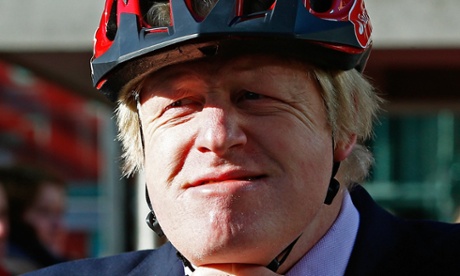
On Newsnight last night Brandon Lewis, the housing minister, said house prices in London were too high. Asked if house prices generally were too high, he replied:
It’s not a straightforward question with a straightforward answer. There are parts of the country that have still got negative equity on homes that people bought in 2006 through 2008. In my own constituency in Great Yarmouth there are people who will say they have got negative equity. So to say prices are too high doesn’t recognise there is a different market in different parts of the country.
In London, prices are too high, we do need to see supply go up to try to deal with that.
He also said he thought house prices in London would stabilise. This is what he said when asked if house prices in the capital would fall.
Yes I do, in a sense that I think - not necessarily that we will see any price fall, but we will see prices being realistic for people again.
There are 65 days to go until the election.
Here’s today’s “election fact” from the Press Association.
MPs voted to extend the lives of parliaments in both world wars beyond the five-year maximum. There were no general elections between 1911 and 1918 and from 1935 to 1945. In both cases, cross-party coalition governments were formed. However, by-elections did take place. There were electoral pacts between coalition parties. This and the low turnouts opened the way for independents and minor party candidates, particularly before the end of the Second World War. There were three wins for the Common Wealth Party and one for the SNP, which lost the seat in the 1945 general election and was not to return to Westminster for 22 years.
Yvette Cooper, the shadow home secretary, says Theresa May is wrong if she thinks people will believe the Conservative promise to cut net migration below 100,000 again.
Who is Theresa May kidding?
Even her own colleagues are saying her net migration target is in tatters.
No-one will believe a word she or the prime minister says on this, after they promised ‘no ifs, not buts’ to meet their chosen target last time, yet instead net migration is three times the level they promised.
Theresa May is taking people for fools by trying the same trick again. This massive gap between Tory rhetoric and reality just undermines trust in the immigration system.
Ukip’s Patrick O’Flynn thinks the move will be good for his party.
Thanks so much Theresa May for keeping the migration promise so you can break it again if re-elected. We are all most grateful.
— Patrick O'Flynn (@oflynnmep) March 3, 2015
And Rob Ford, the academic, thinks May has gone mad.
The definition of madness is doing the same thing over and over expecting different results. Theresa May - delivering madness on migration.
— Rob Ford (Britain) (@robfordmancs) March 3, 2015
May says Tories will keep their immigration target
Tuesday's Times front page: May defies cabinet over 100,000 cap on migrants #tomorrowspaperstoday #bbcpapers pic.twitter.com/YOctLvHGPZ
— Nick Sutton (@suttonnick) March 2, 2015
In an interview in today’s Times, Theresa May, the home secretary, defends the Conservatives’ target to reduce net migration below 100,000 (the one that the government has failed to hit by a margin of almost 200,000) and says a version of it will appear in the party’s election manifesto.
I think we will keep the target.
It is important because it is about not just dealing with those coming into the system but also about making sure that those people who shouldn’t live here actually leave.
You will have to wait for the manifesto to see the exact words. The idea of the net migration target will still be there.
Today's Guardian seat projection - Tories 277, Labour 271
And here’s today’s Guardian seat projection.
Conservatives: 277
Labour: 271
SNP: 51
Lib Dems: 25
Ukip: 4
Greens: 1
UPDATE at 11.58AM: This subsequently got updated, and I’ve changed the post to include the most up-to-date figures.
Updated
Here are today’s YouGov GB polling figures.
Update: Cons lead at 3 - Latest YouGov / Sun results 2nd Mar - Con 35%, Lab 32%, LD 7%, UKIP 15%, GRN 6%; APP -18 http://t.co/AJFHiMZ5y1
— YouGov (@YouGov) March 3, 2015
Yesterday’s poll from Lord Ashcroft also put the Conservatives three points ahead.
In a post for his UK Polling Report blog, Anthony Wells advises that it is too soon to mark this down as a Tory surge.
All the usual caveats apply – it is only two polls and Populus showed a two point Labour lead. It wouldn’t be the first time that two polls have popped out on the same day showing something unusual, only for it to turn out to be pure co-incidence when polls in the following days showing everything back to normal. Keep an eye on it though…
Here’s a BBC picture gallery showing today’s front pages. Both the Guardian and the Daily Telegraph are splashing on David Cameron’s child abuse summit, and his proposal to extend the offence of wilful neglect so that teachers, social workers who work with children and councillors could face up to five years in prison if they turn a blind eye to child abuse.
Good morning. Here’s the agenda for the day.
9am: Boris Johnson hosts his LBC phone-in.
10am: Mark Carney, the governor of the Bank of England, gives evidence to the Commons Treasury committee about the foreign exchange market investigation.
10am: Norman Lamb, the care minister, speaks at the Resolution Foundation about the living wage for care workers.
11am: Report publisheed into sexual abuse in Oxfordshire.
11am: David Lammy, the Labour MP seeking his party’s nomination for London mayor, gives a speech on criminal justice to Policy Exchange.
12.15pm: Simon Stevens, the NHS chief executive, speaks at the UK e-health week summit.
12.30pm: Jeremy Hunt, the health secretary, gives a Commons statement on the review of care at Morecambe Bay hospital.
1.15pm: David Cameron hosts a summit on child exploitation at Number 10.
As usual, I will be also covering all the breaking political news from Westminster, as well as bringing you the most interesting political comment and analysis from the web and from Twitter. I will post a summary at lunchtime and another in the afternoon.
If you want to follow me on Twitter, I’m on @AndrewSparrow.