Afternoon summary
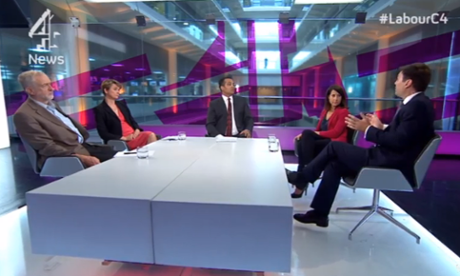
- Jeremy Corbyn, the favourite in the Labour leadership contest, has faced strong criticism from his rivals over his foreign and economic policy. In one of the more spiky and interesting leadership debates held over the summer (there were no audience questions, a colleague points out - that often helps), Andy Burnham told Corbyn he sounded as if he were making excuses for President Putin. Yvette Cooper told Corbyn his economic policy (more quantitative easing) amounted to “PFI on steroids”. Cooper’s attack during the Channel 4 News debate was more assured than Burnham’s, but neither seemed to seriously ruffle Corbyn. Corbyn also confirmed that, unlike the other candidates, he does not favour curbing the right of EU migrants to access benefits. The level of net migration to the UK was actually rather small, he said.
That’s all from me for today.
Thanks for the comments.
Here is some Twitter comment on the debate.
From the Spectator’s Isabel Hardman
For someone who had a longer long campaign to be Labour leader than any other, Andy Burnham’s short campaign has been quite uncomfortable
— Isabel Hardman (@IsabelHardman) September 1, 2015
From Harry Leslie Smith, the Labour activist and writer
My own impression on #labourC4 was that the other candidates are resolved to the fact that they will be defeated by jeremy corbyn
— Harry Leslie Smith (@Harryslaststand) September 1, 2015
From the Telegraph’s Michael Deacon
One of Corbyn's weakest arguments is that Labour MPs should back him as whoever wins (ie him) will have a "big mandate" from those who voted
— Michael Deacon (@MichaelPDeacon) September 1, 2015
Tony Blair won the leadership contest of 1994 with 57% of the vote. Nearest rival got 24%. Pretty big mandate. Didn't stop Corbyn rebelling
— Michael Deacon (@MichaelPDeacon) September 1, 2015
Here’s an alternative winner.
The winner of the Labour leadership hustings is @krishgm's lobster tie pic.twitter.com/EAEbP48CMU
— Siraj Datoo (@dats) September 1, 2015
Huffington Post’s Paul Waugh thinks he’s found the picture that sums up the debate. (Not sure Yvette Cooper will agree.)
Pic of the Debate. @Corbyn4Leader a study of supreme confidence, despite Cooper attacks. pic.twitter.com/By40HzTvCC
— Paul Waugh (@paulwaugh) September 1, 2015
Q: Tony Blair said Labour was a changed party in three months. Do you agree?
No, says Burnham. Labour members are the same.
But people are fed up with retail politics, and small policy offers. They want something bigger.
Q: How would you get MPs to obey you?
Corbyn says the new leader will have a mandate from the 550,000 people who have voted in the contest.
He says he wants the registered supporters to become members. And he wants members to have a say in making policy. He wants policy making to come from the bottom up.
And that’s it. The debate is over.
I will post a summary soon.
Burnham says he agrees with some of Corbyn’s proposals, for example on housing.
Q: [To Kendall] Would you be as loyal to Corbyn as he has been to previous Labour leaders?
Good trick question, says Kendall. (Corbyn has routinely been the most disloyal of all Labour MPs, if disloyalty is judged by the number of votes against the party whip.)
Updated
Q: [To Cooper] Why does Corbynomics not make sense?
Cooper says she disagrees with his plan to print money. That will push up borrowing and push up inflation.
Corbyn says the last Labour government put £385bn into the banks.
And it used the private finance initiative to fund investment, even though the government is repaying six times the investment.
He would increase investment. That could be funded by quantitative easing, or by borrowing. His plan is just a proposal, he says.
He asks Cooper if she would go back to PFI or to borrowing?
Cooper says Corbyn’s plans is “PFI on steroids”. His plans is just not responsible, he says.
Labour should have forced the banks to invest in industry, he says.
Updated
Q: [To Cooper] This is a big trashing of the New Labour approach to welfare, which you were part of. [She was work and pensions secretary]
Cooper says it is the government that is to blame.
Corbyn says the benefit cap is leading to social cleansing in places like London.
Q: Would you change the way benefits sanctions are applied?
Burnham says there is something very wrong with the way the benefits system works.
Andy Burnham says the DWP is “operating a dehumanised, punitive sanctions regime” that is “driving people to despair” #c4news
— Jon Stone (@joncstone) September 1, 2015
He would look at finding a Labour way to cutting the welfare bill.
Kendall says Labour does need to get the welfare bill down. Welfare is a big problem for the party. One of the reasons why the party lost the election was because people did not like its stance on benefits.
Corbyn says we are spending too much using the welfare budget to subsidise high rents and low wages.
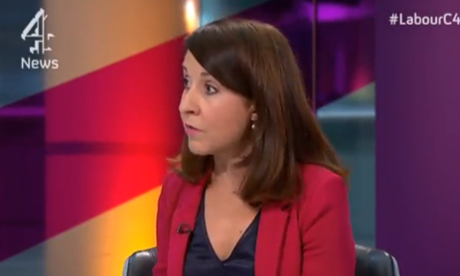
Updated
This is from the Spectator’s Isabel Hardman.
This entire hustings so far is about Jeremy Corbyn. The whole contest is basically ‘what’s your policy on Jeremy Corbyn?'
— Isabel Hardman (@IsabelHardman) September 1, 2015
Q: [To Cooper] You have criticised Corbyn for the people he has shared platforms with. What do you mean?
Cooper says she is not criticising Corbyn’s values. But you should be careful about sharing platforms with extremists.
Corbyn says you will not achieve peace without talks. Tony Blair has met Hamas more than he has.
Cooper says talking to people is fine, but that is not the same as sharing a platform.
Here is Channel 4 News’s Paul Mason on the debate so far.
Corbyn - Hans Blix 90% sure no WMDs; Blair rejected it. Cooper, for my money, bossing the body language/authority in this studio. So far.
— Paul Mason (@paulmasonnews) September 1, 2015
Burnham says Corbyn says he sounds as if he is making excuses for Putin.
Corbyn says he is not doing that.
Burnham says that is what it sounds like. Corbyn said Russia was pushed into retaliation by Nato.
Q: Is Corbyn a threat to national security, as the Tories say?
Cooper says she does not agree with leaving Nato.
Q: What would you do if Russian troops starting rolling through Ukraine?
Corbyn says he would want talks.
He objects to Nato because it requires countries to spend 2% of GDP on defence. And it could drag Britain into other conflicts.
We should be trying to de-escalate conflicts, he says.
Nato’s obsessive expansion has been a problem, he says.
He says Nato changed its charter after the end of the cold war to give itself a global role. We should be arguing for a more realistic view of its role, he says.
Q: Has Russia been provocative?
He says the Russian military is pushing its government, and one thing leads to another.
Are we heading for a new cold war, he asks. It looks like it.
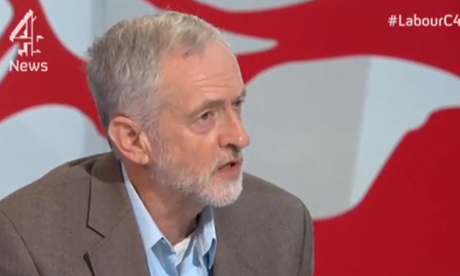
Corbyn says Hans Blix, the UN weapons inspector, told MPs just before the war that he was 90% sure Saddam Hussein did not have weapons of mass destruction. He told the same thing to Tony Blair and Jacques Chirac. Chirac accepted what he said. Blair did not.
Q: Corbyn said Blair should face a war crimes trial if there are charges. Do you support that?
Cooper says Corbyn should have been happy to wait until the Chilcot report is published.
Burnham says we should wait for that report.
Q: Would you support the prosecution of Tony Blair?
Burnham says the question implies Blair knowingly misled people. He does not accept that, Burnham says.
Kendall says the Labour party needs to have a day of reckoning after the publication of the Chilcot report and then move on.
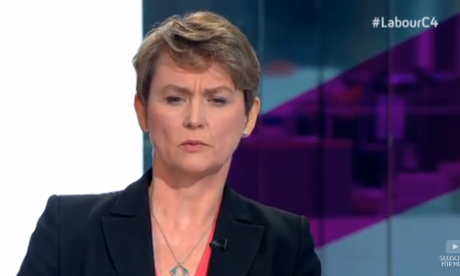
Corbyn says the rapprochement with Iran opens up the possibility of a new political initiative against Islamic State.
But military action would make the situation worse, he says.
Q: Would you back military action against Islamic State in Syria?
Cooper says David Cameron would have to answer some serious questions. What would the mission be trying to achieve? It is hard to see.
Q: Could you conceivably back military action?
Cooper says she would have to look seriously at it. Labour supported air strikes in Iraq. But it is very early.
Kendall says air strikes would have to be part of a wider strategy in the region.
Burnham says he would not rule it out. But Labour has to learn the lessons of the last decade. The legality issue is not important. Syria is not asking for support, unlike Iraq.
There is talk of a vote in parliament next week. That is disrespectful to parliament, says Burnham. It is too early.
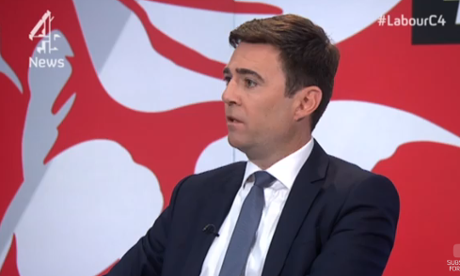
Q: [To Corbyn] Would you put restrictions on people coming into the UK?
Corbyn says, for people outside the EU, there are restrictions anyway. The level of immigration is small, he says.
Back in the debate Burnham says the proposals floated by Theresa May at the weekend to stop EU migrants coming to the UK without a job would affect millions of people. He would not back those plans, he says. But he supports limiting the access of EU migrants to benefits.
Corbyn says he does not support that. If people pay tax here, they should qualify for benefits.
Liz Kendall says backs Burnham’s position on this.
Burnham says that, if Labour were to adopt Corbyn’s position, it would struggle to win back the voters it lost.
Labour looked as if it were not serious about the issue, he says.
At the weekend the Sunday Telegraph said Jeremy Corbyn was getting rid of his trademark vest as part of a mini-makeover.
Now that story seems a bit premature.
The vest is back. #vestgate But Jeremy Corbyn's blue shirt looks ironed #LabourC4 pic.twitter.com/QeITuzRVm5
— Christopher Hope (@christopherhope) September 1, 2015
It has started.
Krishan Guru-Murthy is chairing.
Q: How many refugees from Europe should Britain take?
Jeremy Corbyn says he will not put a number on it, but considerably more than now.
Yvette Cooper repeats some of the points she made in her speech this morning.
Andy Burnham says Britain would get a better hearing from its EU partners on EU migration if it took in more refugees.
The live feed has not started yet, but Paul Mason is keeping us posted.
They're sitting down, Krishnan is explaining stuff to them, they are Corbyn, Kendall, Burnham and Cooper. http://t.co/2mPTOLtOVz
— Paul Mason (@paulmasonnews) September 1, 2015
Channel 4 News Labour leadership debate
Channel 4 News is staging a Labour leadership debate this afternoon.
You will be able to watch it live here. It starts at 3.30pm. I’ll be covering it in detail.
Updated
Jeremy Corbyn, the Labour leadership candidate, is launching his arts strategy at an event in London tonight. He seems to have been inspired partly by Jennie Lee, the arts minister in Harold Wilson’s government and Aneurin Bevan’s wife. According to the Corbyn campaign, Lee produced “the first and, to date only, policy white paper on the arts”.
Corbyn would create a cabinet committee for the arts, a spokesperson said.
In ‘ensuring all have access to the arts’ Jeremy will call for government action to ensure local arts and cultural organisations in receipt of public funding collaborate more effectively to ensure a visible, coherent and accessible offer of extra-curricular activities for all, particularly among children, young people and families previously granted less access to creative, cultural opportunities. Jeremy will propose the establishment of a proper living waged national creative apprenticeship service and introduce guidelines on minimum standards of artists’ pay including exhibition fees.
In a statement Corbyn said:
A successful economy and a healthy, creative, open and vibrant democratic society depend on a flourishing creative sector. Culture and the arts play an essential role on individual and community wellbeing. If we are to achieve our goal in government of supporting people in leading more enjoyable and fulfilling lives, funding for the arts must be central to that offer.
If elected Labour leader, I pledge to work alongside the creative industries to support, develop, and collectively achieve a culturally rich, more prosperous future for our country.

Going back to the question of whether changing the wording of the EU referendum matters (see 1.22pm), here’s one point I should have made earlier; there is obviously a big difference between answering a question blind, after being ambushed by a pollster, and voting in a referendum which has been the subject of intense media discussion in the proceeding weeks. In the first instance, the precise wording of the question may have comparatively more impact; in the second instance, there will be many more influencing factors coming into play. So the difference the wording makes is unlikely to be as much as nine points. But a yes/no question would still have been a bonus to the Inners.
Here’s a Guardian video with an extract from Yvette Cooper’s speech.
Nicola Sturgeon, Scotland’s first minister, is giving a speech to the Scottish parliament now setting out her programme for government.
Education at the heart of FM @NicolaSturgeon's Programme for Government. #pfgscot http://t.co/CzYEvSBBlv
— First Minister (@ScotGovFM) September 1, 2015
Lunchtime summary
-
Yvette Cooper, the shadow home secretary and Labour leadership candidate, broke the political taboo on the British response to the European-wide refugee crisis by calling for the UK to be true to its values and history by taking as many as 10,000 people fleeing the political turmoil in the Middle East. She said that Britain had a proud tradition of taking in refugees and that it was time to resurrect it. Here’s the text, and here’s an extract.
In the thirties despite recession and hardship, we took in over 80,000 Jewish and European refugees. In the nineties we took in refugees from Bosnia.
And remember how this year we marked the death of Sir Nicholas Winton – the man who helped arrange the kindertransport from Prague in the aftermath of the devastation of Kristallnacht, when British Jewish and Quaker leaders urged the British government to offer sanctuary to Jewish children from Germany and Nazi-occupied territory.
Within days a special immigration bill passed Parliament. An appeal was sent out and British families across the country responded.
Just three weeks later the first children arrived. Over the next 9 months, 10,000 children came to the UK from across Germany, Austria, Czechoslovakia and Poland.
10,000.
What are we doing now?
Our country has refused to take any refugees from the Mediterranean. Has refused to take more than a couple of hundred vulnerable Syrian refugees directly from the camps as part of the UN programme. Just 240 have come. And our country has even returned Syrian refugees to other European countries who are already taking far more refugees, simply because they passed through those countries first.
Germany has given more sanctuary to Syrians in a month than we have in a year.
Overall Hungary and Sweden have had three times the number of asylum claims as Britain – though they are smaller countries. Germany has had twelve times more.
How can we be proud of our history helping those who fled conflict if our generation turns its back ...
If every city took 10 refugee families, if every London borough took 10 families, if every county council took 10 families, if Scotland, Wales and every English region played their part, then in a month we’d have nearly 10,000 more places for vulnerable refugees fleeing danger, seeking safety.
The speech has received some rave reviews, from Labour supporters and others.
If Labour's clowns make Corbyn leader after this speech from Cooper, they deserve every defeat he will bring them https://t.co/IqLeVQrZKu
— Nick Cohen (@NickCohen4) September 1, 2015
Just read Yvette Cooper's speech on refugee crisis. If we'd seen this Yvette Cooper five years ago she'd be Prime Minister today.
— Dan Hodges (@DPJHodges) September 1, 2015
- A legal challenge to the election of Liberal Democrat MP Alistair Carmichael will be broadcast live and in full in what is believed to be a television first for a court hearing in Scotland, it has emerged.The election court will sit on Monday and Tuesday at court one of the court of session in Edinburgh to hear a legal challenge to the election of Carmichael as the MP for Orkney and Shetland in May. As the Press Association repots, the Scottish Courts and Tribunals Service (SCTS) has now reached an agreement with STV for the hearing to be streamed live on the broadcaster’s website.
Does changing the wording of the EU referendum question matter? Analysis
Will the Electoral Commission’s decision to recommend a more neutral EU referendum question (see 11.01am), and Number 10’s decision to accept it, actually make any difference to the result?
One way of answering the question - actually, it’s a crude but not unreliable way of assessing almost any political event - is work out which side is happiest. And today the Outers are clearly feeling chipper. (See 10.47am and 10.53am.) They feel they’ve scored a modest victory.
In its press notice announcing its decision, the Electoral Commission says there was a perception that having a yes/no question, with yes the option for those wanting to remain in the EU, would be biased in their favour. This is what people who participated in the commission’s research (pdf) said. But the commission also found that “there was no evidence to suggest that the wording changes [from yes/no to remain/leave] resulted in participants in the research changing their voting preference in any way.” The commission did not try polling using alternative questions to see how the result varied.
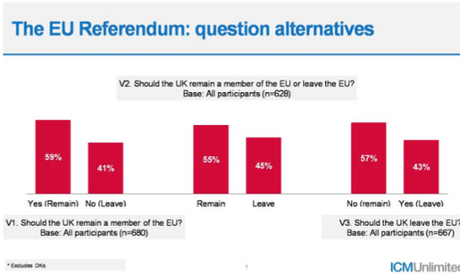
But polling organisations have tried this, and the results show that the wording of the question does affect the result. In other words, there is a yes premium. ICM’s Martin Boon published a short paper on this in June (pdf) and he found it could be worth up to four points. That is partly because of acquiescence bias, he explains.
The tendency for people to yea-say with something is more instinctive than it is to reject it. The proposed referendum question clearly states that we are already members of the EU, and asks pointedly whether we should remain so. In short, it asks people to acquiesce with the status quo, and that probably helps. Indeed, it was for this reason that many unionists criticised the UK government’s acquiescence to the SNP’s preferred Scottish independence referendum question wording (where the positive response was framed as Scotland being an independent country rather than staying in the UK).
ICM tested three questions: the one originally proposed by the government (on the left in the chart), a neutral one (the one now recommended by the Electoral Commission), as well as the question slanted in favour of EU exit. The government’s original yes/no question gave the Inners a clear advantage compared to the question adopted today. The yes score was four points higher than the remain score, and, on yes/no, yes was 18 points ahead, compared to just 10 points on remain/leave. That’s an eight point advantage.
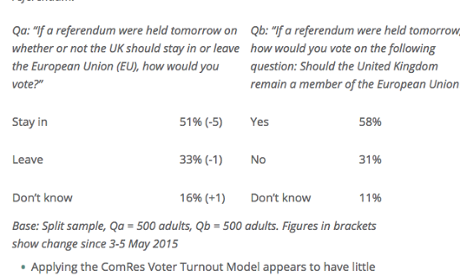
ComRes carried out a similar exercise in June and they also found a yes premium. On yes/no, yes was ahead by 27 points. On stay/leave, stay was ahead by just 18 points. That’s a nine point advantage.
There is a counter view, however. Matthew Sinclair, a consultant at Europe Economics, expressed it on Twitter, pointing out that the new, more balanced question does make it clear that what was a no vote is actually a vote to leave the EU.
I think this new EU referendum wording would actually help "In", hurt "Out"; would raise status quo salience. http://t.co/gfzK4b5Ian
— Matthew Sinclair (@mjhsinclair) September 1, 2015
And the Electoral Commission report itself (pdf) says some people surveyed expressed a similar concern.
Participants felt that this question format (‘remain’/’stay’ or ‘leave’) was more balanced and neutral than the proposed ‘yes’ or ‘no’ question as it provided both options within the question and the answer. The question was not seen to be biased towards any specific voting option: ‘It’s not like it’s biased towards any side, it’s just saying stay a member or leave.’ (Mini-depth, Norwich, male, 60+ years)
While participants were positive about including both options, a few noted that the word ‘leave’ had potentially negative connotations. Some felt that this could encourage people to vote for the UK to remain a member of the EU, especially if they feared the unknown or changing the status quo. However, this was found to be a mild concern.
In the face of the ICM and ComRes evidence, thought, the adjective “mild” seems right. The loss of the yes premium seems more significant - worth up to nine points, if the polls are anything to go by. Nigel Farage is entitled to feel pleased.
UPDATE: One point I should have made earlier; there is obviously a big difference between answering a question blind, after being ambushed by a pollster, and voting in a referendum which has been the subject of intense media discussion in the proceeding weeks. In the first instance, the precise wording of the question may have comparatively more impact; in the second instance, there will be many more influencing factors coming into play. So the difference the wording makes is unlikely to be as much as nine points. But a yes/no question would still have been a bonus to the Inners.
Updated

Here is the Press Association copy on Yvette Cooper’s speech.
Britain should be prepared to open its doors to refugees fleeing the conflict in Syria, Labour leadership contender Yvette Cooper has said.
The shadow home secretary said the failure to offer sanctuary to people trying to escape the “new totalitarianism” of Islamic State (IS) was “immoral” and “cowardly”.
She called on the government to exclude refugees from its target to reduce net migration to below 100,000 a year and suggested that it should be possible to take some 10,000 people seeking asylum.
In a speech to the Centre for European Reform in London, Cooper said acknowledged that her comments would be controversial at a time of heightened concern about immigration.
But in the face of the crisis in the Mediterranean with tens of thousands risking their lives in an attempt to reach safety in Europe, she said that it was essential to separate out the issue of asylum from the wider immigration debate.
“This has become a humanitarian crisis on a scale we have not seen on our continent since the Second World War. Yet we seem paralysed to respond,” she said.
“And its not just us. All Europe is struggling to respond. We can’t carry on like this. It’s immoral, it’s cowardly and it’s not the British way.”
Cooper contrasted Britain’s offer to take a few hundred Syrian refugees through a United Nations programme to the 1930s when in a matter of months the country accepted 10,000 Jewish children fleeing the Nazis.
“We have to step up to the plate. This has become a test not just of Europe’s values, but also of the EU’s resilience and ability to respond. And so far our continent has been found still wanting,” she said.
“And it is a test of British values too - of whether we will again be able to reach out to the rest of the world and help as we have done in previous generations, or whether we will turn inwards and turn our backs instead. And so far our country has been found still wanting too.”
Cooper said called for politicians of all parties to support a “national mission” to change attitudes, end the fear of the “politics of immigration”.
“That has to start with the government and its targets. For our country to have a net migration target which includes refugees is just immoral,” she said.
The full speech is available here.
Everyone should read Yvette Cooper's powerful speech on the refugee crisis http://t.co/Vr5WSPcTZl pic.twitter.com/KDhKbM2pcU
— i100 (@thei100) September 1, 2015
Judging by Twitter, it was a powerful speech. I will post more on it later.
Updated
Here is the Electoral Commission’s recommended format for the EU referendum ballot paper.
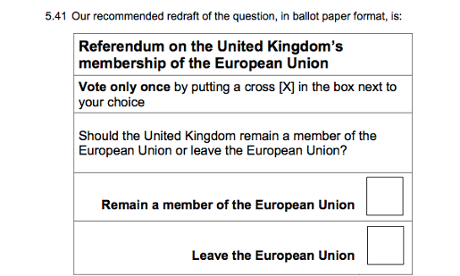
Here is some Twitter reaction to the Electoral Commission recommendation, and Number 10’s decision to accept it.
From Paul Goodman, the ConservativeHome editor
Since @David_Cameron accepts Electoral Commission's view on EU poll question - & good for him - why won't he also accept its view on purdah?
— Paul Goodman (@PaulGoodmanCH) September 1, 2015
From Robert Oxley, the Business for Britain campaign director
Yes/No/Remain/Leave - it matters not. The most crucial way to make #EUref fair is to ensure Purdah rules aren't scrapped
— Robert Oxley (@roxley) September 1, 2015
From Patrick Dunleavy, an LSE politics professor
Electoral Commission just fixed EU ref Q as: "Should the United Kingdom remain a member of the European Union or leave the European Union?"
— Patrick Dunleavy (@PJDunleavy) September 1, 2015
@PJDunleavy The options are: 'Remain a member of the European Union' 'Leave the European Union'. A truly excellent and well-based solution.
— Patrick Dunleavy (@PJDunleavy) September 1, 2015
From Tim Shipman, the Sunday Times political editor
All that No campaign logo branding now goes into the khazi. It's "remain" v "leave" on the EU referendum ballot now.
— Tim Shipman (@ShippersUnbound) September 1, 2015
From ConservativeHome’s Mark Wallace
A side point but if the way to vote for Brexit is now "leave" doesn't this mean Banks has jumped the gun with his @TheKnow_EU branding?
— Mark Wallace (@wallaceme) September 1, 2015
And, for a very Lib Dem take, here’s the Lib Dem peer Sarah Ludford
Perhaps electoral reform could encompass abolition of X in favour of tick - always seemed odd to me that we mark positive choice negatively
— Sarah Ludford (@SarahLudford) September 1, 2015
Nigel Farage, the Ukip leader, has also welcomed the Number 10 decision.
I’m in no doubt that the Yes/No offering was leading to great confusion and that remain or leave is much clearer. That combined with a more explicit question is the right direction of travel.
Daniel Hannan, the Eurosceptic Conservative MEP, has welcomed Number 10’s decision to accept the Electoral Commission’s advice on the wording of the EU referendum.
I'm glad the PM has accepted the Electoral Commission's recommendation on a fair question in the EU vote. Rigged ballots settle nothing.
— Daniel Hannan (@DanHannanMEP) September 1, 2015
David Cameron has accepted a recommendation by the electoral commission to change the wording of the EU referendum to avoid favouring the pro-EU side.
Downing Street has announced that the government will table an amendment to the EU referendum bill to reflect the new wording.
The move by No 10 means that voters will be asked whether Britain should remain a member of the EU or whether the UK should leave the EU. The government had intended to ask voters simply whether the UK should remain a member of the EU, prompting the Electoral Commission to warn that this could favour the status quo in the referendum.
The prime minister’s spokeswoman said: “We will follow the recommendation of the Electoral Commission by tabling an amendment to the bill. The government’s approach has been to follow the Electoral Commission’s advice.”
The move means that, unlike the Scottish referendum, there will not be a Yes and a No campaign. There will be a campaign to remain in the EU and a campaign to leave.
No 10 says EU referendum wording will change following Electoral Commission's advice
The government has accepted the Electoral Commission’s advice on changing the wording of the EU referendum.
No 10: @David_Cameron accepts new wording from Electoral Commission on EU referendum. Amendment to bill will be tabled in autumn
— Nicholas Watt (@nicholaswatt) September 1, 2015
Electoral Commission explains why original EU referendum question seen as 'biased'
Here is a more detailed statement from the Electoral Commission’s press notice explaining why it wants the government to change the wording of the EU referendum question. (See 11.01am.)
Our assessment found that the wording of the referendum question currently included in the bill is written in plain language and is easy for people to understand and answer. However, we have concerns, based on our assessment, about the proposed question. This is because of what we heard through the consultation and research about the perception that the question encourages voters to consider one response more favourably than the other. This is in line with our previous research carried out at the time of the 2013 private member’s bill on an EU referendum, details of which can be found on the Commission’s website.
The question currently in the bill was tested with members of the public and the commission also sought views from other individuals and groups to make sure the question was clear, unambiguous and to the point. The commission’s established referendum question assessment guidelines (used for previous referendum bills, most recently for the Scottish referendum on independence in 2014) state that the question should be neutral, which means it should not encourage voters to consider one response more favourably than another or mislead voters.
There were two main reasons why consultation respondents and research participants viewed the question as biased – it only sets out the ‘remain’ option in the question, and the ‘yes’ response is for the status quo. Consequently, while the question is not significantly leading, we have concerns about the perception that this question will encourage voters to consider one response more favourably than another. These views raise concerns about the potential legitimacy, in the eyes of those campaigning to leave and some members of the public, of the referendum result – particularly if there was a vote to remain a member of the European Union. The views of campaigners in particular provided an extra dimension that had not been available in our previous assessment.
The commission tested alternative questions and its assessment suggests that it is possible to ask a question which would not cause comparable concerns about neutrality, whilst also being easily understood. The commission’s research indicates that the alternative question it has proposed addresses the concerns about potential bias that were expressed.
Read the commission’s full question assessment report and research report here.
Electoral Commission tells government to change EU referendum question
The Electoral Commission has just issued a statement saying it wants the government to change the wording of the EU referendum question.
Here’s an extract from the news release.
The question currently in the bill and that was tested by the commission was:
“Should the United Kingdom remain a member of the European Union?”
The responses would be ‘Yes’ / ‘No’
Following its assessment process, the commission has recommended that the question should be amended to:
‘Should the United Kingdom remain a member of the European Union or leave the European Union?’
The responses would be ‘Remain a member of the European Union’ / ‘Leave the European Union’.
And here is a statement from Jenny Watson, the commission’s chair, explaining its reasoning.
Any referendum question must be as clear as possible so that voters understand the important choice they are being asked to make. We have tested the proposed question with voters and received views from potential campaigners, academics and plain language experts.
Whilst voters understood the question in the bill some campaigners and members of the public feel the wording is not balanced and there was a perception of bias. The alternative question we have recommended addresses this. It is now for parliament to discuss our advice and decide which question wording should be used.
Updated
Boris Johnson's LBC phone-in - Summary
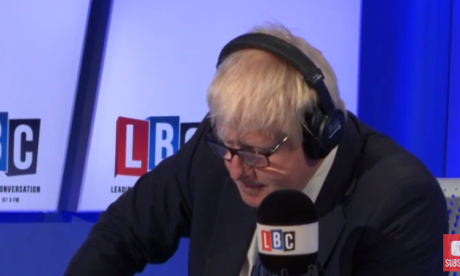
Here are the key points from Boris Johnson’s LBC phone-in.
- Johnson said it was “very disappointing” that David Cameron did not seem to be insisting on a full opt-out from the social chapter as part of his EU renegotiation.
I looked at the headlines this morning about the possibility of Britain dropping its insistence on changes to employment law and I thought that was very disappointing. I think we need to move forward on that.
- He appeared to back Theresa May’s suggestion that EU migrants should be prevented from coming to the UK unless they have a job.
I think it’s quite interesting that on Sunday the home secretary, Theresa [May] went further and said she would like a new rule so that even if you are an EU citizen, you cannot come to this country unless you actually have a job lined up ... I thought that it very interesting that she advocated that.
-
He said people in the EU were increasingly alarmed at how little control their leaders had over immigration.
[Angela Merkel said] unless we sort this immigration problem out, we are going to have to get rid of the Schengen agreement [that removes border controls from most EU countries]. I think we are getting to the stage where individuals countries - what people object to is the sense that there is no political control, that governments cannot deliver that thing that they promised to the electorate.
- He said he could imagine voting to leave the EU.
- He said the House of Lords should be reduced in size by a half.
I think the whole thing has got completely out of control ... 843 members? Something radical needs to happen there, in the sense of pruning.
I think they had a voluntary euthanasia plan, a voluntary exit plan, a Dignitas approach to the Lords ...
There are a great many of these geezers who don’t actually do anything very much at all. They take the money and they don’t do much. It seems to me we should make them an offer they can’t refuse ... If they don’t turn up, if they’re not really interested, they’re just interested in the glory of being a member of the House of Lords, I think, stuff that. That’s absolutely absurd. We probably need about 400 legislators to scrutinise bills, to amend them and improve them.
-
He denied receiving a text from David Cameron telling him to “fucking shut up”.
Updated
Q: Will the new transport commissioner be on the same “absurd” salary (£650,000) as Sir Peter Hendy?
Johnson says he cannot comment on the precise salary the new commissioner will get. But if you want good people, you have to pay the market rate, he says.
And that’s it.
I will post a summary soon.
Q: Is it true that David Cameron sent you a text message telling you to “fucking shut up” or Ed Miliband would be prime minister?
Johnson says he cannot remember getting a text like this. It is a “total mystery”.
Johnson says he did not compile such a list.
If there was such a text, it was not sent to him.
Q: Did it go to any of your aides?
Not that I know of, says Johnson.
Q: Why is the Notting Hill carnival allowed to continue when it causes so much trouble?
Johnson says the mayor does not organise the carnival.
There is an argument that it boosts London’s economy.
But he understands why many Notting Hill residents would like to see it go.
Q: You were caught recently not wearing a seat belt while driving?
Johnson says he cannot remember this. It must have been a “rare aberration”.
Q: Is it true that you will cut 18 routes on the night buses when the overnight tubes are running?
Johnson says night buses will continue to run. He does not “recognise” the 18 services to be cut figure. But the night bus service will be revised to take account that tube services will be running.
Q: Will any night bus routes go?
Johnson says he cannot give that assurance.
Q: Would you refuse to take a peerage?
Johnson says he would not accept a seat in the Lords as it is currently constituted.
He is unlikely to be offered one, he claims. He is just getting on with his job.
Q: The Sun says today you get your hair cut by a Turkish barber every three weeks?
Johnson says there are a lot of mistakes in that story in today’s Sun. He does use that hairdresser. But he does not go every three weeks, and does not have a head massage.
Updated
Johnson says that he has seen a report saying the number of white vans on the roads of London will go up by 20% by 2031. That is because of the rise of online shopping, he says.
He says one solution will be restrictions on freight traffic.
But he says he has also seen plans suggesting new tunnels under London, running east to west and funded by tolls, could help to cut traffic on the streets by 15%.
Q: Will cyclists have to use the new cycling super-highway?
Johnson says he is still thinking about that. He says that cyclists will be mad not to use it.
Johnson criticises PM for not demanding full EU social chapter opt-out
Q: Would you vote to leave the EU if we cannot impose controls on EU immigration?
Johnson say people should not be able to come to the UK and pick up benefits after a very short interval. That is “patently absurd”. Cameron wants a four-year waiting period before EU migrants can claim. Johnson says he strongly supports that.
Johnson says that at the weekend Theresa May, the home secretary, proposed stopping EU citizens coming to the UK unless they have a job.
He says there have been suggestions that the Schengen agreement, on free movement in the EU, will have to go. That is very interesting, he says.
Q: So would you vote yes or no?
Johnson says he has strong confidence that Cameron will get what he wants.
Q: Could you vote no in the referendum?
Yes, says Johnson.
Q: So what is the deal breaker?
Johnson says the FT story today about the government dropping its insistence on opting out of the social chapter was “very disappointing”.
He is referring to this story. Here is how it starts.
David Cameron has scrapped demands for full British exclusion from EU employment laws ahead of his planned Brexit referendum, in a move that could help keep trade unions and Jeremy Corbyn, the leftwing Labour leadership candidate, in the Yes camp.
The prime minister was reported in July to be fighting to exclude Britain from the full range of EU employment and social laws, but instead he is pushing for more limited protection for the UK’s flexible labour market.
Actually, Cameron never said explicitly that getting an opt-out from the social chapter was party of his renegotiation agenda, although Number 10 did let Eurosceptics think this was a possibility.
- Johnson says Cameron’s refusal to demand a full opt-out from the social chapter as part of his EU renegotiation is “very disappointing”.
Updated
Johnson calls for around 400 peers to be removed from Lords
Q: How can you justify the size of the House of Lords?
Johnson says “something radical” needs to happen. It needs “pruning”. He has not looked at this for a long time. But there should be some sort of voluntary exit plan, a Dignitas option. Many of these “geezers” do not actually turn up. We only need about 400 people there.
Q: So it should be half the size?
Effectively yes, says Johnson.
Q: So why did Cameron put more there?
Johnson says the Tories need more peers to help get their legislation through. Putting more peers in the Lords was the only option Cameron had, he says.
-
Johnson says “something radical” needs to happen to the Lords. Claiming many peers do not contribute, he suggests around 400 peers should be removed.
Q: What is the daily cap on the tube fare from zones 1 to 6?
Johnson waffles. Eventually he finds a piece of paper and reads out some figures (but not the answer to the question.)
Q: Tessa Jowell is right in saying fares should be frozen?
Johnson says they will go up with inflation.
Boris Johnson's LBC phone-in
You can watch the Boris Johnson phone-in on the LBC website here.
Q: How well do you think you have handled the tube dispute?
Boris Johnson says tube services are better than they were eight years ago. And he thinks he has handled the dispute as well as he could have done.
Q: But the start of 24-hour services has been delayed?
Johnson says he always wanted it to start this autumn.
Q: You said on TV recently you did not give a monkey’s when the 24-hour service starts. You have done nothing to resolve that dispute.
Johnson says he did not say that.
On not talking to the unions, he says Ken Livingstone did not do that either. Livingstone had only one meeting with Bob Crow (the late RMT leader) and that ended in a slanging match. If Johnson got involved, he would undermine the mandate of his negotiating team. And the union leaders themselves are not involved in the talks. They are for negotiators.
Johnson says the night tube will come in in the autumn.
He says the RMT is making “crazy demands” that would put up fares.
Good morning. Welcome back to Politics Live. Summer is now officially over, and I’m back to writing the blog every day.
Autumn is a time for relaunching and we are going to start with Boris Johnson, who is about to hold his regular LBC phone-in. According to a recent Financial Times story (subscription), he thinks his Tory leadership hopes need serious resuscitation.
Boris Johnson is planning a political relaunch this autumn to put behind him a dismal summer and to convince sceptical Tory MPs he has the gravitas to win the “long game” to succeed David Cameron.
Mr Johnson’s team want to reposition the London mayor as a serious, unifying, “one nation” politician, a move aimed at arresting a slide in his standing among Conservative MPs at Westminster.
The sell-off in Johnson stocks by Tory MPs in recent weeks has been of an almost Chinese intensity. One Tory MP said: “It’s over for Boris: nobody is talking about him as leader now” ...
The Johnson team believe there will be an opening for the mayor as the reductions in tax credits for the low-paid announced by Mr Osborne begin to bite next spring, and the public grasps the likely impact on poorer families.
To that end, Mr Johnson is pitching himself as the true “one nation” Tory: earlier this month he delivered a speech at the Centre for Social Justice where he called on Conservatives to “smash down” barriers to social mobility.
“When the tax credits come into effect next April, George Osborne is not going to be looking so popular — remember he was booed at the Olympics, there will be opportunity for Boris,” says one ally involved in the Boris rebrand.
I will be covering the phone-in in detail.
After that, I will be focusing more on Labour.
Here is the agenda for the day.
9am: Boris Johnson hosts his LBC phone-in.
10am: Yvette Cooper, the Labour leadership candidate and shadow home secretary, gives a speech on the refugee crisis.
11am: Number 10 lobby briefing.
Afternoon: Channel 4 News screens a debate with the Labour leadership candidates live on YouTube, before a version is broadcast on its evening news programme.
As usual, I will also be covering breaking political news as it happens, as well as bringing you the best reaction, comment and analysis from the web. I will post a summary at lunchtime and another in the afternoon.
If you want to follow me or contact me on Twitter, I’m on @AndrewSparrow.
Updated