Labour leadership hustings - Summary and Verdict
That was the third Labour leadership hustings in three days. One was behind closed doors (to the parliamentary Labour party), but I watched Saturday’s and today’s. The contours of the race are getting clearer.
There are three frontrunners: Andy Burnham, the favourite; Yvette Cooper, who, like like Burnham, is in the continuity/experience tradition; and Liz Kendall, the Blairite/change/middle England candidate. Then there is Mary Creagh, who, like Kendall, is a pro-business fresh face, and Jeremy Corbyn, the leftwinger, but both of those two may have difficulty getting enough nominations to make it onto the ballot paper.
On Saturday the key arguments were between Burnham/Cooper on the one hand, and Kendall on the other. Creagh did not say anything particularly distinctive, and Corbyn, although popular with Guardian readers, looked like someone going through the motions, rather than launching a serious bid to become the next Labour leader.
Today Corbyn still sounded like the token leftwinger. But the dynamic between Kendall and Creagh shifted a little. Kendall (who at one point prompted mild booing on Saturday) seems to have softened some of her provocative Blairite rhetoric a little, and on Europe she has shifted closer to Burnham. (See below.) And Creagh has struck out. She made a mark today by being the only person to say she would share a platform with David Cameron in the pro-EU campaign. That might not be enough to get her on the ballot paper, but now she can claim to be the most pro-EU voice in the field.
Earlier I quoted Harry Cole saying it was a bad day for Andy Burnham. (See 4.37pm.) Actually, I disagree and, although it is hard to tell watching on a video feed from across the Irish Sea, my impression was that he came over as well as any of the candidates. True, there was some jeering at some point when he refused to answer a yes/no question, but it sounded more jocular than hostile and many observers would take the view that refusing to respond to complicated policy questions in simple yes/no terms is perfectly reasonable. In policy terms it is hard to differentiate between Cooper and Burnham. But, in communication terms, he is ahead of her (and the others) because he exudes more passion and charisma. That came out at several points today when he was able to engage emotionally with the audience better than his rivals; for example, in his closing statement.
I went from a Merseyside comprehensive to Cambridge and then to the cabinet, but I’ve never forgotten who I am or where I come from. In 2009 I went to Anfield as a representative of the last Labour government. For 20 years a whole city, our city, my city, had been crying injustice, but Labour wasn’t listening, and rightly I felt the force of their anger that day. But moments like that make you who you are. I took that message back to the cabinet table and I took on the establishment. And I hope that will tell you everything you need to know about me.
Here are the key news points.
-
Burnham said that Labour’s manifesto in 2015 was the best the party has had in the last four elections. He said:
I would say that it is the best manifesto that I have stood on in the four general elections I’ve stood for parliament for Labour. And I says that and pay tribute and give credit to Ed Miliband. I believe he did something important in re-focusing our party on inequality and in putting his finger on the growing casualisation of work, and the damage that does, the insecurity that comes from that, the damage to people’s health and well-being.
This came when the candidates were asked if the manifesto was too leftwing. They all rejected this idea, but Burnham was the only candidate to speak up for it enthusiastically, and his comments were striking in the light of the extent to which Labour frontbenchers have been disowning large chunks of the manifesto since 7 May.
- Burnham was jeered by the audience for failing to give a direct answer when they were asked if they supported lowering the benefits cap from £26,000 to £23,000. Burnham said that he was not opposed to the principle of a cap but when the Mirror journalist Kevin Maguire, who was chairing the event, repeatedly demanded a straight yes/no answer to the question of whether he favoured a £23,000 cap, and Burnham refused to answer in those terms, members of their audience expressed their anger. Burnham insisted that it was a complicated issue, and that it depended on what other changes were introduced alongside the cap. Cooper also refused to give a simple yes/no answer, prompting some audience complaints. She said the current policy was unfair. Corbyn said he would not back the £23,000 cap, but Creagh and Kendall both said they were in favour of it.
-
Creagh became the only candidate to say that she would share a platform with David Cameron in a pro-EU campaign. She said:
Yes. It’s in Britain’s interests. We should do the right thing.
All the other candidates ruled out sharing a platform with Cameron. At the Labour hustings on Saturday how Labour would campaign in the EU referendum provided a dividing line between Kendall and Burnham, with Kendall saying it would be a profound mistake for Labour to boycott the cross-party pro-EU campaign, and Burnham saying Labour should run its own campaign. Today Kendall was much closer to Burnham’s position on this. She said she would not share a platform with the prime minister, and she stressed the need for Labour to run a strong campaign on Europe.
-
Kendall said Labour was “under mortal threat”. In her opening statement she said:
We are here at a moment when the Labour party, the party formed to represent organised labour, is under mortal threat. The scale of our defeat at the election, and the threats we face in future, leave me in no doubt we must change or face irrelevance.
- The candidates have shown they are split over fracking. On Saturday Burnham said that he favoured a moratorium on fracking and he repeated that call today. He was backed by Corbyn, who said he was opposed to fracking because of the pollution it caused. But Kendall and Creagh both signalled that they were in favour of fracking. Cooper also said it would be a mistake to rule it out, but she sounded marginally more cautious about it than Kendall and Creagh.
-
Burnham strongly defended trade unions and said the Labour leadership had not spoken up for them enough in the past.
It [union money] is the cleanest money in politics to organise the donations of ordinary working people, then to fund political parties. And to give those people a voice in politics. I’m sorry to say that you have not had Labour politicians on the national stage saying that enough in recent years. My whole family, my whole background, is in the trade union movement. As your leader, that is precisely what I will do because trade unions boost participation in democracy, in politics, they support people at risk of exploitation, they help build civil society.
-
He said he wanted to take Labour “out of the Westminster bubble”.
The painful truth is this. Labour has lost its emotional contact with millions of people ... They look at us and they don’t see people they can relate to, who speak their language. They see a Westminster elite talking in a political code. Well, this is the big change that I’m going to make as the leader of the Labour party. I will take Labout out of the Westminster bubble. I will be a leader who people can relate to, whose voice will be able to carry into all the nations and regions of our country.
That’s all from me for today.
Thanks for the comments.
Updated
Here are two journalists who think Yvette Cooper emerged best.
From the BBC’s Sam Macrory
Not sure that #gmb hustings changes much, but certainly Cooper seems more fired up while Burnham's squirm on the benefits cap played badly..
— Sam Macrory (@sammacrory) June 9, 2015
From Huffington Post’s Owen Bennett
.@YvetteCooperMP gave the best speech at #GMBC15 IMO. Touched on a range of issues with a bit os passion
— Owen Bennett (@owenjbennett) June 9, 2015
I’ll post a full summary shortly.
In the meantime, the Guido Fawkes website thinks the main story is that it was a bad day for Andy Burnham.
Hot air, not much light. But everything you need to know from the GMB hustings is right here. Bad day for Burnham: http://t.co/NHiBgdZSlj
— Harry Cole (@MrHarryCole) June 9, 2015
I don’t agree, and I’ll explain why when I sum up.
Cooper says the voting will take place in nine weeks. The new leader will take the party into the 2020 election. Opposition sucks. By 2020 the party will have been in opposition for a decade. It cannot just re-run the 2015 campaign. The party needs a party strong enough to take on David Cameron. And it needs to take on the things the Tories say that are rubbish; for example, it was not too many teachers and nurses that caused Lehman Brothers to collapse. And we need to champion the rights of women. Women have been hit harder than men. Cameron has a woman problem. Let’s give him a bigger one, and elect a woman leader.
And that’s it. The hustings are over.
Corbyn says he wants to promote an alternative economic strategy. The 100 richest individuals earn one third of the nation’s wealth, he says. Labour was founded to give a political voice to organised labour. Many of Labour great achievements, from the the NHS to Human Rights Act, are under threat. He says he makes no apology for being opposed to the wars in Iraq.
Kendall says Labour could have won in 2015. It will only win in 2020 if it makes the right changes. It lost touch with the country. People did not trust Labour with their money, or think it offered them a better life. She champions wealth creation, because without that we won’t get decent jobs. But she believes in opportunity too. We won’t help the weak by railing against the strong. We have to give power to cities and towns; we have not spoken about that much today.
Creagh says it was a surprise when she decided to run for the leadership. It was a surprise for her too. She wanted to be international development secretary. But she decided she had to stand up for leadership. She remembers asking her first question at a GMB conference. We have to be the party of unorganised labour as much as organised labour, she says. We have to be a party where hope and competence go hand in hand. We know how bad inequality is. Let’s make power, wealth and opportunity available to the many, not just the few.
Closing statements
We are now on final statements.
Burnham says his family roots lie in Ireland, with labourers who left Ireland to work on the docks in Liverpool. His grandfather drove lorries in Liverpool, and his mum cleaned offices. He was the first member of his family to to go university. And he got into the cabinet. He spoke up for the victims of Hillsborough, and he took their message to the cabinet. He remembers where he comes from. He comes from a culture where people look after each other. That is who he is. He won’t change.
Updated
Question 14 - Big business
Q: What should Labour’s strategy be for big business?
Cooper says Labour should be doing more to get businesses to provide high quality jobs. They should also provide training, and pay their bills on time.
Burnham says Labour should support big business when it does the right thing, but oppose it when it doesn’t. In health, he proposed tougher rule son salt, fat and sugar in food. But Labour will not win an election if it looks anti-business. The language about predators turned people off. We should be pro-business, he says.
Creagh says the predators language was wrong. We should ensure firms pay their workers well.
Kendall says Labour should be pro-worker and pro-business. Businesses need to pay their fair share, she says.
Corbyn says Tony Benn first raised concerns about the behaviour of multinationals in the 1970s. We need to revisit that agenda. Too many firms are able to avoid paying their fair share of tax in the UK.
Question 13 - MPs' pay
Q: Will you accept the proposed pay rise for MPs?
They all say no.
Burnham: "I won't take it - and I was the first to come out and say that." Kendall: "Actually, I said it in 2013."
— Jack Blanchard (@Jack_Blanchard_) June 9, 2015
Updated
Question 12 - Regional pay
Q: Is it fair for a teaching assistant in one part of a country to be paid less than one in another?
No, says Corbyn. We must protect national collective bargaining.
No, says Cooper, although she backs London weighting.
No, says Burnham. This is a product of a fragmented system.
Creagh says she supports London weighting, but she does not support regional pay. The government was wrong to scrap national pay boards.
Kendall says she agrees with Corbyn.
Updated
Question 11 - Fracking
Q: Do you support fracking?
Kendall says if gas is available, we should try to get it, provided it can be done safely. She does not agree with Burnham’s call for a moratorium.
But she does not think it will be quite as beneficial as David Cameron suggests.
Corbyn says he does not support it because he is worried about the pollution it causes.
Cooper says she would rather have renewable energy, but there is not enough available yet. There has to be proper regulation. But it would not be right to rule this out. We need a sensible, hard-headed approach to this, she says.
Burnham says he has not taken a knee-jerk position on this. He has had to look at the licences being handed out in his constituency in detail. It is a former mining area. He is not convinced that it is safe for his constituency. And if it is not safe for his area, it is not safe for other places either.
This has ben driven by George Osborne, he says. It is an example of a policy being driven by Westminster, leaving local communities behind.
Creagh says the first duty of a government is to keep the lights on. Gas produces less carbon than coal. This is driven by the price of oil. If it goes up, fracking will become more attractive. We should not be making energy policy for 2020 based on circumstances today.
Updated
Question 10 - Unions
Q: How would you get more people to join unions?
Creagh says the way they organise needs to change. The Labour party is an analogue organisation in a digital age.
Kendall says she encourages people to join unions. But she does not know what legislation could be passed to help. She asks the questioner for suggestions.
Corbyn says tribunal fees should be cut.
Burnham says his whole family comes from the union movement. Unions build civil society. The Labour leadership has not spoken up in their defence enough in recent years, he says.
Updated
Question 9 - Price quizz
Kevin Maguire is asking the questions now. He has a “how much” question for everyone.
Q: How much is a TV licence?
Kendall says she pays £12.74 by direct debt 10 times a year.
That’s about right, Maguire says.
Q: How much is an NHS prescription?
Corbyn says £7.60.
Maguire says it is just over £8.
Q: What is the apprentice rate of the minimum wage?
Cooper is conferring with Burnham.
Burnham says £2.75.
It is £2.73, Maguire says.
Q: How much is a litre of unleaded petrol?
Burnham says £1.60.
Maguire offers him another go.
Maguire tells him it is 116.4p
Q: How much is a loaf of broad?
Creagh says a Hovis ganary is about £1.25.
Updated
Question 8 - Workers' rights
Q: We had an inspiring speech yesterday on workers’ rights. Were you in the toilet when it was agreed?
No, says Burnham. But he was not as involved as he would like to have been. And he says a big attack on trade unionists is coming in the Queen’s speech. If he becomes Labour leader, he will take that on. He has ruled out taking union donations for his campaign. That is because he thinks he will then be in a stronger position to stand up for unions. It pleases him that dinner ladies have as much as in this election as Paul Kenny (the GMB general secretary). That is a strength of the party, he says.
Creagh says, unlike Burnham, she would be happy to accept union donations. She would fight the proposed Tory changes. Unions play an important role. They are part of Labour’s DNA.
Kendall says we need a more profound change. The jobs of the future are going to come from ideas. Unions have a role to play in this, she says.
Corbyn says unions should play a bigger role in the Labour party. He regrets the changes in the 1990s that downplayed the role of the unions in the policy-making process.
Cooper says she first marched under a union banner when she was 12 or 13, with her father. The Tory plans to impose strike thresholds are “outrageous”, she says. But we also need to make serious exploitation a crime, she says. And employment rights laws need to be enforced more rigorously, she says.
Question 7 - Vision
Q: What is your vision for a Labour vision?
Cooper says she wants us to be fairer, more equal and more socially just. And there should be more time for family life.
Burnham says we are a society where the postcode where you are born determines the life you will have. And that has got worse. So, more than ever, we need a strong Labour party that helps everybody get on.
Creagh says, as the song goes, should offer bread and roses. As well as looking after people, it should be about letting people having fun. And Labour should promote cycling, because it is good for you and fun. (Creagh is a keen cyclist.)
(The video feed went down for a bit, so I missed Kendall and some of Corbyn. But, as it came up, Corbyn was talking about a world where there were human rights.)
Question 6 - EU referendum
Q: In what circumstances would you advocated a no vote in the EU referendum?
Corbyn says he is concerned about attacks on workers conditions. And he is concerned that the EU is getting closer to Nato. And he is concerned about how the EU is imposing austerity on Greece.
Cooper says if she thought EU membership was not in Britain’s interests she would argue for a No vote. But she thinks it is in Britain’s interests. We need reform, she says. In her constituency there is a new Haribo factory. They export to the EU.
Burnham says he cannot see any circumstances in which he would recommend a No vote. He thinks the Labour party should be internationalist. He supports the free movement of labour; his own father went to the EU to work. But he does not support free movement to claim.
And this could be a good moment for Labour, he says. The Tories are already split over this.
Creagh says her parents left Ireland to go to England. And she has worked abroad herself. She wants people to carry on having these opportunities.
We need two EU campaigns, she says; a general one and a Labour one.
Kendall says there are no circumstances in which she would back a No vote. This is not just an issue about benefits, she says. Wider issues are at stake. There should be a strong Labour campaign. But Labour should not boycott the wider campaign, she says.
Kevin Maguire asks them if they would share a pro-EU platform with David Cameron.
They all say no except Creagh, who says she would.
Question 5 - Growth and living standards
Q: How do we raise growth and living standards?
Kendall says we need higher productivity. That requires a partnership between business, unions and government.
Corbyn says public services need to be better.
Cooper says childcare needs to be better. And she is fed up of the way vocational skills are under-valued. 95% of coding is done by men. Why aren’t women doing those jobs?
Burnham says the plan to give tax breaks to firms paying the minimum wage in the manifesto was a good one. There could be more tax breaks for firms staring out. But we need a proper industrial strategy too, he says. He has called for a moratorium on fracking. Why? Because he wants more focus on green jobs.
Creagh says she wants more spending on infrastructure. She wants not just HS2, but HS3, 4 and 5.
Updated
Question 4 - Manifesto
Q: What was wrong with the manifesto? Was it too leftwing?
Creagh says it was not too leftwing. But it did not contain a vision. Some of the policies, on zero-hours contracts, were brilliant. But nothing explained how the country would be different in 2020. And nothing explained how the country would be safe under Labour.
Kendall says being too leftwing was not the problem. The problem was that people did not trust us with their taxes. And too many people did not feel we shared their values, on hard work and looking after your family.
Corbyn says it was not particularly leftwing. It should have said more about housing. It should have included rent controls.
Cooper says it was not too leftwing. We should not be rejecting it; we should be building out from it, she says. She would have liked more explaining how high-tech jobs would come to a place like Yorkshire.
Burnham says it was not too leftwing. It was the best manifesto he has stood on in the four elections he has been elected an MP. It addressed the issues of security. It could have been stronger on education. He would have liked to have seen more opposition to academies and free schools. And he would have liked to extend the NHS principle more to social care. But, in the end, it was too narrow, he says.
Updated
Question 3 - Benefits cap
Kevin Maguire, the Mirror columnist who is chairing, asks his own question now.
Q: Do you back a £23,000 benefits cap?
Maguire wants a yes or no answer.
Burnham says that is unfair.
Members of the audience start heckling. They want a yes or now answer.
In principle it is not right that people get more in benefits than people get in wages. But it depends what else they do, he says. You cannot give a simple answer.
Creagh says yes.
Kendall says yes. But there could be an issue in London, she says, and the work programme is not good enough.
Corbyn says no.
He gets applauded.
Cooper says it is unfair, as it stands, because it will create problems in London. Paying money straight to landlords is a problem. And it could be unfair for the disabled, she says. But she says it is right to have a benefits cap.
Q: Yes or no?
Cooper says there have to be reforms.
Burnham says it is unfair to try to simplify the question like this.
Updated
Question 2 - TTIP
Q: Will you campaign against TTIP (the transatlantic trade and investment partnership, the proposed US/EU free trade deal)?
Cooper says we need to reform it?
Burnham says he has already campaigned to change it. It could bring benefits. But he will not guarantee that, under his leadership, he would support it.
Creagh says she would definitely take the public services out of TTIP. But free trade is good. It has lifted people out of poverty.
Kendall says she does not favour agreements that boost corporate power. But she favours free trade.
Corbyn says he has campaigned against TTIP and will continue to do so. It is secretive; the details are not shared with MPs. And it undermines working conditions, and allows corporations to sue governments.
Updated
Question 1 - Scotland
The opening statements are over. Now we are onto questions.
Q: In Scotland Labour has alienated working class voters. How would you get them back?
Corbyn says we often talk about aspiration. But we need to talk about collective endeavour too.
Cooper says England/Scotland is not an either/or. Labour needs to win back support in both places. She believes in solidarity between working people. Whether in Perth or Peterborough, people have shared interests.
Burnham says this is the point he was making earlier; people felt Labour was out of touch. What made it worse was seeing Labour campaign for the UK with the Tories. (This gets a round of applause.) Under his leadership, Labour won’t do this with the EU campaign. He would like to see Scottish Labour make more of its own decisions, but as part of a UK party.
Creagh says we have a hollowed out party in Scotland. We have to rebuild from the bottom up. Working people in Scotland want the same as in England, Wales and Northern Ireland.
Kendall says the problems in Scotland developed over a long period of time. There are no glib solutions. But aspiration is not a middle class thing. It applies to kids who want good vocational education, as much as to kids who want to go to university. What most people want is somewhere to live, something to do, something to live for and someone to love.
(That’s a quote from the former New Zealand premier, Norman Kirk.)
Updated
Mary Creagh says she is a GMB member. She set up a GMB/Apex branch in Brussels, because she discovered MEPs did not treat their staff well.
People did not trust Labour, she says. We have to rebuild the party, and speak for every region of Britain.
The world of work is changing. The jobs her children will do have not been invented. We need to invest in infrastructure and skills.
She says she is pro-business.
She says she had to wear hearing aides in her 20s. People thought she was a bit thick. She fought that prejudice. And she will fight other prejudice too.
Andy Burnham says he does not want to be back here in five years time. He is running a campaign, not just to win the leadership, but to win in 2020.
That means addressing uncomfortable issues.
One of them is this: far too many GMB members either did not vote, or voted Ukip.
He recalls meeting a union member who told him he sits alone on his tea break at work because he is the only person there who speaks English. And that person told him politicians defending immigration on TV do not get it.
Burnham says he will be a leader who will take Labour out of the Westminster bubble, and speak for people’s real concerns.
He says he will put “the heart and the soul” back into the Labour party.
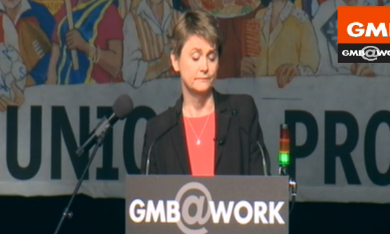
Yvette Cooper says she is also a member of the GMB. None of us wanted to be here, she says. They wanted to win. She recalls meeting a constituent who was in tears because of the bedroom tax. We let her down, she says.
We need to reach out, Cooper says. Not move to the left or the right, but reach out. Just trying to win over Lib Dem voters is not enough, she says.
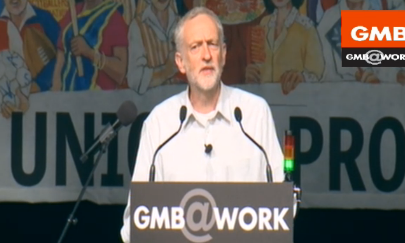
Jeremy Corbyn goes next.
He says he wants to raise the issue of how we face austerity.
He says the Tories are trying to end the ability of working people to organise.
We lost the election because we lost votes to Ukip, he says.
One problem is that Labour did not offer a clear enough alternative.
Labour leadership hustings
All the candidates are making opening statements.
Liz Kendall goes first. She is a GMB member, she says.
She says Labour is in mortal danger.
She will defend unions, she says.
She says the union members do not know her “from Adam - or Eve”. But she knows the unions. Through her work as head of the Maternity Alliance before becoming an MP, and as shadow care minister, she worked with unions, and knows the importance of the work she does.
The Labour leadership hustings at the GMB conference in Dublin is starting now.
I will be covering it in detail.
Opening of the EU referendum bill debate - Summary
Here are the key points from the opening of the debate.
-
Philip Hammond, the foreign secretary, has said that the government will not use public money to campaign for a Yes vote in the EU referendum in the final weeks of the campaign. Responding to claims that the decision not to apply purdah rules would allow the government to sway the result, he said that this was not the case and that it would apply “proper restraint”. But he said purdah rules had to be suspended otherwise they would stop the government conducting normal EU business. He told MPs.
I can assure the House that the government has no intention of undermining those campaigns [the main crossparty Yes and No campaigns] and is not proposing to spend large sums of public money during the purdah period. A vibrant, robust debate in the best traditions of British democracy is in all of our interests. And I would say to my honourable friend, if his concern is that the government is thinking of spending public money to deliver doorstep mailshots in the last four weeks of the campaign, I can assure him that the government has no such intention. The government will exercise proper restraint to ensure a balanced debate during the debate.
- He has said David Cameron will formally set out the “key elements” of the government’s demands at the EU summit later this month.
- Owen Paterson, the Conservative former environment secretary, said that Hammond was talking “nonsense” about purdah. (See 1.53pm.)
-
Alex Salmond, the SNP foreign affairs spokesman and former Scottish first minister, has mocked Cameron’s “Bavarian blunder” over collective responsibility. He also affirmed the SNP’s demand for 16 and 17-year-olds and EU citizens to be allowed to vote in the referendum. And he said it would be “totally unacceptable” for the referendum to be held on the same day as the 2016 Scottish elections.
Owen Paterson says Hammond's argument over purdah is 'nonsense'
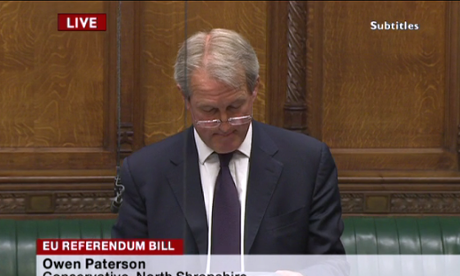
Owen Paterson, the Conservative former environment secretary, is speaking now. He says he was “dismayed” to read Hammond’s article for ConservativeHome today, in which Hammond defended the fact that “purdah” rules will not apply during the referendum. Hammond’s argument was “nonsense”, he says.
He says, just as the government is not allowed to campaign during a general election, it should not be allowed to campaign during the referendum.
People will only accept the referendum result if they think the contest was fair, he says.
And he says the Electoral Commission, in a briefing yesterday (pdf), expressed concern about this aspect of the bill.
The prime minister’s spokesperson has been briefing lobby journalists in Westminster. She was asked whether the prime minister agreed with Boris Johnson’s comments on LBC this morning that it would be “safer and more harmonious” to give ministers a free reign on the EU referendum. She replied:
The prime minister is clear that he thinks the approach during the referendum is an issue for further down the road. We need to take this step by step, the focus very much now is on the renegotiating our relation and addressing the concerns of the British people.
Updated
Benn says Labour is opposed to the referendum being held on the same day as other elections.
As for those who say combing elections will increase turnout, the Scottish referendum showed that, when a lot is at stake, people will turn out to vote anyway.
Since we’re on this subject, this is what David Cameron said at his briefing with journalists on Sunday when asked if he was willing to hold the referendum on the same day as other elections (ie, in May 2016 or May 2017). He said:
On whether it should be with other elections or not, I take a very open-minded view ... Personally, I think the British public are quite capable of going to a polling booth and making two important decisions rather than just one, and I think, you know, the evidence has shown that. But what will determine the timing of the referendum is not the timing of other elections; what will determine the timing is the outcome of the negotiation, but with that deadline at the end of 2017.
Sarah Wollaston, a Conservative and a GP, says one in four 16-year-olds will live to be 100. We should extend the franchise, she says.
Benn agrees. He says he looks forward to Wollaston voting with Labour on this point.
Benn says Labour supports 16 and 17-year-olds getting the vote in all elections, including this one.
There will be debates about this, he says. But, over the last 200 years, the forces of conservatism have opposed all attempts to extend the franchise, he says.
Benn is now mocking David Cameron over his U-turn about whether to stop ministers campaigning for British withdrawal from the EU.
Peter Lilley, a Conservative, says Benn should not mock. In 1983 Tony Blair and Gordon Brown were elected as MPs on a manifesto saying Britain should leave the EU, he says.
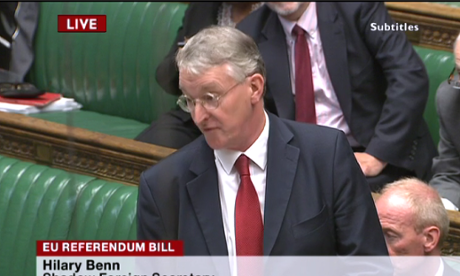
Hilary Benn, the shadow foreign secretary, is speaking now.
He says what is happening now is a mirror image of what happened in 1975. Now it is the Conservative party offering a referendum as a means of dealing with an internal party split.
The EU needs to reform, he says. But change has happened over recent years. For example, far less is spent now on the common agricultural policy than in the past.
Douglas Carswell asks if Labour would support amendments to ensure that there is an appropriate period of purdah. Civil servants should be neutral, he says.
Benn says it is reasonable to expect the government to take a view, and for it to be able to explain this.
Douglas Carswell, the Ukip MP, complains Philip Hammond ignored him during his speech.
Tried to intervene on Foreign Secretary over 40 times. Ignored. What chance will phoney Phil Hammond give Out campaign a fair hearing?
— Douglas Carswell MP (@DouglasCarswell) June 9, 2015
Hammond says government will avoid expensive campaigning during EU referendum
Back in the debate Hammond is explaining why the so-called ‘purdah” rules will not apply during the referendum.
If they were to apply, the government could not conduct European business during the terms of the campaign, he says.
He says the government will take a position on whether Britain should stay in the EU. Ministers will want to be able to explain this. If “purdah” rules applied, they could get into trouble for posting something on Twitter, he says.
Peter Bone, a Conservative, says this is precisely what people are worried about. They do not want the government deciding the result, he says.
Hammond says that the Electoral Commission will designate umbrella campaigns for Yes and No. He says they will campaign, and produce broadcasts. He says the government will not spend large sums of money itself during the campaign period. There will be no mailshot going to every home, he says. The government will show “proper restraint”.
-
Hammond says government will show “proper restraint” during the referendum campaign and will not be running an expensive Yes campaign.
Updated
At the end of today’s debate there will be a vote on an SNP amendment saying the bill should not get a second reading. The SNP object to the bill because EU nationals and 16 and 17-year-olds cannot vote, because there is no “double majority” rule saying Scotland would have to vote for Britain to leave the EU, not just Britain as a whole, for the vote to be valid, and because it does not rule out the referendum taking place on the same day as Scottish elections.
Alex Salmond, the former SNP leader, has summarised this in a tweet.
The EU referendum Bill fails to meet gold standard set in #indyref in terms of inclusivity and democratic participation.
— Alex Salmond (@AlexSalmond) June 9, 2015
Caroline Lucas, the Green MP, says Hammond said 16 and 17-year-olds should not be included because this was a matter of great importance. But that is why they should be included, she says.
Hammond says his personal view is that, rather than lowering the franchise to 16, it would be better to focus on getting a better turnout amongst young people who are allowed to vote.
Hammond says the government want the franchise to be the same as for general elections, with peers and Gibraltar included.
He says the government is “not persuaded” that 16 and 17-year-olds should be allowed to vote in general elections. And so, because the general election franchise is being used for the referendum, they should not be included in that.
He also says the referendum is about allow British people to decide their future. It would be a “travesty” for EU nationals to be included, he says.
David Hanson, the Labour MP, says people may want to remain in the EU on the current terms, not on the terms negotiated by the prime minister. Shouldn’t that be an option too?
No, says Hammond. That is not the proposal put to voters at the election.
Paul Farrelly, the Labour MP, asks if Hammond thinks MPs like Sir Bill Cash will be satisfied with the concessions David Cameron will achieve.
Hammond says Cash can speak for himself.
Bernard Jenkin, a Conservative, says none of the changes obtained by Cameron in the last parliament fundamentally changed our relationship with the EU. How will Cameron achieve this?
Hammond says we need to ensure that Britain, as a country outside the euro, is protected from the “ever closer union” provisions. And we need to ensure that the eurozone countries cannot force non-eurozone countries to act against their interests. Those are two examples, he says.
Hammond says the Tories’ record shows they can deliver change in Europe.
Hammond says the EU needs to change. And Britain’s relationship with it needs to change too, he says.
Brussels has got too much power. Some of that power needs to come back to London.
And the EU needs to focus on jobs, growth and competitive. It needs to be less bureaucratic, and more competitive.
Sir Bill Cash, a Conservative, says the prime minister said in the last parliament that he wanted a fundamental change in our relationship with the EU. What did that mean?
Hammond says some general reform to the EU is needed. But there are particular concerns that matter to the UK. Britain is not part of the single currency, he says.
He challenges Labour to say if they are now opposed to Britain ever joining the euro.
He says Britain needs a framework that will protect Britain’s interests as a non-eurozone member.
And, because we are a crowded island with a comparatively generous benefits system, we are more sensitive than other EU countries to concerns about immigration.
He says Cameron will formally set out Britain’s demands at the EU summit later this month.
-
Cameron to set out the government’s demands for the EU renegotiation at the EU summit later this month, Hammond says.
Hammond says we have had referendums on devolution, a regional assembly and the electoral system. But an entire generation of voters has been denied a say on Britain’s relationship with the EU.
Today that Tories will give people a say, he says.
MPs debate second reading of EU referendum bill
Philip Hammond, the foreign secretary, is opening the debate now.
This is a simple but vital bill, he says. It will deliver on the Tories’ promise to allow a referendum.
MPs will have a sense of deja vu, because they have debated this before. In the last parliament James Wharton’s referendum bill was passed by MPs, but blocked in the Lords.
He says he voted for Britain to remain in the EEC almost 40 years ago. He was voting for Britain to be in an economic community. He does not remember anything about ever closer union, or a single currency.
Kenneth Clarke, the Conservative former chancellor, intervenes. He took part in those debates. Sovereignty features heavily, he says. And “ever closer union” was in the treaty.
Hammond says he was 18 at the time. He did not read the treaty.
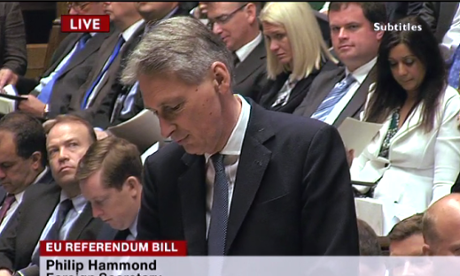
Here is a live feed from the Commons chamber, where the debate is about to start any moment now.
MPs are about to debate the EU referendum bill. Philip Hammond, the foreign secretary, will open the debate.
Hammond has been taking Foreign Office questions in the Commons. In the course of the exchange, several points emerged.
-
Hammond claimed that David Cameron had been consistent on the issue of whether ministers would be allowed to campaign for British withdrawal from the EU.
Philip Hammond says the PM "has been consistent . He feels he was misinterpreted. We are able to move on".
— Sam Macrory (@sammacrory) June 9, 2015
Hammond:"The Pm has made the position clear. Ministers.. are all signed up to renegotiate..all commited to success.."
— Tim Reid (@TimReidBBC) June 9, 2015
"It's simply hypothetical to talk about who will be allowed to do what" says Hammond on EU vote. Like the PM did. Except he didn't.
— Sam Macrory (@sammacrory) June 9, 2015
-
He ruled out allowing 16 and 17-year-olds to vote in the EU referendum.
Philip Hammond just told MPs 'it would not be appropriate' to include 16 and 17-year-olds in EU referendum franchise. #fcoQs
— Paul Waugh (@paulwaugh) June 9, 2015
-
He said he did not want to rule out holding the referendum on the same day as other elections in May because at this stage the government wanted to keep its options open.
MPs are going to get the chance to debate and vote on assisted dying legislation.
Labour MP Rob Marris, who came top of Private Members Bill ballot, has chosen assisted dying as his bill http://t.co/FJJWMOOvt9
— Paul Waugh (@paulwaugh) June 9, 2015
George Galloway, the former Respect MP, has said that he is running for London mayor next year, and he is clearly going for the black cab vote. On LBC he said he was opposed to Uber, the internet cab firm undercutting conventional cabbies.
Galloway promises he’ll “run Uber out of town” if elected Mayor http://t.co/7VtmzjcA0u
— LBC (@LBC) June 9, 2015
Galloway: “Black cabs pay tax. Uber pays zero tax and yet hopes to build a monopoly in a city like London. It’s ridiculous."
— LBC (@LBC) June 9, 2015
Tristram Hunt, the shadow education secretary, has an article in today’s Guardian explaining where he thinks Labour got it wrong on education at the election. In an interview on the Today programme, he elaborated on his view that GCSEs should be abolished. He said:
We have GCSEs but we are no longer leaving school at 16. We have got a rising participation age to 18. In a decade’s time, if we have still got GCSEs in England, in Britain, we will be completely out of kilter with other European countries and not giving young people what they need.
I think we need both academic and vocational baccalaureates so young people begin to choose about their pathways - whether those are technical, vocational pathways or academic pathways - at the age of 14. That would remove some of the exam overload.
Zac Goldsmith wants to be Tory candidate for London mayor
The Conservative MP Zac Goldsmith has announced that he would like to stand for London mayor. But, in an interview with the Evening Standard, he said he would balloting his constituents to secure their agreement because he does not want to stand if they do not support him. He said:
London needs a mayor who can work with government to get the resources that London needs to deal with massive pressures on housing, transport and policing but is also strong enough to stand up to the government when it gets things wrong.

Boris Johnson's LBC phone-in - Summary and analysis
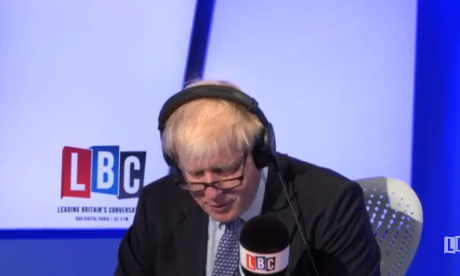
In Number 10 David Cameron and his colleagues are well used to Boris Johnson launching commando raids on their territory, and planting a Boris flag on some piece of political real estate not yet colonised by the Cameroons. But rarely has the London mayor trumped Cameron with such aplomb as he managed this morning. It was a stitch-up masterclass.
Johnson’s key achievement was to undermine Cameron’s attempt to impose collective responsibility on ministers over the EU referendum. Yesterday, as Patrick Wintour reports, Cameron’s attempts to clarify his position on collective responsibility descended into farce, leaving Tory MPs mystified as to whether or not ministers will be allowed to campaign for British withdrawal from the EU when the referendum finally takes place. This morning, doing his best to adopt a tone of utter reasonableness, Johnson insisted that the solution was obvious, and that they should be allowed a free vote.
This will grab the headlines, but what Johnson said about the EU renegotiation was just as important. He took a tougher line on what Britain should demand than Cameron, saying that Britain should leave the EU unless it succeeds in banning EU migrants from claiming benefits for four years. And he also threw some fresh demands into the mix.
But it wasn’t just what Johnson said; it was how he said it that was remarkable. Johnson claimed to only have a hazy recollection of what happened in 1975, even though he is a former Brussels correspondent, and that for Tories interested in Europe, the collective responsibility rules that may apply during a referendum is a subject on which most of them could write a PhD thesis. And then he claimed that he had not really thought any of this through before: “Thinking about it out loud, on the spur, of the moment, let me think ...” If you believe for a moment that Johnson had not planned carefully what he was going to say about this, then let me sell you Brooklyn Bridge. For a soundbite as phony as this, you will probably have to go back to some of the master performers of postwar British politics, like Harold Wilson or Tony Blair.
But I digress. Here are the key points.
-
Johnson said that ministers should be allowed to campaign for Britain to leave the EU in the forthcoming referendum. This approach worked in 1975, and it would be “safer and more harmonious” than trying to apply collective responsibility, he said.
I think in 1975, from memory, I think cabinet ministers were allowed to campaign against staying in and to keep their positions. It seemed to work last time ...
Just thinking about it out loud, on the spur, of the moment, let me think: I think probably it would be safer and more harmonious just to say ‘Okay, you make your minds up’.
I think probably on something like this, do you really need to bind everybody in? There will be different views, get it over.
-
He said that Britain should leave the EU if it cannot change the rules to block EU migrants claiming benefits for their first four years in the UK. This applied to in-work benefits too, he said. Cameron has said that he wants to change these rules, but he has never been as explicit as this about leaving the EU if he does not get his way. This is what Johnson said about what it would take for the government to recommend that Britain leaves.
I would think that it’s pretty clear from everything that has been said so far that, at least on that first point, that is to say unless we can get treaty change to prevent migrant workers from being able to access benefits before they have been here for four years, obviously there will be no alternative but to recommend a No.
In the Observer on Sunday, in an interview with Poland’s Europe minister, Rafał Trzaskowski, Toby Helm explained why this would be so hard to achieve. Toby wrote:
It is this last demand – which was spelled out in the Conservatives’ election manifesto – that most enrages the Poles, 700,000 of whom live and work in the UK. Poland will veto any such change.
“If it is discriminatory, like the ideas under which everyone who comes to Britain for four years, even though he or she pays the same taxes, will not be entitled to social benefits, we will not agree to it. Obviously such ideas are in contravention of the treaty itself,” Trzaskowski says, adding that a fundamental EU principle is the right to free movement of labour.
Laurent Fabius, the French foreign minister, has also said his country will block any “special status” for the UK. While there have been more supportive, if noncommittal, public comments from the German chancellor, Angela Merkel, in private the Germans take the same line as the Poles about restricting benefits for those in work. The message – sometimes delivered in public, but mostly in private – is strikingly similar from Paris to Brussels, Berlin and Warsaw. Everyone wants to try to help Cameron, but there are limits beyond which they will not go.
- Johnson said that reform of the common agricultural policy and the social chapter should be included as key demands in the EU renegotiation. Asked what changes Britain should demand, he said: getting a four-year time lag before EU migrants can claim benefits, including in-work benefits; a “new self-denying ordinance from Brussels” allowing national parliaments to hold up yellow card and stop unnecessary legislation and regulation; fundamental reform of the CAP; reform of “completely nonsensical” elements in the social chapter; extending the single market to cover financial services; getting a transatlantic trade area; and getting rid of the notion of “ever closer union” from the EU treaties.
Updated
Here is the key quote from Boris Johnson. I’ve taken it from Matt Chorley’s Mail Online write-up.
I think in 1975 from memory I think cabinet ministers were allowed to campaign against staying in and to keep their positions. I don’t see why not myself.
Just thinking about it out loud on the spur of the moment let me think: I think probably it would be safer and more harmonious just to say “OK you make your minds up”.
I think probably on something like this, do you really need to bind everybody in? There will be different views, get it over.
The prime minister will be able to make a recommendation. It’s almost certain if he gets the deal that he wants the overwhelming majority of his colleagues on both the front and backbenches will support him.
The LBC phone-in is now over. I will post a summary shortly.
Obviously, Boris Johnson’s comments on the EU referendum were the story.
Boris squashes Dave on the EU referendum collective responsibility. "Do you really need to bind everybody in?" #lbc
— Joe Murphy (@JoeMurphyLondon) June 9, 2015
But it was not just the way Johnson merrily discarded the position adopted by David Cameron. He also adopted a rather tougher stance on what Britain needs to get out of the renegotiation to justify the government advising people to vote to stay.
Q: As Uxbridge MP, how disappointed were you that Brentford did not get into the play offs.
Johnson makes it clear that he does not know what Ferrari is talking about.
Q: Would Sol Campbell be a good Tory candidate for London mayor?
Johnson says he wants a wide choice. But he says he will not blight Campbell’s chances by praising him.
Q: What are the three qualities you need to be London mayor?
Johnson says you need lots of energy, a keen eye for value for money, and you need to love the job.
Q: How do you react to the HSBC job losses?
Johnson says this shows why he urges people not to engage in banker bashing.
Q: Will Londoners have to pay for the maintenance of the garden bridge?
No, says Johnson.
Q: But that’s not what was said in this document, as reported in the Observer.
Johnson says that, to get planning permission, the Garden Bridge Trust had to declare that the Greater London Authority would guarantee the running costs. But in practice the trust itself would pay the running costs.
Johnson says Simon Jenkins wrote a good article defending the plan.
Johnson says ministers should be allowed to campaign for withdrawal from EU
Johnson reaffirms his support for national parliaments to be able to deploy a yellow card.
Q: What does the prime minister think of this?
Johnson says he thinks he is supportive.
There is a lot to play for, he says.
But there is no point going into a negotiation like this unless you are prepared to walk away.
Q: Is Cameron prepared to walk away?
Johnson says if he did not get what he wanted, he thinks Cameron would be willing to walk away.
Q: Should ministers be allowed to campaign for a no vote.
Johnson says that is a matter for the prime minister.
In 1975 ministers were allowed to campaign for Britain to leave and keep their positions.
Q: Should that apply again?
It seemed to work then, Johnson says.
He says it would be “safer and more harmonious” to allow ministers a free vote.
Do you really need to bind everyone in, he asks.
Q: Would you campaign against EU membership if you did not like the deal?
Let’s see what we get, says Johnson.
The crucial thing is “to go into this thing hard”.
-
Johnson says ministers should be allowed to campaign for EU withdrawal.
Updated
Q: Can you name five changes required to the EU for the Tories to recommend that Britain stays in?
Johnson says he cannot
But he says EU migrants should have to wait four years before they can claim benefits.
He says national parliaments should be able to deploy a “yellow card” to hold up legislation.
There should be fundamental reform of the common agricultural policy, he says.
He says the social chapter is completely wrong.
And the single market needs to be fully applied, he says.
And we need a proper US/EU trade deal, and to get rid of the idea of “ever closer union”.
He says it is crazy that we are talking about devolution within the UK, but not in the EU context.
Q: So, if we don’t get a four-year block on benefits, you would not recommend staying in.
Johnson says unless we can get treaty change to stop migrants accessing benefits for four year, there will be no alternative to recommending a no vote, he says.
Updated
Q: Will you make the cycling super-highway compulsory for cyclists?
Johnson says he is considering this. It would be a shame for it not to be used, he says.
Boris on whether cyclists would have to use cycle super-highway. It would be a shame to construct a hamster wheel for hamsters not to use it
— Theo Usherwood (@theousherwood) June 9, 2015
Q: Why won’t it be compulsory. It is costing £80m, and disrupting London.
Johnson says Nick Ferrari, the presenter, is always complaining. Cycling is safer in London than ever. He has to comfort the relatives of victims who are killed, he says. And some of those who are not killed suffer appalling injuries.
Cyclists would be “crazy” not to use the super-highway, he says.
Q: Why don’t police officers and staff have confidence in the Met’s senior leadership?
Johnson says he has not seen this survey.
Q: It was a Met survey.
Johnson says the officers in the Met should have confidence in the service.
He says the people surveyed did not give their names.
Johnson says he understands the rage of taxi drivers. They are dealing with the results of a powerful force, consumer choice and competition from firms like Uber. But he is trying to help the trade, he says.
He says, under the law, he cannot put a block on the number of minicab drivers.
Q: How can people be minicab drivers if they can’t speak English?
Johnson says you do not have to speak English to work in London.
Q: But how can you pass your driving test, and read road signs, if you can’t speak English?
Johnson seems a bit flummoxed by this, but he says that in his experience minicab drivers do speak English.
The black cab protests have just boosted the profile of Uber, he says. Instead, black cab drivers should promote themselves as the gold standard service, he says.
Q: What are you doing to restrict the number of minicabs? And how do you feel about being responsible for the death of black cabs in London?
Johnson says he will not get rid of minicabs. But he is announcing an increase in the number of compliance officers, who check that minicabs obey the rules.
Johnny in Brixton, a cabbie, wants a block on the number of mini-cab licences. That's it. Boris says he can't, and won't, ban mini-cabs.
— Theo Usherwood (@theousherwood) June 9, 2015
Boris Johnson hosts his LBC phone-in
Q: Why don’t you increase the congestion charge to improve air quality?
Boris Johnson rejects this idea. But, on air pollution, he says he is a technological optimist.
Air quality has substantially improved in London since 2008, he says.
He says London is scrupulous about how it monitors air quality. Air quality monitors are located where they are likely to be exposed to as much pollution as possible. Other cities are less scrupulous, he says. They put monitors where there are likely to be fewer fumes.
How Labour will campaign in the EU referendum has become a key issue in the Labour leadership contest and Hilary Benn’s stance (see 8.59am) seems to be a bit of a compromise. Liz Kendall has said it would be a profound mistake for the party to boycott the cross-party Yes campaign, but Andy Burnham has said Labour must run its own campaign. Benn’s position is more Burnhamish than Kendallish, but he is not ruling out Labour playing its part in the main, cross-party campaign. Presumably the party won’t fully clarify its position until it gets a new leader.
Agenda for the day
Less than four years ago David Cameron suffered a huge Conservative rebellion in the Commons when he tried to stop his MPs voting for a referendum on Britain’s membership of the EU. Since then politics has moved on a bit, and early this evening the government’s EU referendum bill will get its second reading, probably with an overwhelming majority.
In advance of the debate, Hilary Benn, the shadow foreign secretary, has given some details of how Labour will approach the campaign. He does not rule out Labour joining the official Yes (to staying in) campaign, but he says Labour will run its own Yes campaign, and he rules out sharing a pro-EU platform with David Cameron. He told the Daily Mirror:
There are distinctive Labour values about workers’ rights and fairness which are not shared by the Conservatives. Look at the legislation they’re proposing to bring forward. hat’s why it’s important alongside all these other voices that there is a distinctive Labour voice in the campaign.
I’ll be covering the opening of the debate in detail.
Here is the agenda for the day.
9am: Boris Johnson, the Conservative mayor of London, hosts his LBC Ask Boris phone-in.
9.30am: The Labour candidates for the deputy leadership hold a hustings for Labour MPs behind closed doors.
11am: George Galloway is interviewed by James O’Brien on LBC.
12.30pm: MPs start debating the EU referendum bill.
2pm: The Labour leadership candidates take part in a hustings at the GMB conference in Dublin.
As usual I will be covering the breaking political news as it happens, as well as bringing you the best reaction, comment and analysis from the web. I will post a summary at lunchtime and another in the afternoon.
If you want to follow me on Twitter, I’m on @AndrewSparrow
Updated